Showing posts with label Four Marks. Show all posts

Monday, 8 August 2022

8th August - Splish Splash I Was Taking A Bath

The dry weather continues unabated, although it would appear that Four Marks has dodged the bullet of a hose pipe ban, for now!  We removed the garden pond and waterfall this spring, due to the mobility of our young grandson, in its place we have added a water feature, a fountain consisting of two bowls and reservoir about a metre high.  This has been used by several of the garden birds since we installed it, not least the Woodpigeons, who are quickly chased off if seen.

We also have several bird baths spread around the garden, on e of which has started to be drained daily, putting a camera trap on the bath has shown that this is down to the woodpigeons drinking it all, sometimes the bath has to be topped up twice a day.

Water is scarce around the village, the only natural water being found at the pond, but that is now very low, so it is difficult to see where the birds and animals get any water, the grasses being yellow and straw like, the ground bone dry.

There has been a pair of Bullfinches in the garden through the spring and summer, both male and female visiting the feeders and I also think there were young about too, but I was never able to see them.  Saturday one appeared on the top bowl of the water feature while we were sitting in the garden but didn't seem to be able to work out how to get to the water.

Sunday morning a couple of Blue Tits were bathing in the lip of the bowl where the water cascades out to the next bowl and the male Bullfinch appeared and watched.  Once the Blue Tits left, the Bullfinch moved in, he had worked out how best to bathe and went about it in style.  Later in the afternoon he returned for another bath, with the female in tow, she just watched.

This morning they were back and I was able to get some pictures, although the first few were through the window upstairs which played havoc with the light and exposure.

The male turns up first


And is then joined by the female


The female muscles and the male steps aside, she has watched and learnt from the male.


The female then leaves and the male takes over, I have been able to move downstairs.


It has the flow of water and the depth of the bowl into which it plunges.


Beak open


Turned completely over.


Time to dry off, you can see the bare neck.


The attraction must be the cool running water, all the other baths are static, this water stays cool.

Later on in the afternoon he returned again and this time I was able to get some video.


I am sure they will be a regular visitor now.

Other activity in the garden saw a Chalk Hill Blue butterfly go through the garden on Sunday the 7th.  Considering this used to be a chalk down field, probably not as surprising as the other two special butterflies this year.  This took the garden count to 21 and the Four Marks count to 31.

Finally as I went out to water the pots at the front of the house on Sunday evening I noticed a large bird coming over the house, heading west.  It would glide on flat wings with a few elastic like wing beats, both the head and neck were long as was the tail and I am one hundered percent certain this was a Honey Buzzard.  Not the first around the patch, but the first over the garden, the purple patch continues


Wednesday, 27 July 2022

26th July - What's She Gonna Do About HIM?

July has been extremely dry, with Hampshire having only 2% of the average rainfall and to be frank that was a waste of time, probably evaporating just after it fell.  Watering the garden has become essential and I know in times like these one should be frugal with water but I don't want to see a lot of my wife's hard work go to waste.  So it was then that I decided to use the static spray to water the beds at around six thirty.  

It was a pleasant evening with plenty of sunshine, there are plenty of trees in the garden, mostly Acer and several Amelanchiers, and the garden is about the size of a tennis court with levels. 

After about five minutes watering I noticed a large butterfly had appeared and was flying in and out of the water spray, I could see white flashes as it passed by me and from the flight, which consisted of glides through the water spray and then flicks of the wings as it turned to re-enter the water, I was almost certain of the identification but just couldn't believe it!

It flew around me and then flew to the kitchen windowsill where it settled and the identification was settled and I just couldn't believe it, a female Purple Emperor in my garden!  I rushed into the house to get the closest camera, my phone.  Back inthe garden the Emperor was still there and I could get close.

This butterfly spends most of its time in woodland canopy where it feeds on aphid honeydew, with the occasional close encounter when it comes down to feed on sap runs or, in the case of the male, animal droppings, carrion or moist ground that provide much-needed salts and minerals.

The male butterfly is one of the most beautiful of all of the butterflies found in the British Isles. From certain angles it appears to have black wings intersected with white bands. However, when the wings are at a certain angle to the sun, the most beautiful purple sheen is displayed.  The female, on the other hand, is a deep brown, with bolder white markings, but does not possess the purple sheen found in the male, she is also larger than the male  Possible confusion species could be the White Admiral, but this species is smaller with rounded wings and flies with a flitting movement and not he gliding behaviour of the Purple Emperor.  This one is also showing signs of wear and damage in the wings. 

From the window sill the butterfly flew off and circled the garden once more to land in one of the trees where I was able to watch it drinking the water from the leaves.


A typical first-appearance date for this butterfly is between June 20th -25th, with most adults then emerging over a three-week period. The flight period is reasonably short and by early August the adult butterfly season is over.  This is the latest I have ever seen one and with the good weather this summer I would think could be one of the latest sightings

So what was it doing here in my garden?  For perspective, we live in a close and established estate, there is an oak tree along Lymington Bottom about 50 metres away, but I wouldn't say this was the ideal woodland canopy habitat.  Old Down Wood has plenty of oak and I have also found plenty of sallow, I have always been hopeful of finding Purple Emperor and indeed Purple Hairstreak (which also turned up in the garden 13 days ago!) but I have never been able to find any sign or activity or either.

The females apparently will travel good distances to seek out suitable sallow, but how far I don't know, the closest known habitat where Purple Emperor could also be found would be Bentley Wood, which is close to the railway station at Bentley (not the one on the Wiltshire / Hampshire border), and that is again close to Alice Holt.  I will never know where it came from but will have to have a closer and more intense search of Old down Wood next year. 

I managed to also get some video of her as she imbibed on the leaves.  It did mean I became soaked from the spray, but believe me it was worth it.


I can only say I was really buzzing, this was the 20th butterfly species in the garden, which in itself is quite impressive.  I was bucked with Purple Hairstreak due to the particular habitats they have but to then get Purple Emperor is just incredible.  On top of that this is the 30th butterfly species found around the Four Marks patch, there have been several stand out wildlife experiences this year so far, but this is up there close to the top.

Friday, 22 April 2022

20th April - The Warmer Weather's So Much Finer

The Easter Holiday weekend saw some beautiful weather with the hottest day of the year so far on Good Friday and four days of wall to wall sunshine and glorious azure blue skies.  And where was I?  Well working in the garden!  This though did present some opportunity with two new butterflies for the year making their way across the garden.  On the 16th a Holly Blue and on the 18th a male Orange Tip.  Neither of course stopped and even if they had of I didn't have a camera close by.

While the temperatures dropped off into the week, the sunshine remained and this provided the opportunity for an afternoon walk.  I was hoping for some afternoon butterflies after having seen another Holly Blue in the garden, but they were conspicuous by their absence throughout the walk.

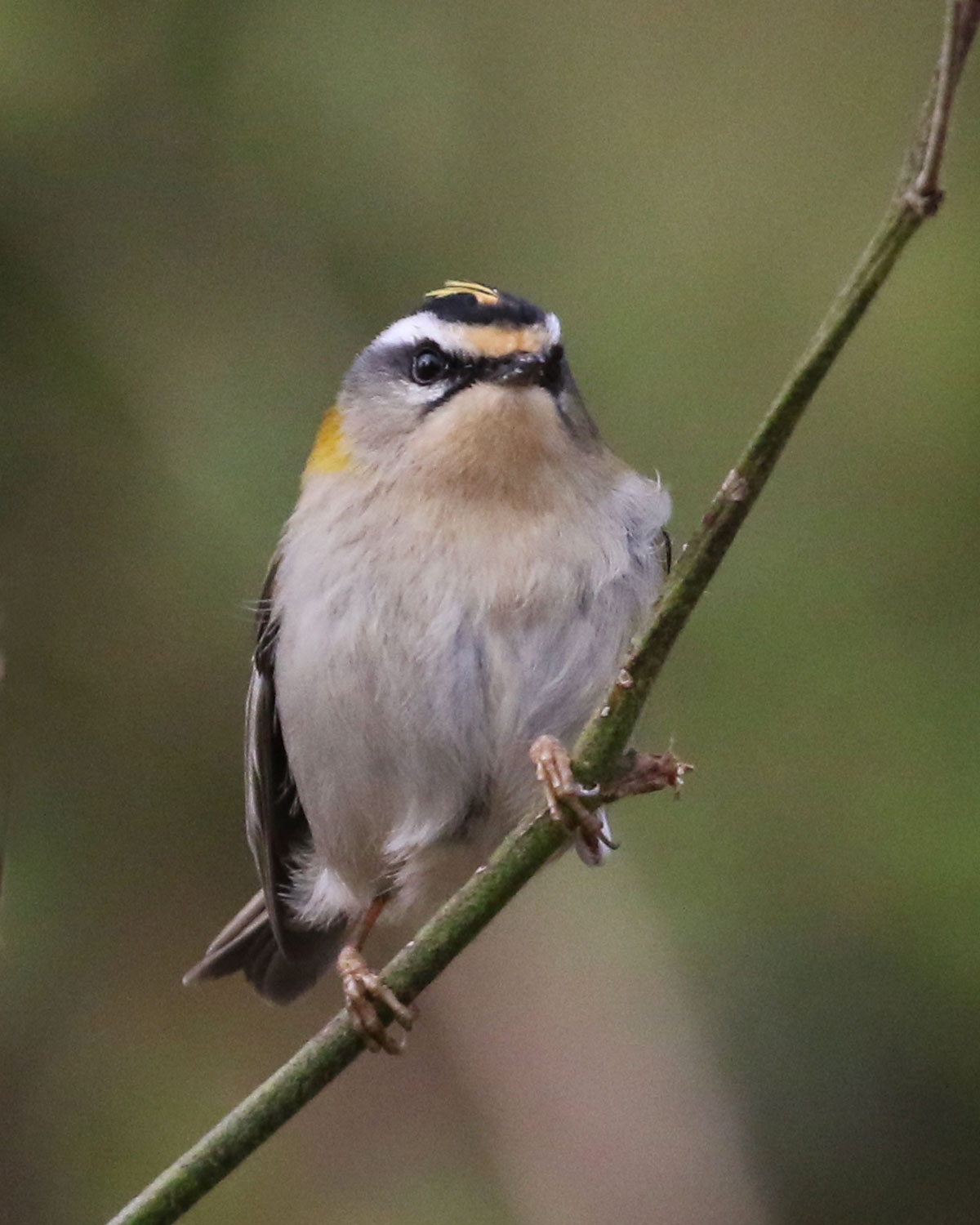
I headed along Brislands Lane and stopped at the junction with Gradwell Lane when I heard a familiar song.  It was another Firecrest and showed well in the bushes along the road side.

I thought I would take the opportunity to give some background to the Firecrest.  This tiny, restless jewel of a bird vies with the Goldcrest for the title of the UK's smallest bird. Compared to the Goldcrest, the Firecrest is brighter and 'cleaner' looking, with a green back, white belly, bronze 'collar' and a black and white eye-stripe. They have a yellow and black stripe on their heads, which has a bright orange centre in males. Like Goldcrests, they move through trees and bushes in search of small insects.


A member of the Kinglet family, the Firecrest's scientific name has a royal ring to it. Regulus ignicapilla translates roughly as the fire-capped little king, a reference to the beautiful orange crown of the male.


The Firecrest is monogamous. The male sings during the breeding season, often with its crest raised, and has a display which involves pointing its bill at another bird, showing the crest and strong face pattern. This differs from the display of the plainer-faced Goldcrest, which bows its head to emphasise the crest.


The breeding territory is about 1.2 acres and may overlap with neighbouring Goldcrest territories. Firecrest will sometimes defend their territories against Goldcrests with the crest raised and a great deal of wing-fluttering, but the amount of actual competition between the species may not be very great.

Unlike more specialised woodland birds which forage on trunks, the crests do not need large woodlands, and their population density is independent of forest size. In winter the Firecrest is less reliant on conifers than the Goldcrest, moving from forest to fringes and scrub. It occurs singly or in pairs, spending much time in the tree canopy, although frequently venturing into bushes and other lower vegetation.


The first breeding of Firecrests in the UK was observed in Hampshire back in 1962.  Since then the species was more likely to be seen on migration, but just recently breeding numbers have significantly increased.  Current figures suggest over 500 breeding pairs but the likelihood is that this number is far greater.  Firecrests thrive in fairly urban areas on the continent, provided that suitable habitat is available in parks or large gardens.  Locally around Four Marks they are more likely to be found in gardens, showing a preference to Holly trees rather than the dense conifers

Leaving the Firecrest I continued out into the open fields away from the houses and gardens.  In the field alongside Old Down Wood there was a group of what I thought initially were Woodpigeons, but as they flew I realised they were Stock Dove.  I flight I was able to count them, there were 19 in total, by far the highest number I have seen on the patch.

Fortunately the Stock Dove flew around and settled back into the field and I was able to get some records of them, both from the road

And from the path that leads into Old Down Wood.


I took the perimeter path to take in the Bluebells that were now coming through, I would estimate that they are currently at about 50% emerged, the blue haze still entwined with the green.  Here is a selection of the best views as I walked around.


One other plant I was looking for was the Early Purple Orchid.  As you can see it is yet to flower, but won't be far off.

A Yellowhammer called from the top of the trees on the edge of the wood.  It is not usual to see them here so the numbers must be expanding.

While there were a few Blackcaps singing amongst the resident Robins, Wren, Blackbirds and Song Thrushes, the dominant singer was the Chiffchaff.  Setting up territories, their songs were essential in letting those that look to move in and take over.


This is the best time of year to photograph them with just the emerging leaves to provide the scenic accessories


This shows very clearly the short primary projection of the Chiffchaff aside from song one of the more reliable ways of telling the Chiffchaff from the closely related Willow Warbler.

It was a pleasant two hour walk, only shame was the sun decided to hide behind clouds and there were no butterflies.

Monday, 29 November 2021

28th November - All the Leaves are Brown

Temperatures have plummeted over the last few days, we were away Saturday and overnight in the Cotswolds, the journey there went through a blizzard from Newbury and coming back Sunday morning the fields were Christmas card perfect with blue skies and a very low sun. It stayed cold and bright so I decided to take a walk locally, it has been a long while since I have walked the local patch.

Heading along Brislands towards Old Down Wood the impact of the recent road works on the A31 could be seen.  Brislands was a convenient detour to escape the traffic lights that caused many long queues during the say, however it is a single track road and the verge was cut up badly where vehicles had to pull over to let others pass.

The other difference was the use of the field south of the road.  The field was divided into two areas with sheep being grazed on what looked like beets and turnips.

I can't recall ever seeing this field being used for Sheep, and it was proving an attraction for the birds with Pied Wagtails and Skylarks being seen, while a good number of Common Gulls could be seen in amongst the Sheep.

It wasn't a surprise to walk into a silent wood.  As soon as the temperature drops the birds concentrate on survival and that means searching for food.  Several Chaffinch flew up from the leaf litter on the main path, I stopped and watched them in hope of finding the white rump of a Brambling but there was nothing.

Turning towards Gradwell at the cross roads a Jay flew up to the tree in front of me, an acorn in its beak that looked like it had been retrieved.


I checked to see if maybe the tawny Owl had taken up residence early in the season but there was no sign of it in the tree.  Making my way to the main path that leads to the Old Down entrance there were lots of calls coming from the tops of the larch trees and there were about fifty plus Goldfinch feeding on the cones.  As I watched the Goldfinches and searched for something maybe a little more interesting I could hear a Raven Calling from somewhere in the wood.

Coming out of the wood I headed for the pond where there were twenty four pairs of Mallard, one drake was snoozing in the sunshine, the sunlight catching the bottle green head and the whole bird reflected in the still dark water.


I walked around the back of the pond and then took the footpath that leads to Lye Way.  More Common Gull could be seen in the fields on both sides of the road. They would fly across between the two sides.


Scanning the fields I found a single Lapwing, not an easy bird to find around here, although this time of year sees one or two arrive, typically they need bad weather.


Just before the lane turns right to pass through the farm I noticed a flock of what I first thought were Woodpigeon, but as they flew above the horizon I could see that they were a flock of Golden Plover.


They settled initially out of view from me as the field dips away.  I was able to get to an opening in the hedge and I could now see them feeding in the field.  I counted 22 birds in the flock.


Walking through the farm and around to the pasture on the other side there were good numbers of thrushes feeding on the closely cropped grass.  The cold snap having made the need to forage more important.  There were the resident Blackbirds and Song Thrushes, but also good numbers of Redwing and Fieldfare.  Both these birds though were difficult to get close to, both choosing to fly off at the slightest movement.  This was the only acceptable shot of a Redwing I could get.


Most of the Fieldfare were feeding on the far side of the pasture, closer to the road.  I was able to use the hedge as a form of cover which meant I didn't spook the birds too much.


By standing still and waiting, gradually the Fieldfare would come closer.


A really impressive thrush, that may be overlooked.


Scanning around the pasture I counted 135 Fieldfare and 57 Redwing, but all were continually moving from the pasture to the surrounding hedgerow.


Leaving the thrushes I walked a little way along the road and almost immediately found what I hoped I could, a Brown Hare sitting in the field.


Once it realised I was there it turned away and headed for the security of the hedge and revealed another by the side of the field.


I turned to come back and in the next field I watched another flock (this time with far more birds) of Golden Plover.  They settled in the field and I was able to count 52 birds, making a total of 74 birds


They quickly spread out and I was able to get a little closer to some of them.


With the sun sinking low in the sky I decided to head back, taking the footpath that runs all the way down to Old Down Cottage.  The footpath itself has always been overgrown and the edge of the field was a better walk, but a sign now directs you to the footpath which has been cleared and is in fact a much better walk with views across the fields away to the west.

As I walked I flushed both Redwing and Fieldfare from the tress and Long-tailed Tits flew in front of me in between inspecting the fence posts for any small insects and spiders.  As the path opened up into the field behind the large house a Siskin appeared briefly on the bramble above my head.


I crossed into Old Down Wood where it was even quieter, the main paths are all covered with fallen Sweet Chestnut leaves and the cover they provided stopped the water puddles from freezing so you had to be careful where you stepped.

Looking east towards the Gradwell entrance


Looking back at the cross roads towards the Old Down Cottage entrance.


Coming out on to Brislands Lane there was a large area of frozen water, around it a Pied Wagtail, one of many was feeding in the leaf litter.


Then for some reason it turned and walked out onto the ice.  Mud had stuck to its feet and it looked like it had snow shoes on as it made its way across the ice


As well as the wagtails there were Chaffinches, Robins and Blackbirds all feeding on the edge of the field.

I walked home with the temperature falling and cloud developing to the north, it looked as if we were going to be getting some snow later on.

It was nice to get out and although not the quantity of birds, the quality today was there.