Showing posts with label Redwing. Show all posts

Monday, 29 November 2021

28th November - All the Leaves are Brown

Temperatures have plummeted over the last few days, we were away Saturday and overnight in the Cotswolds, the journey there went through a blizzard from Newbury and coming back Sunday morning the fields were Christmas card perfect with blue skies and a very low sun. It stayed cold and bright so I decided to take a walk locally, it has been a long while since I have walked the local patch.

Heading along Brislands towards Old Down Wood the impact of the recent road works on the A31 could be seen.  Brislands was a convenient detour to escape the traffic lights that caused many long queues during the say, however it is a single track road and the verge was cut up badly where vehicles had to pull over to let others pass.

The other difference was the use of the field south of the road.  The field was divided into two areas with sheep being grazed on what looked like beets and turnips.

I can't recall ever seeing this field being used for Sheep, and it was proving an attraction for the birds with Pied Wagtails and Skylarks being seen, while a good number of Common Gulls could be seen in amongst the Sheep.

It wasn't a surprise to walk into a silent wood.  As soon as the temperature drops the birds concentrate on survival and that means searching for food.  Several Chaffinch flew up from the leaf litter on the main path, I stopped and watched them in hope of finding the white rump of a Brambling but there was nothing.

Turning towards Gradwell at the cross roads a Jay flew up to the tree in front of me, an acorn in its beak that looked like it had been retrieved.


I checked to see if maybe the tawny Owl had taken up residence early in the season but there was no sign of it in the tree.  Making my way to the main path that leads to the Old Down entrance there were lots of calls coming from the tops of the larch trees and there were about fifty plus Goldfinch feeding on the cones.  As I watched the Goldfinches and searched for something maybe a little more interesting I could hear a Raven Calling from somewhere in the wood.

Coming out of the wood I headed for the pond where there were twenty four pairs of Mallard, one drake was snoozing in the sunshine, the sunlight catching the bottle green head and the whole bird reflected in the still dark water.


I walked around the back of the pond and then took the footpath that leads to Lye Way.  More Common Gull could be seen in the fields on both sides of the road. They would fly across between the two sides.


Scanning the fields I found a single Lapwing, not an easy bird to find around here, although this time of year sees one or two arrive, typically they need bad weather.


Just before the lane turns right to pass through the farm I noticed a flock of what I first thought were Woodpigeon, but as they flew above the horizon I could see that they were a flock of Golden Plover.


They settled initially out of view from me as the field dips away.  I was able to get to an opening in the hedge and I could now see them feeding in the field.  I counted 22 birds in the flock.


Walking through the farm and around to the pasture on the other side there were good numbers of thrushes feeding on the closely cropped grass.  The cold snap having made the need to forage more important.  There were the resident Blackbirds and Song Thrushes, but also good numbers of Redwing and Fieldfare.  Both these birds though were difficult to get close to, both choosing to fly off at the slightest movement.  This was the only acceptable shot of a Redwing I could get.


Most of the Fieldfare were feeding on the far side of the pasture, closer to the road.  I was able to use the hedge as a form of cover which meant I didn't spook the birds too much.


By standing still and waiting, gradually the Fieldfare would come closer.


A really impressive thrush, that may be overlooked.


Scanning around the pasture I counted 135 Fieldfare and 57 Redwing, but all were continually moving from the pasture to the surrounding hedgerow.


Leaving the thrushes I walked a little way along the road and almost immediately found what I hoped I could, a Brown Hare sitting in the field.


Once it realised I was there it turned away and headed for the security of the hedge and revealed another by the side of the field.


I turned to come back and in the next field I watched another flock (this time with far more birds) of Golden Plover.  They settled in the field and I was able to count 52 birds, making a total of 74 birds


They quickly spread out and I was able to get a little closer to some of them.


With the sun sinking low in the sky I decided to head back, taking the footpath that runs all the way down to Old Down Cottage.  The footpath itself has always been overgrown and the edge of the field was a better walk, but a sign now directs you to the footpath which has been cleared and is in fact a much better walk with views across the fields away to the west.

As I walked I flushed both Redwing and Fieldfare from the tress and Long-tailed Tits flew in front of me in between inspecting the fence posts for any small insects and spiders.  As the path opened up into the field behind the large house a Siskin appeared briefly on the bramble above my head.


I crossed into Old Down Wood where it was even quieter, the main paths are all covered with fallen Sweet Chestnut leaves and the cover they provided stopped the water puddles from freezing so you had to be careful where you stepped.

Looking east towards the Gradwell entrance


Looking back at the cross roads towards the Old Down Cottage entrance.


Coming out on to Brislands Lane there was a large area of frozen water, around it a Pied Wagtail, one of many was feeding in the leaf litter.


Then for some reason it turned and walked out onto the ice.  Mud had stuck to its feet and it looked like it had snow shoes on as it made its way across the ice


As well as the wagtails there were Chaffinches, Robins and Blackbirds all feeding on the edge of the field.

I walked home with the temperature falling and cloud developing to the north, it looked as if we were going to be getting some snow later on.

It was nice to get out and although not the quantity of birds, the quality today was there.

Tuesday, 2 February 2021

25th - 31st January - There's No Colour And No Sound

 The snow that suddenly arrived on Sunday and disrupted several plans was still with us on Monday morning, but gone was the grey monochrome conditions, to be replaced with clear blue skies and very cold temperatures despite the welcome sunshine.  At lunchtime I went out for a walk, the side roads still covered in snow and ice while the main roads were clear.  I headed along Brislands with clear skies providing excellent visibility and white snow as far as the eye could see.


A closer view.

Shadows from the trees along the lane scattered across the snow and taking on a blue hue.

Looking towards the entrance to Old Down Wood.


This was so much different from the previous day's walk.  I walked into Old Down Wood and was greeted with this scene.


On Sunday the trees were covered with snow and unfortunately this had either dropped off or melted.  I had hoped for some shots from below with the branches snow covered against the blue sky, but had to make do with the following:

Beech, Sweet Chestnut and some Oak

The Larch trees looking like palms along Sunset Boulevard


Finally, Silver Birch.


With time not on my side I walked to the Gradwell entrance, on my left the Four Trees, now looking more like five, distant across the snow covered field, the dark shadow of the wood stretching across the snow.


Walking across the field and looking back Four Marks had taken on an Alpine feel.


This was the first snow fall locally for at least two years and the first opportunity to enjoy it.

Back home once the snow had gone there were some notable garden sightings, on Tuesday, the 26th, a male Blackcap was seen briefly on the feeders, on the 28th a pair of Siskin returned to feed on the feeders, but preferred the loose seed in the tray as it meant that they could avoid the aggressive Goldfinches.

The male


And the female 


But the best record was of a male Lesser Redpoll on the 27th, apologies for the poor photograph but I had to move quickly to capture the record and then it was gone.


As is always the case around Four Marks at this time of year, the garden prove to be the best source of interesting sightings both in and over.  I have had Buzzard and Red Kite over the garden regularly, but as yet this year still await sightings of Sparrowhawk and Kestrel.

One further bird of interest in the garden this week is a very pale, almost greyish Great Tit, researching the possibility of it being a continental bird it would appear it is probably more like a first winter female.


In order for the snow to go we had to have a temperature rise and some rain, this resulted in some very murky and miserable conditions through the middle of the week.  On Thursday though things brightened up and I was able to get out for a lunchtime walk.  As I left the house one of the aforementioned Red Kites drifted over the house and along Lymington Rise.


I have seen this bird frequently since the start of the cold spell, it is distinctive by the notch in the secondaries, there are three distinct birds that patrol the area, I have seen all three at one time on a couple of occasions.  I can only assume that some of the neighbours put food out for them.


Later as I walked home one without the notch in the wing drifted over but distant.

Walking up Gradwell Lane I stopped for a Nuthatch that was calling by the footpath that leads to Old Down Wood.


A Rabbit was out in the open, the first I have seen for a while.


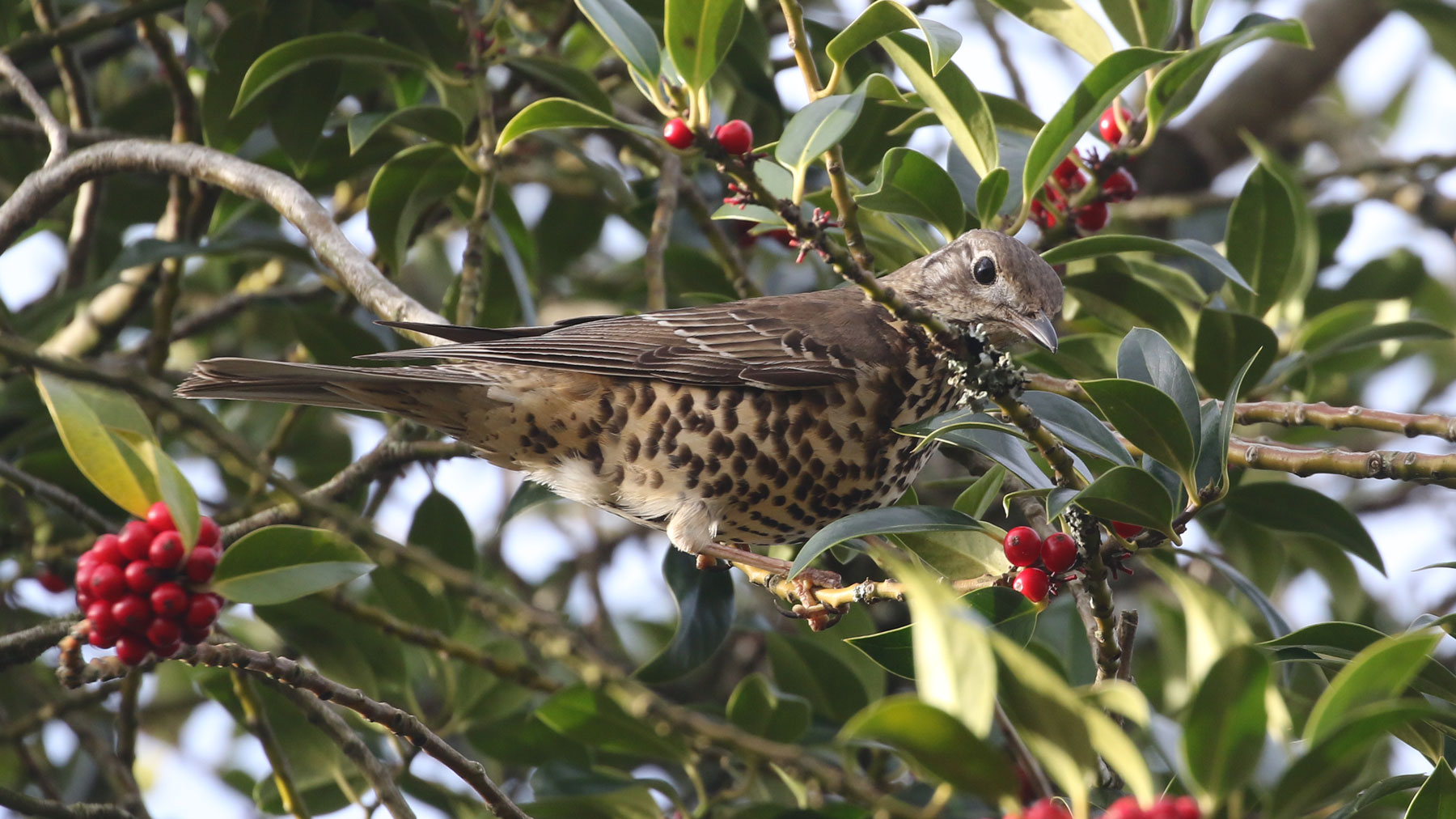
A single Holly Tree along Brislands has been laden with Berries since the autumn and has been the sole property of a Mistle Thrush that has guarded them veraciously.  Any Blackbird coming close would be chased off.  But with the recent cold snap and snow the challenge became much harder to protect its store.  

Today I watched Redwing fly in and and the numbers overwhelmed the poor Mistle Thrush.  I saw some attempts to repel the Redwing but eventually gave up as the numbers became too much and concentrated in feeding itself.  Here one of the successful Redwing


And the Mistle Thrush accepting the situation despite it superior size over many Redwing, digging into the Holly Berries.


I stood watching after the Mistle Thrush left, but the hoped for Fieldfare did not appear and the Redwing were never in a place that allowed me to get a good shot.  Just as I was about to walk on I heard song from the tree close by.  The Mistle Thrush was singing at the top of the tree.


Saturday was a complete wash out, it rained all day.  Sunday morning started dry and with some sunny spells.  I had a window of opportunity and headed out.  Passing the Holly tree on Brislands I noticed that all the berries were now gone, the tree stripped in three days.

Along Brislands close to the entrance to the wood I picked up three Yellowhammers flying into the field where I promptly lost them.  I made some noise and disturbed them from the ground and they flew up into the nearby tree where, despite my best efforts I could not get a view of them to enable a suitable photograph.

From across the field I could also hear the distant song of a Skylark, but again it was too far away for any pictures.

Entering the wood there was initially an eerie silence, I struggled to hear any bird calls let alone song.  I walked to check the owl tree but there was no sign of it being present, it doesn't hurt to keep checking though.

Reaching the main path I turned south, stopping in the open space to look and listen.  Again it was very quiet, then as you stand and watch things begin to appear.  I heard a distant flock of Siskin but couldn't see them.  On the other side of the path a few birds flew across the trees settling in  the top branches, they were a group of about 10 Bullfinches, a mixture of male and female birds.


As they moved through the branches you could hear their soft piping contact calls.


A calling Great Spotted Woodpecker could be heard, but I found another closer preening at the top of a Larch tree.


I walked to the pond and have to admit I wasn't surprised to see the drake Tufted Duck back.


The number of Mallard reduced significantly when the majority of the pond froze over last weekend, so I can only assume wherever the Mallard went the Tufted Duck went with them.  The Mallard numbers were back up to 42 so it must have returned with them.  It does seem to be associating with one female Mallard.  It was a chance to get some more photographs then.


Some people insisted on feeding the Mallard and it drifted over to join them but realised its mistake and started to swim back towards me, moving into some nice reflections in the water.


I walked around the pond, stopping to watch a flock of Long-tailed Tits and Goldcrest move through the tree branches.


I walked around the back of the pond to a path that accesses the footpath that runs around the back of the pond to Lyeway Road.  Before leaving I stopped to get some more shots of the Snowdrops around the picnic area.


The path at the back of the pond is heavily flooded and I waded through about a foot of water coming out in the garden and then heading towards Lyeway.  As I approached the road a Common Gull flew over.


Common Gulls are the coomonest gull seen around Four Marks in the winter and scanning across the fields I could see, after spooking a Roe Deer close to the hedge, a group of about twenty birds.  A van coming up Lyeway Road disturbed and they flew up before settling back down out of view.


The field looked very wet and flooded in places and they were probably looking for worms coming to the surface.  In this they were joined by a good number of Carrion Crows, but no sign of the pair of Ravens.

I made my way home without any notable sightings.  Coming into the garden I noticed the male Blackcap on the feeder.  It flew up into the tree and I stood and waited until it moved to a more open position.  The first Blackcap photograph of the new year wasn't a bad one.


Rather than rush in I decided to put out some mealworms and almost immediately was joined by the Robins, this one is the infamous "Donald".  Looking almost angelic!


The Wren then appeared, I missed the chance to catch it on the log, but watched as it picked up a mealworm that looks like a substantial meal for a little bird.


It then proceeds to wack it against the side of the dish to stun or kill.


Then it turns to take it under the log to eat before returning for more.  The maximum I have seen it take is four.


The Wren is one of the early risers, in this video taken a few weeks ago you can see it was active a 7:20 a good 40 minutes before sunrise.  It clearly knows the trays are a source of food and comes back during the day to check if there is anything it might have missed.  It also watches, I am convinced for me to come into the garden as once I go in it appears to check the trays.


I have often wondered what happens when some worms are left in the tray overnight, well here was the answer.


I know they are not badgers but it is the best I can do aside from Wood Pigeons.

So we have completed the first month of the year and it is much the same for now as the old year.  February next, what will this bring.  The long range forecast is for cold weather to return, will this bring more snow?  We shall have to see.