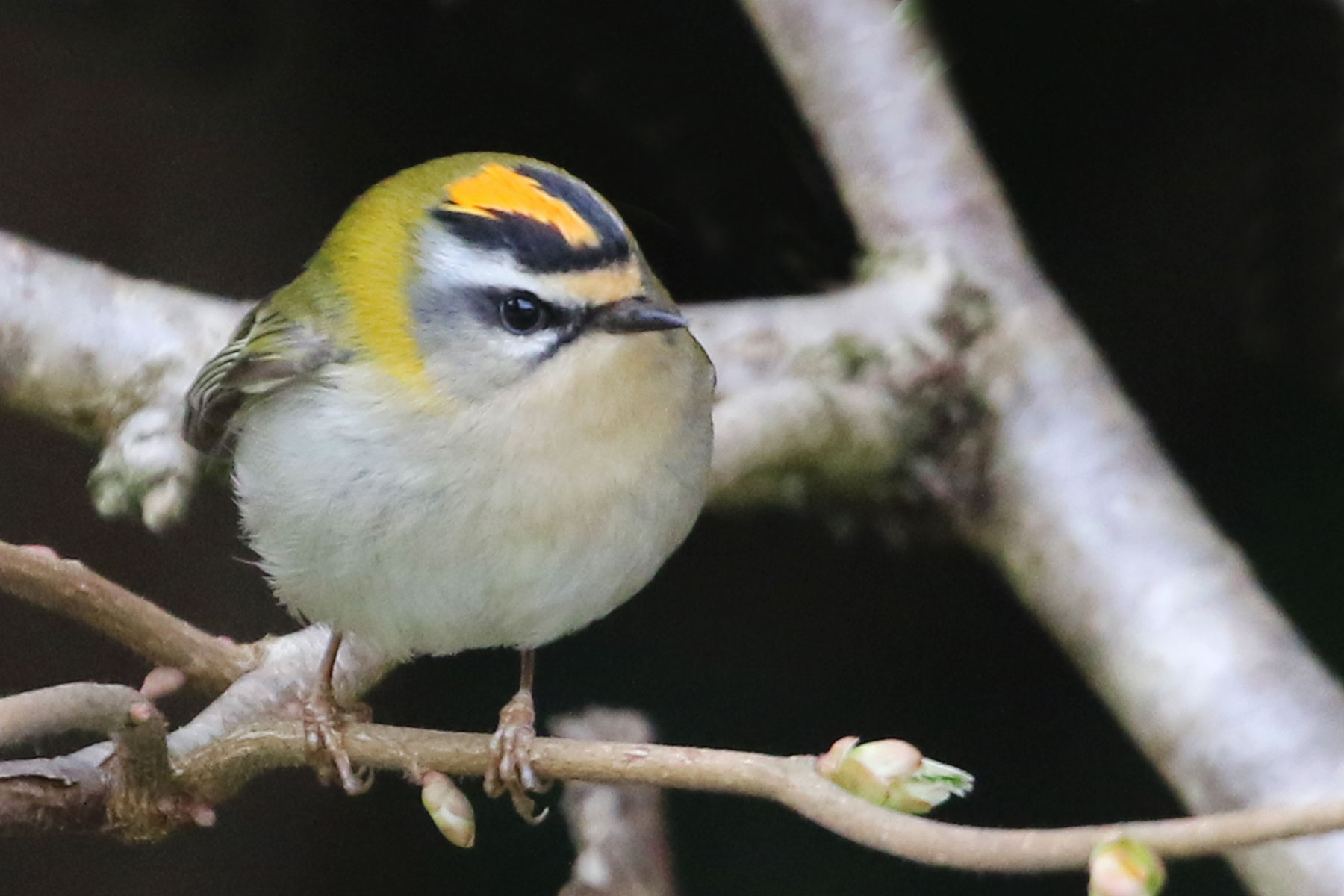
The highlight of last year's first lockdown for me was to be able to get up close with some of the commoner birds locally and have the opportunity to get very close to one very special little bird. The Firecrest is becoming something of a specialty around the Four Marks area. Last year I found ten individual territories. They appear to be migrants moving into the area to breed as I have yet to encounter one outside the months of April to June, despite some considerable searching.
The first sighting was recorded last post on a very wintry day though. I was keen to try and catch up once again in more clement weather. Over the the period it has been very dry with only small snow flurries to contribute to the available moisture. While the sun has been warm, the wind remained quite keen and fresh, mainly from the north east. As well as the Firecrest returning there has been a significant increase in the number of Chiffchaff and Blackcap and at the end of the period the arrival of the Swallows and a passing Willow Warbler. Butterflies too were emerging and slowly the species on the wing at the start of spring were found although they were a little hard to photograph.
But back to the Firecrests, I returned to the spot where I had found the first one last week and sure enough it didn't disappoint once it had appeared in the hedge.
The Firecrest is greenish above and has whitish
underparts. It has two white wingbars, a black eye stripe and a white supercilium.
The head crest, orange in the male and yellow in the female, is displayed during
breeding, and gives rise to the English and scientific names for the species.
This bird superficially resembles the Goldcrest, which largely shares its
European range, but the Firecrest's bronze shoulders and strong face pattern
are distinctive

Both the Firecrest and Goldcrest are members of the Kinglet family, a small group of birds that were once included
in the Old World warblers, but recently given family status, especially
as recent research shows that, despite superficial similarities, the crests
are remote from these warblers. The
names of the family, Regulidae, and its only genus, Regulus, are
derived from the Latin regulus, a diminutive of rex, "a
king", and refer to the characteristic orange or yellow crests of
adult kinglets. The Firecrest was first formally described by Dutch
zoologist Coenraad Jacob Temminck in 1820 as Sylvia ignicapilla; the
relatively late identification of this common European bird arose from a
perception that it was just a variety of the Goldcrest.
[11] The
species name is derived from Latin ignis "fire" and capillus "hair".
This one kept close to the hedge, remaining on the edge with a dark black background which can provide a dramatic back drop for the photographs but brings with it a challenge of exposure.
All species of kinglet are almost exclusively insectivorous,
preying on small arthropods with soft cuticles, such as springtails, aphids and
spiders. They also feed on the cocoons and eggs of spiders and
insects, and occasionally take pollen. All species will hover to catch flying
insects. Although the similarly sized Firecrest and Goldcrest are often found
together, there are a number of factors that reduce direct competition for food.
Common Firecrests prefer larger prey than Goldcrests. Although both will take
trapped insects from spider webs on autumn migration.
The Firecrest feeds in trees, exploiting mainly the upper
surface of branches in coniferous habitat and of leaves in deciduous
trees. This is in contrast to the Goldcrest, which frequently feeds on the
undersides of branches and leaves. In winter, flocks of common Firecrests cover
a given distance about three times faster than do Goldcrests.

The differences in behaviour are facilitated by subtle
morphological differences; Firecrests have broader bills with longer rictal
bristles (which protect a bird's eye from food items it is trying to
capture), and these features reflect the larger prey taken by the species. The Firecrest's
less forked tail may reflect its longer episodes of hovering while hunting.
Firecrests forage more often while standing, and have a foot better adapted for
perching, whereas the Goldcrest's longer hind toe reflects its habit of moving
vertically along branches while feeding. It also has a deep grooves in the
soles of its feet capable of gripping individual needles, while Firecrests have
a smoother underside to the foot


The second bird I found was in a new location, the habitat is perfect though with conifers and rhododendrons and I am rather surprised I have not found any here previously. Once again it was the male that caught my eye and it was not happy about a pair of Goldcrests that were singing close by.
It gave some wonderful close up views showing the vivid orange red crest that is a part of the Kinglet family.
The Firecrest is monogamous. The male sings during the breeding season, often with its crest raised, and has a display which involves pointing its bill at another bird, showing the crest and strong face pattern. This differs from the display of the plainer-faced Goldcrest, which bows its head to emphasise the crest. The breeding territory is about 0.5 hectares (1.2 acres), and may overlap with neighbouring goldcrest territories. Firecrests will sometimes defend their territories and against Goldcrests with the crest raised and a great deal of wing-fluttering, but the amount of actual competition between the species may not be very great.
As is typical for the Kinglet family, the nest is
a closed cup built in three layers with a small entrance hole near its top. The
nest's outer layer is made from moss, small twigs, cobwebs and lichen, the
spider webs also being used to attach the nest to the thin branches that
support it. The middle layer is moss, and this is lined with feathers (up to
3,000) and hair. The
nest is smaller, deeper and more compact than that of the Goldcrest, about
8 cm across and 5–7 cm deep, with a wall thickness of about 2 cm.
The nest is constructed by the female
alone, although the male will accompany the female while she builds the nest
over a period of a few days to three weeks.
The search will continue through Spring for other territories, but already I have a wonderful portfolio of the absolutely stunning little bird, one of my absolute favourites.
Other activity through out the period covered was a mixture of resident activity and the arrivals and emerging visitors. In the usual tree the Tawny Owl was watching me as I attempted to get a good view of him.
It is still a good time to get views of the woodpeckers with the leaves still to come out in Old Down Wood, however they still don't make it easy. The Green Woodpeckers announce their presence with their laughing call and will occupy the denser parts of the trees. The Great Spotted Woodpeckers have a distinctive call too and are maybe a little easier to locate.
Since the middle of March Chiffchaff have been singing in the wood, gradually over that time their numbers have increased with almost every part of the wood having a singing bird. Pairs have also been seen in locations where I know they have bred on previous years.
While the leaves are still at the emergent stage the little warblers show up well, and while they are focused on territory they are a lot easier to photograph.
There are several ways to separate the Chiffchaff from the other similar leaf warblers apart from song. One that isn't probably as well know is a diagnostic tail movement consisting of a dip, then side-wards
wag, that distinguishes it from other Phylloscopus warblers and
gives rise to the name "tailwagger" in India.
The other numerous migrant visitor in the wood is the Blackcap, again a distinctive song, but this time a more melodic warble. They have now arrived in good numbers and while not as numerous as the Chiffchaff they can be found all over the wood. Here the male of a pair that seem to be settled.
And the female with her russet red cap in contrast with the male's black cap.
Gradually through the period the weather warmed up and we were treated to some wonderful blue skies with those lovely white fluffy clouds. Here the view looking west from the edge of Old Down Wood.
The leaves too, as they emerged were looking special when contrasting with the dark background of the wood.
Apparently Bluebells are blooming much earlier these days, but the cold weather has held them back a little this year. This time last year they were almost 50 per cent in bloom as you can see from this
blog post, this year however they are a little behind with only a few flowers showing. I expect to see a significant difference as we move to the end of April.
Another new plant flowering along the verges is the greater Stitchwort
Butterflies too have been slow to show in any quantities, the areas best to find them being the sheltered spots in the sunshine away from the cold wind. This Comma was warming up on the north south path through the wood.
The one butterfly to show in any number was the Brimstone, with males drifting by along the main paths. There have also been one or two females. As ever it is a rare opportunity when they settle.
Other butterflies to have been seen are a Holly Blue in Old Down Wood on the 15th and 18th, a Small White in my garden on the 18th and the first Orange Tip along Swellinghill Road on the 18th and in Old Down Wood on the 20th. All of course did not stop and flew straight past and away.
Also on the 20th I watched this pair of Peacocks. the One with wings spread appeared to be displaying to the closed wing butterfly, flapping the wings and moving from side to side very much in the same way Avocets display to each other.
Moving behind
And then to the right side
The display clearly wasn't having any impression on the closed wing Peacock and eventually the other gave up and flew off leaving the other on the path, wings still closed.
The pond is a good place to check at this time of year, although the water level is very low as we continue to have hardly any rainfall. There were two pairs of Mallard present with one single male. Maybe the other female is still sitting on a nest somewhere.
Cuckoo Flower is emerging around the banks of the pond, liking the damp boggy soil. Unfortunately this as yet has not attracted the Orange Tips, but the Bee Flys like it.
The Bee Flys also can't get enough of the periwinkle flowering on the raised bank
Birds of Prey have been dominated by the Red Kite and Buzzard, several Buzzard have been seen over the garden in the last few days.
Sparrowhawks are about too, their presence being brought to my attention by the alarm calls of the resident Starlings as they mob it. The Sparrowhawk does manage to evade the guards though as I disturbed one on the front lawn having just taken a juvenile Blackbird.
Our other small resident bird of prey, the Kestrel has become a lot harder to see around the patch. A single male along Gradwell lane on the 18th being the first for a long while.
We have seen that the Chiffchaff is doing very well in Old Down Wood, however the other commoner leaf warbler here in the UK, the Willow Warbler is not a very common find around Four Marks. We have to be happy with migrants passing through. There was an area around Newtown Farm where they could be found through the summer, but that has now grown over and they haven't been there for a while. For me there song is as much an indicator of spring as that of a Chiffchaff or the sight of a Swallow, a lovely wistful string of notes, usually delivered from the top of a tree.
It was this song that greeted me as I walked up to the pond on the 19th. The owner of the song gave me a little run around before I was able to find it, in a tree above the picnic bank. It was feeding vigorously in the willow flowers and was delivering little snippets of song in between foraging.
Despite its rarity, the Willow Warbler is a very common and widespread leaf warbler
which breeds throughout northern and temperate Europe and
the Palearctic, from Ireland east to eastern Siberia. It is
strongly migratory, with almost all of the population wintering in Sub-Saharan
Africa.[2][3]It
is a bird of open woodlands with trees and ground cover for nesting,
including most importantly birch, alder, and willow habitats.
The nest is usually built in close contact with the ground, often in low
vegetation.
The willow warbler is green above and pale yellow below,
with an off-white belly and eyebrow stripe. Willow warblers and chiffchaffs are
both very similar, olive-coloured warblers, and are best identified by their
song. Willow warblers have slightly pale legs, while Chiffchaff legs are dark
grey. The Willow Warbler has longer wings,
the primary projection extending further to the tail than in the Chiffchaff.
I like to make the most of any early spring sighting because they are soon gone, which is a real shame.
The first Swallow I saw was a distant bird over Brislands on the 14th, however a visit to the pond on the 20th had two birds circling the pond, dipping into the water and collectig mud from the dark edges of the pond.
I suspect these birds were already starting to build the nest in the horse stables that are the other side of the copse surrounding the pond.
Walking through the wood the commoner birds are also very busy, Robins can be heard singing and Dunnock appear regularly along the path and every so often their twinkling song will ring out as you walk pasta bush.
However the one bird that announces its presence with a vengeance is the tiny Wren, a burst of song rattled out from a prominent perch or branch before dropping back into the bramble and bracken.
So a lot more activity around the patch, but I thought i Would end with something man made, but equally as beautiful. With the relaxation of the Lockdown restrictions tourist attractions were opening up and locally the big one is the Watercress Line. The whistle of the steam engine alerted me as I walked through Old Down Wood. Gaps in the trees afford some wonderful views of the locomotives as they steam their way through the lovely country side that surrounds me here in Four Marks.