Showing posts with label Moths. Show all posts

Monday, 10 May 2021

Garden Birds - Update two

Despite the arctic like conditions we have experienced this month the garden has been busy and we have seen success with several fledged Robins.  At one point the garden was busy with the calls of juvenile Robins on both sides of the garden and adult birds getting confused over who belonged to who and who their mates were.

Here are some pictures of at least two individuals, it may be three, if their parents struggle then I have no chance


The young Robins graduated from begging for food from the adults and being fed, to begging and not being fed to coming close to me and being fed.  This last activity greatly annoyed the adults and one or two little squabbles would ensue, the young Robins learnt quickly and were quick to the meal worms.

Then one day, they were gone, not to be seen or heard anywhere, the adults became less manic over feeding and a clam returned to the garden.  It will be interesting to see if any of the couples decide to have a second brood.

Donald the Robin still comes to the kitchen door and sits on the patio chair staring in the window.  I have noticed over the last few days that his breast is losing its vibrant red, becoming a little paler.


These two looks are the hard ones to resist and normally result in the door being opened.


One other Robin, this on the mate of the tame Robin that feeds from my hand.  The mate just watches and makes no effort to do the same.  He has also been quite amusing as he gets confused when surrounded by the juveniles.

Last year we were feeding a Blackbird family, this year our male has been dumped and is on his own.  He still comes for the meal worms but we have to feed him inside the house as he gets attacked by his former mate who has young by another male this year.  The patch above his eye looks a little better, we are not sure if it might be a wound as a result of one of the attacks, interestingly the other male blackbird has similar wounds but on both eyes.


The garden is looking quite smart right now, although the blossom in this picture all went after the storms on the third May.

That just leaves the Wren, who has become quite a character, it turns up in the early evening, usually when called or by knocking the meal worm dish on the wall.  The following photograph lays out where the Wren goes as it finds its way to get a meal.

The starting location is on the log at the far end of the patio under the tree, number 1.


Typical views around the log.


Having become comfortable all is well it moves quickly to the first planter at number two on the garden picture.  At first using the plants as cover.


But then becoming a bit bolder, checking to see what and who was about.


Then creeping mouse like along the edge of the planter.  The blurred image in the photograph is one of the Robins on the patio chair.


A quick look down, a meal worm had just been thrown for the Robins


Then it creeps around the first planter and into the big pot with hydrangeas at number three on the garden picture.


It is now quite close but has one more move next, down to the next planter alongside the hydrangeas.  Once again using the flowers as cover it creeps around the planter.


A final check to make sure all is clear, it is not worried about me it is the Robins it is watching for, not that it is intimidated, it is quite prepared to take them on, it is watching them for the chance for food.


And then the opportunity arises and it drops quickly to pick up the worm.


A quck shake of the worm against the ground and it is off around the back of the planters and away to the bottom of the garden.


Finally an update from the moth trap.  Progress has been slow, the cold weather seemingly keeping them away.  The only new moth in he period has been this Brimstone Moth.


One has to hope that the moth counts will improve as we move towards the summer and that the House Martins will return.


Monday, 12 April 2021

29th March - 3rd April - Time to Sit Back and Unwind

Spring and summer suddenly arrived in Four Marks for the week before Easter.  The temperatures soared to the highest March temperature for over fifty years on the 30th, but then quickly tailed away to single figures over the Easter weekend, but fortunately with sunshine that kept you warm if you were out of the wind.

With the warm weather I decided on a lunchtime walk to see if there were anymore butterflies about.  The pond is usually a good spot to find them around midday as the sun hits the bank of shrubs about then.  Sure enough as I walked around the side of the pond I disturbed a Peacock butterfly, although it was looking a little worse for wear.


The periwinkle was flowering on the bank, while Lesser Celandine were dotted around the grass verge.  I managed to find this first flowering Cuckoo Flower or Lady's Smock.  It is a very delicate plant with pale pink flowers and is known as an indicator species.  The Cuckoo flower is favoured by the Green-veined White and Orange Tip butterflies, both lay their eggs on the flower.


The periwinkle was attracting several Bee Fly, they could be seen probing the flower head with their long proboscis.


Leaving the pond I walked to Old Down Wood, on the pebbles at the gate was another Bee Fly, this time resting on the stones, catching the warmth of the midday sun.


Chiffchaff were singing and several Brimstone butterflies flew past, one of which was my first female of the year.  The loud screeching call of Jays caught my attention and one flew through the trees and perched amongst the branches.  It is not that often you get the opportunity to catch one like this, despite the branches quite an acceptable shot.


I disturbed another Peacock and annoyingly my first Comma of the year which decided to fly away and out of sight.  I followed the main path to keep in the sunshine in the hope of getting some stationary butterflies, but the combination of sun and time of day meant they just kept flying past me.

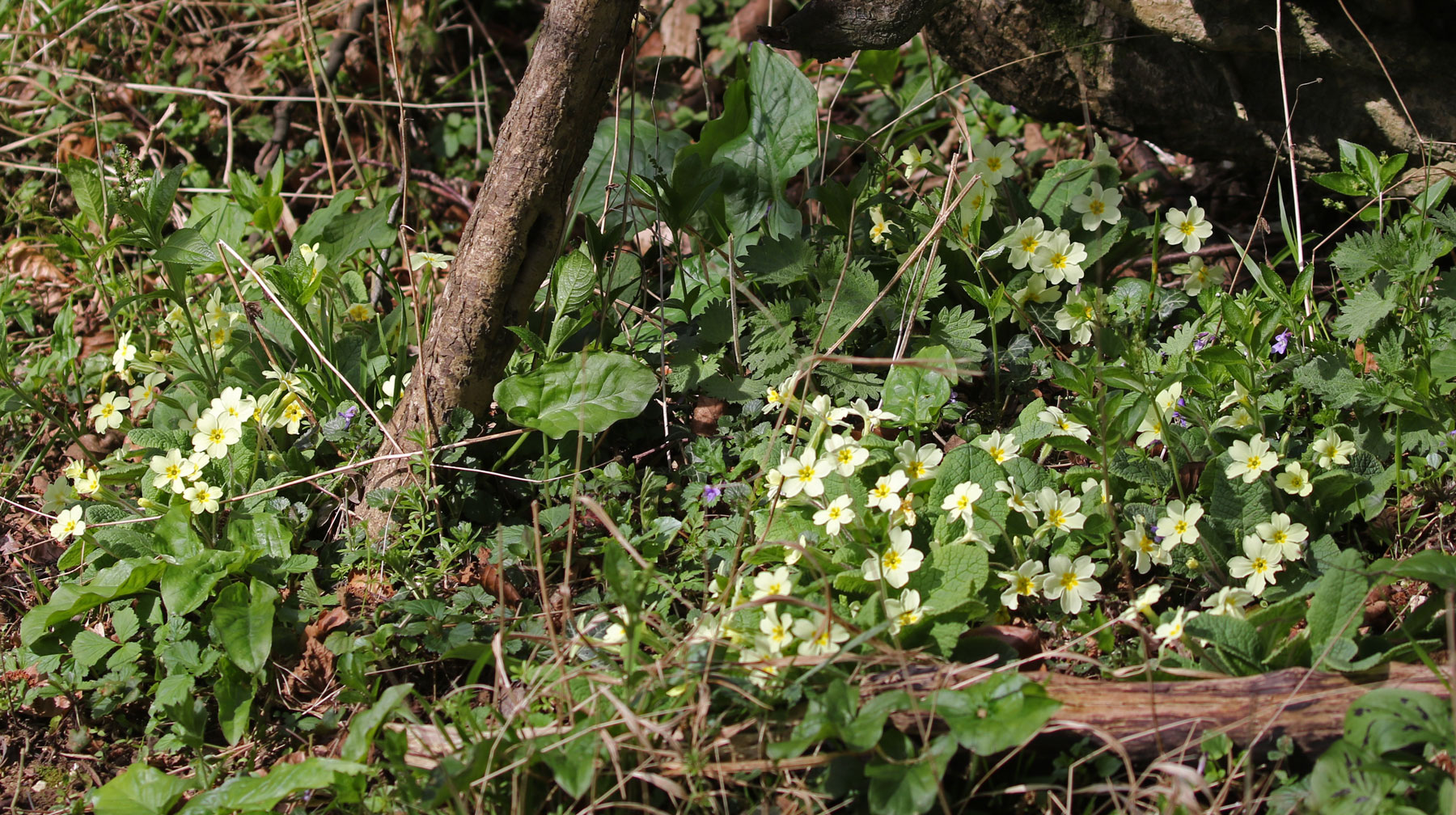
At the west end of the wood was a lovely clump of wild Primroses.


The bluebells were well advanced now and in places there were flowers showing.  According to data from Natures Calendar Survey the first flowering bluebells has advanced by 17 days since 2001.


Another "blue" flower out at this time is the wild Violet, and many could be seen carpeting the south facing bank.


Walking back along the main path I came across another Peacock, although this time it was a little more confiding, the Pussy Willow flowers holding its attention.


And a different view which shows more wing damage and a fading of the scales making the wings a little translucent.


Leaving the Pond I drove around to Lye Way to check the fields, hopeful for a Wheatear.  There were no Wheatear but I did manage to find this Brown Hare sitting on one of the tractor ridges.


The garden remains busy, with the female blackbird, that was paired with our long term Blackbird, but is now with another male, feeding young as she has been seen carrying food.  If the old male is feeding she will chase him off, so we have taken to feeding him inside the kitchen, she is not that brave yet.

There are three pairs of Robin, one to the street side, one in chalk close and another in the gardens to the right.  Only one Robin will take from the hand, the others will come close with only Donald prepared to come into the kitchen.  Here is a slow motion video of the Robin taking a meal-worm.  Its partner takes a lot of time to sing, so I am assuming this is a female.


The Wren watches all this action and has started to come closer, nipping in to pinch a stray worm dropped for the Robins.

With the warmth of Tuesday still in the air I decided to put the moth trap out overnight.  I had expected a few more than I caught, but then it is still early in the season, but I did mange to catch these four new moths for the year.

First up a micro moth, Eudonia Angustea or Narrow-winged Grey, flys all year with a peak in the summer months


A Brindle Beauty 


Occurring locally throughout a large part of Britain, this species is commonest in the south, especially the Home Counties.  The moths fly in March and April, and the males at least, are attracted to light.


It prefers woodland and suburban habitats, and feeds on a range of deciduous trees


The Common Plume, one of the commonest of the 'Plume' moths all over Britain, and one of the few to be found in the early part of the year, as the adults occur in all months.  Like most of the Pterophoridae, the wings are cleft or divided, but this can be difficult to see, as the moth often rests with the wings rolled up tightly.  It occurs in any suitable habitat where the larval foodplants, bindweed grows.


Finally the Brindled Pug, another micro moth.  An early spring species, and one of the first Pugs of the season to be regularly encountered, it flies in one generation in April and May.  It inhabits deciduous woodland and is fairly common in much of Britain.


I will not be bothering with the moth trap until the weather warms up and there are some blossom and flowers around.