Monday, 11 May 2020

3rd May - 8th May Week Seven - Those Useless Trees Produce the Air That I Am Breathing


The week started with overcast conditions but with sunny spells, this would gradually improve through the week with very warm conditions experienced over the bank holiday weekend.  In the garden there were a pair of juvenile Robins following their parents around and constantly begging to be fed.


As I have said before as we move into May local activity begins to become quite samey and it becomes a question of finding something of interest that might not necessarily be immediately visible.  Both Swallows and House Martins have now arrived, the House Martins though not always present around the houses while the Swallows are yet to be come resident at many of the usual spots around the patch.  There were though a couple about along Alton Lane on Monday.


The Rooks were busy still feeding youngsters in the rookery.  At the bottom of Alton Lane we heard a Cuckoo call and caught a short glimpse as it flew from the tree tops and out of sight.  I was informed that it has been present for a good few weeks and seems to come mostly from the woods around Kitwood Lane.

Tuesday saw us walking through Old Down Wood once again, the canopy is closing over as all the trees now have a full set of leaves and with this the floor of the wood has started to look tired, the bramble too has restarted its attempts to take over everything.  A project I have considered previously was to try and identify as many of the trees in the wood, so I thought now would be a good time to start.  The leaves are in their most pristine condition, and these are usually the best way of identifying the trees. 

Lets start small, this is the Elderberry, not widespread in the wood but found in a few places probably the product of birds eating the fruit outside the wood and depositing the seeds.


The Hawthorn is widespread and found all over.  At this time of year the bushes are covered with the white blossom or May.


This one was an unusual find, I would hazard a guess this is the only one in Old Down, the Laburnum.


The next is probably the most numerous tree in the wood, the Beech.


The last one for this post is the Sallow.  I was surprised to find this, but it brings hope that maybe once day I would find a Purple Emperor butterfly as these are the food plant of the larvae, I can but dream


Stopping at the pond on the way home, the shallow edges of the pond were black with large groups of tadpoles.


Back home in the garden there was some interesting light and some carefully hidden meal worms attracted the Robins producing an illuminated bird with a nice dark background.


As is always the case when the Robins find or are fed the mealworms the Starlings and House Sparrows muscle in.  This Starling has young screaming in the roof of the house to be fed and I suppose you can't admonish them.


Wednesday saw us walking to Hawthorn Lane and then across the footpaths past the Garden Centre to home.  In the fields and paddocks along the footpath from Hawthorn Lane Rooks scoured the buttercup covered paddocks.


In a willow tree on the outskirts of the garden centre a Chiffchaff sang out in the open at the very top of the tree.


Thursday saw the daily walk put on hold as we sorted the garden out, new flowers had arrived.  However there was still plenty of activity, mostly over the house.  We visited several times by the female Sparrowhawk, her approaches though always spotted by the residents, alarm calls sending the robins and blackbirds to cover while the Starlings flew up to intercept the threat.

More alarm calls alerted me to a Buzzard that was drifting over the garden.  This time it was the local crows that took on the air defense role.


Moving in to intercept


Which resulted in the buzzard taking evasive action and using it's most lethal weapon, it talons, by rolling on to its back to face the crow and lunging with the talons
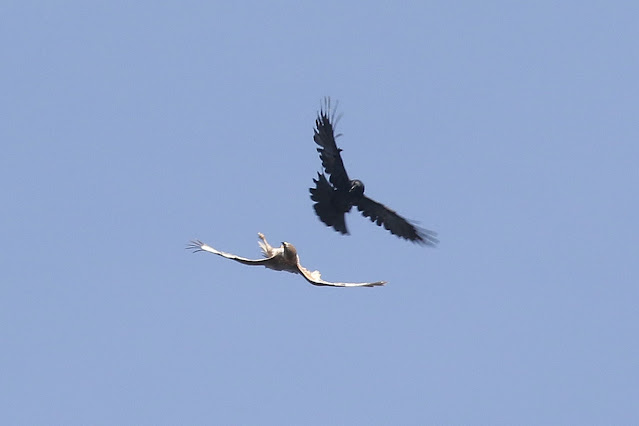

The Crow backs off as the Buzzard falls away


Talons safely out of the way the crow keeps a safe distance but ensures the Buzzard leaves the air space.


Shortly afterwards a Red Kite drifted over.  The small birds seem completely un-phased by their presence not seeing the beautiful raptors as the same kind of threat imposed by the Buzzard and Sparrowhawk.


All through the afternoon our Blackbird had been singing, something he doesn't do tha often, and could only mean one thing, his mate was sitting on another clutch of eggs.  We think the previous nestlings were taken, probably by a Magpie.

Late in the afternoon the blackbird moved to a different tree and was the first time visible in song.


That evening there was the last super moon of the year, a flower moon, so called due to the fact that flowers are now all out and blooming.


The Friday Bank Holiday was very strange, it felt like a Saturday and I suppose the whole feeling was compounded by the strange days we are living in presently.

It was another warm and sunny day with temperature forecast, once again, heading towards the mid twenties.  I set out for a walk around Old Down Wood late morning, hoping to catch up with some butterflies.  As I walked along Brislands Lane I did see butterflies, a male Orange Tip and Large White, but true to form they just flew on by.  

Long-tailed Tits could be heard calling in the hedgerows, I suspect that they have nests bulging with youngsters and they need feeding so the adult birds are scouring the bushes and leaves for insects and spiders to feed them.  This leads to the feathers, notably the tail feathers becoming very worn and tatty.


In Old Down Wood the Chiffchaffs and Blackcaps were singing, I took the diagonal path towards the west end of the wood.  As I came through the Beech Trees I heard the call of a Tawny Owl, the male's "toowhoo" followed by what sounded like the "keevit" call, but a lot quieter and without the usual clarity.  This was then followed by a strange warbling call.  I checked the calls of the owl on my phone and found that the strangled "keevit" was most likely that of young owlets, the warbling a form of contact.  I walked to the area where I thought it was coming from and scoured the trees without any luck.

Not able to find the owls I went back to the original plan to search for butterflies, notably Green Hairstreak.  This proved to be a fruitful as the search for the owls.  In the location I have found them there was no sign of any butterfly.  After waiting for sometime I had to conclude they were not there.  Walking back to the crossroads I did come across this Speckled Wood.


And at last this Large White that settled on a dandelion.


From the wood I walked to Swellinghill Pond, it seemed quiet at first but then I spotted a male Broad-bodied Chaser settled on a bullrush.


It was then off doing a circuit of the pond , looking to settle but teasing and moving.  Another flew over my head and settled in the tree on the bank, this one was a female, having the orange brown body in contrast to the male.


The male then returned and perched very nicely for me on another bullrush stem.


A walk around the pond finally managed to find some damselflies.  One Azure Damselfly was around the emerging Iris but never settled for me to get a photograph.  A Large Red Damselfly though did and I was able to record the first of the year.


As I searched for more damselflies I came across this exuvia or the old skin of a dragonfly nymph on the leaf of an Iris.


There were now two pairs of Broad-bodied Chasers touring the pond and I suspect that one of them emerged from this exuvia.

I left the pond and walked to Kitwood where I crossed the field back into Old Down Wood.  Here there were two more trees to add to the list.  First the Larch, the only deciduous conifer in the wood,  After the beech the larch is one of the most numerous tree species in the wood.  From a distance the Larch can easily be recognised as they are one of the tallest trees present.


Less numerous is the Silver Birch.  They are probably easier to identify in winter by their silver grey bark, but when the leaves do appear they take on a gentle beauty of their own.


I walked to see if the owl was in its tree but I couldn't see it.  If it had of been I would have been able to assume that the owls I had heard earlier were different, but with it not present it was impossible to make the call.

As I turned to leave I heard another Firecrest singing.  After a short search i was able to find it in the canopy.  I know more Firecrest photographs, but I just can't resist them.


This was now the seventh singing bird around the patch,m not bad for a bird that only recently was considered a rare breeding bird in the county.


I left the Firecrest singing and headed out towards the Gradwell entrance.  As I headed towards the footpath I heard yet another Firecrest singing.  I could n't get to see this one, but the number is now up to eight birds, amazing.

Crossing the field towards Gradwell a Red Admiral that was a little worn and worst for wear settled on the dried ground of the path.


The rest of the day remained warm and sunny and this was to be the same on Saturday as well, however the weather was set to change to cold but sunny next week which I am sure will come as a shock to many.  Whether it brings in anything of interest locally remains to be seen.  There is also the hope that maybe we will see some relaxing of the restrictions to our freedom we have  had for the last six to seven weeks.

Monday, 4 May 2020

26th April - 1st May Week Six - There Was a Shopping Mall, Now It's All Covered In Flowers

Working from home introduced a little drama this week.  One of our Robins has become quite clever realising that it doesn't have to compete with the others if it trusts us.  This has involved coming into kitchen to be fed as can be seen for the photo.
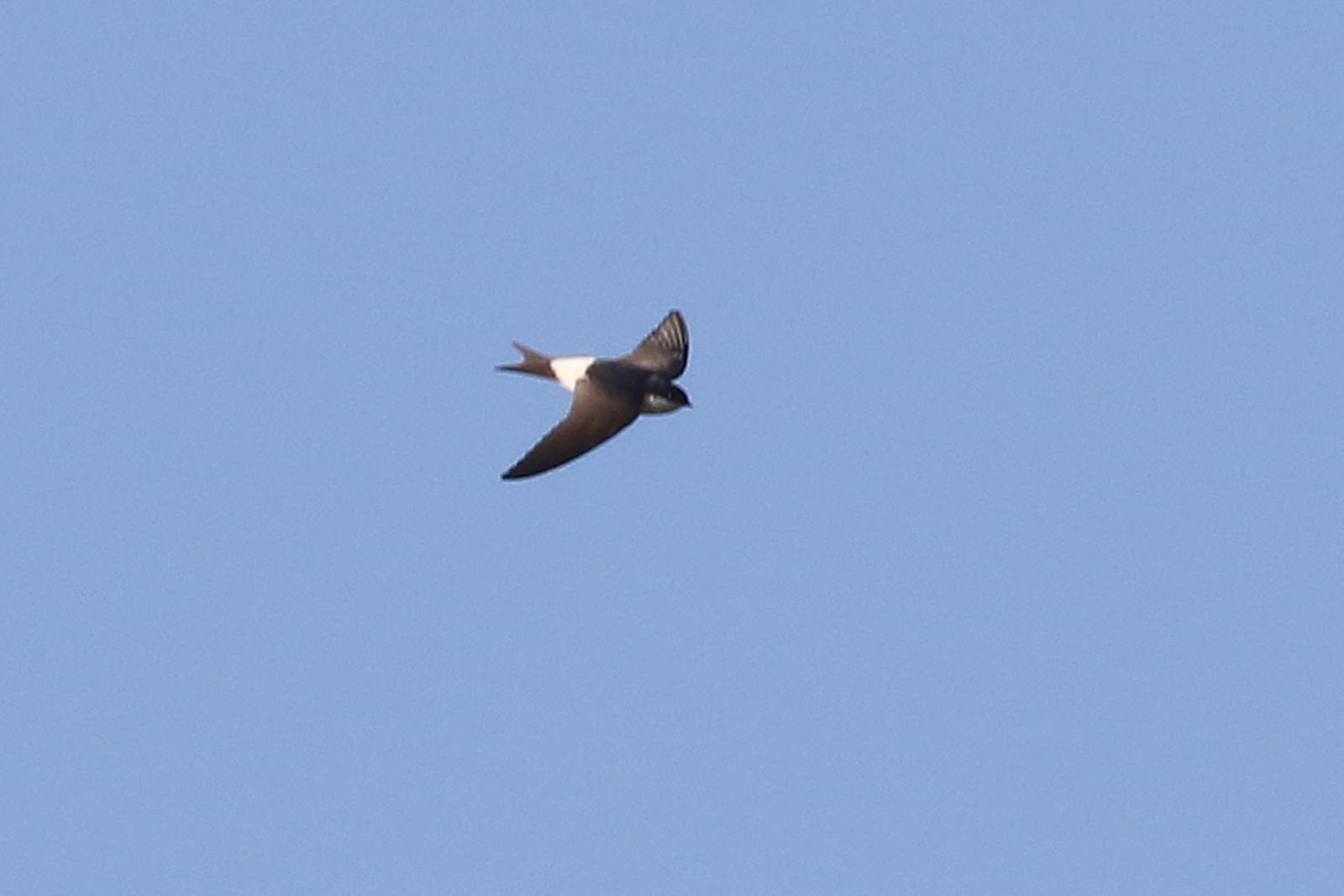


On Tuesday we had lunch with the back door open after feeding the birds, just after one I shut the door and returned to my office upstairs.  An hour and a half later I went o make us both a cup of tea and on returning to the office found the Robin there!  It wasn't too difficult to catch and appeared quite calm as we released it back into the garden.  Afterwards we started to find little messages that gave some idea of where it had been in the house for those 90 minutes.  The Robin clearly wasn't put off by its experience and has resumed its feeding methods by coming into the house.  We, though are a little more careful after having the door open!

The week started with glorious weather once again but soon after this deteriorated into what can only be described as more "normal" April weather with much cooler conditions and four Seasons in one day, with sunshine, wind, rain and even hail, backed up by thunder and lightning.  As a result my exercise spells were restricted to only three days, the best of which was on Sunday when I took advantage of the sunshine to spend sometime in Old Down Wood.

Walking from home along Brislands I was accompanied once again by Orange Tip butterflies that would not stop, while in the fields on both sides of the lane Skylarks could be heard in song and the Cow Parsley is beginning to cover the verge.


The Greater Stitchwort are still in flower along the  in places the flowers are very open exposing the yellow stamen.


Finally an Orange Tip did settle on a leaf along the lane but it wasn't the sort after male but a female.


After negotiating my way around several groups of dog walkers I took the northern perimeter path.  The bluebells were still about, but are starting to go past there best.  However there were pockets that could still impress and with the sun streaming through the canopy it would pick them out, highlighting them in the darkness.


Here a larger patch.


This is the best side of the wood to see the Early Purple Orchids, they have been in flower for a few weeks now and several more have appeared.  I found this close to the edge of the wood.


And then another a little further along the path.


Where the sun managed to get through the closing canopy there were a group of insects warming up on the leaves of the Ransoms.as if they had just emerged


Identification has been difficult, but due to the large size around two centimetres, I think they may have been Hornet Hoverflies.

There were still plenty of patches of bluebells worth photographing.


Some distant in the middle of scrub not accessible to wandering persons


Solomon's Seal are also now flowering everywhere.


Coming around to the West End of the wood the clump of Bugleherb was still in flower.


And there was a lot of Wood Spurge about too.  The lovely lime green leaves being highlighted by the sun and backed by the darkness of the trees.


The view this morning from the West End was quite stunning.


The main path back up into the wood is beginning to become a little overgrown.  A Blackcap sang from within the Hazel scrub, once or twice a singing Blackcap would have me questioning whether it was maybe a Garden Warbler, but a brief glimpse of the black cap confirms the owner of the song and I know that when I hear a Garden Warbler I will know in an instance that it is one.

Competing in volume, if not maybe quality, was a Wren, singing from an elder bush.


Light was a challenge, however they are always a joy to watch, such power from such a little creature.

Large White Butterflies are on the wing now, however they seem intent on exploring and despite the fact that they fly around in circles they would not stop for me.  It was as I followed a Large White that I came across a Chiffchaff carrying feathers for nest building I presume.


The female Chiffchaff does the nest building, it is a domed nest built on or close to the ground.  Vegetation and leaves are used in the construction and feathers used to line the nest.  Here the nest must be complete.  

I watched to try and see where she went with feather but lost her in the bushes.  She did return though to watch me.


Again the light was a challenge but it does show that in certain conditions the appearance of the Chiffchaff can change, in the open it appears as a drab brownish olive bird, but here under the canopy it takes on a greenish hue to match the surroundings.


I wandered along the main path to the Crossroads, this is where the two main footpaths through the wood meet.  For more details about the sites and area of the wood I have written a description of those in Old Down and around the patch and they can be found here).


I turned Right and made my way towards the Old Down Cottage exit.  I paused in the open area in the hope of getting some butterflies to settle.  There were Red Admiral, Peacock, Brimstone and more Large Whites, however they didn't stop and I was left to just enjoy the view of the open clearing.


I stopped to take some photographs low amongst the bluebells, this gives a different perspective on the beautiful flowers.


I was also taken by the huge Sycamore leaves lit up by the sun and contrasting with the dark backgrounds.


A view I don't think I have posted before is that of the pathway into the wood by the Old Down Cottage.  The sign by the style says no horses but this hasn't stopped the many cyclists coming through here recently.  Hopefully the mud that will appear with the week's rain will put some off.


On Saturday I had noticed some Starlings hanging around the pole supporting the power lines, today I saw why.  They had nested in a hole in the pole and the youngster not far off fledging was peering out.


I can only assume this used to be a Great Spotted Woodpecker nest.  I don't see the Starling excavating the hole in what is quite dense wood.

I had a walk around the pond in the hope of finding some damsel flies but there were none about.  As I left a female Holly Blue appeared on the holly bush.  She is though looking a little worn, her flight season coming close to finishing.


I walked down Kitwood lane and crossed the field back into Old Down.  I couldn't resist going to look for the Tawny Owl and was pleased to find him in the usual tree although the light was awful and had to make do with this attempt.


I had been wandering around for some time so I decided to make my way home, the Sweet Chestnuts are just coming into leaf.


In the hedgerow next to footpath leading to Gradwell Lane another Holly Blue settled on the leaves.  Another female she turned to get the sun showing the underside and the dots that separate this from the other blues!


Then turning and opening the wings to show the dusky black wing tips of a female.


Back home from the garden a Greenfinch was singing from one of the surrounding trees.


Later in the afternoon a group of House Martins just appeared and started to inspect the old nests and other potential sites.  This is the nest on our house and as you can see needs some serious attention.  There was a lot of chattering as the nest was inspected.


Its mate was circling close by, probably keeping a distance from its chattering mate.


Then the two were finally in the nest together and the chattering became more intense as they looked at it.


Both birds twisting and turning around.


Whether deliberate or as a result of the inspections and both birds tucked into the nest, Monday morning saw the majority of the nest on the floor.  It now requires an almost total re-build.

Monday was a much cooler day, with some sunshine about but mostly cloud.  We were able to get out for a walk though and once again walked through the wood.  Over the last few weeks I have heard Stock Dove calling from the area around the Old Down Cottage entrance and down by the Ash Trees to the west end of the wood.  There has also been calls from the trees by the large house close to the pond.  My attempts to see the birds let alone photograph them have been very few.  I did manage a quick glimpse and then in flight last Saturday but that was it.  So when a couple of pigeons flew from the trees close to the pond as we made our way towards kitwood I thought at first they were the usual Woodpigeons, but as they landed on the roof of the little house on the other side of the lane I could see these were the sought after Stock Dove.


They look so much nicer than the Woodpigeon, more delicate and if you catch them in the light properly, with some glorious colours in the grey plumage.


Tuesday, Wednesday and Thursday saw heavy rain, hail and thunderstorms, this eased a little on Friday and we were able to get out for a walk.  Keeping to the lanes we walked down Brislands and around Gilbert Street to Old Down Wood.  

At the bottom of the hill on the open grass a Mistle Thrush was searching for food, probably to satisfy youngster in a nest somewhere close by.  The Mistle Thrush is larger than the more commonly seen Song Thrush.  It has a slightly greyer plumage and a white breast with spots as opposed to the streaks in the Song Thrush.


As we left the Mistle Thrush behind Helen informed me that on the journey into Alton on Thursday she had seen a Hoopoe alongside the A31 just before you reach the Chawton roundabout.  She described it perfectly and I know she has seen them on our travels so there is no reason to doubt her, I was just gobsmacked that she was only telling me now!

The lambs we had seen the week before in the field along Gilbert Street were now much more independent and scattered around the field.

Walking up through the Desmond Paddocks there were newly born calves in the field and Swallows flew around the fields.  Looking south down across the paddocks the evening sunshine was very welcome.


Walking through the wood more trees were coming into flower, a Copper Beech.


While the Horse Chestnut were in flower along Lymington Bottom.


The weather for Saturday was a lot more preferable, however we were planning a short excursion to re-charge the batteries.  Next week will see a return to the warm weather of the past few weeks, however we will have to endure some rain to start with.  We are now entering a quiet time around the patch, typically this time of year sees few arrivals and the canopy in the wood closes over and the floor of the wood sees the wild flowers dying back.  There will always be things of interest it just means you have to work harder to find them.