Thursday looked like the best day of the week for an evening walk, and I had planned to take the chance to walk the circuit at Plain Farm. However on checking the Hampshire Go Birding site, I decided to change that plan, and headed off towards Old Down and then up over Andrew lane.
As I walked down Lymington Rise I could hear the alarm calls of a Robin and Blue Tit. Mindful of the Robin last Saturday I scanned the sky. After a couple of false alarms involving a Jackdaw and Wood Pigeon, I finally found a Sparrowhawk, and I wasn't the only one, two Jackdaws were also in hot pursuit, and dive bombed the hawk until it flew off and out of sight.
I headed up Brislands, the sun was quite warm, and there were birds singing on both sides. Blackcaps are now quite abundant, and their lovely song could be heard above all the others. The Firecrest was singing at the usual site, and I managed a brief view of the male in amongst the rhododendrons. A Great Spotted Woodpecker called from the Ash trees above us, and checking the hole I discovered last week seems to be a little lafger.
After missing a photograph of the Whitethroat on Saturday I was keen to find one today, I had considered walking back down Lye Way, a good spot for them, but as I approached Old Down I heard the familiar scratchy song from the hedge. I stopped, and it stopped, then I heard it a little way off. I waited, and soon it came closer and I watched it fly across in front of me, and then it appeared on the edge of the hedge singing.
In some areas they are known as the "Nettle Creeper" due to the way it stays tucked in amongst the foliage and hedgerows. It is a slender, clean -lined bird with a grey head and distinctive white throat. You can see in these photographs how well it can merge into its habitat, and the only way you know it is there is when you hear its scratchy little warble or you catch a glimpse of movement, or if you are lucky you see it burst into the air in full song, only to drop again out of sight.
I walked along the outside of Old Down in the hope of finding some butterflies. An Orange Tip flew past me, and I disturbed my first Red Admiral of the year from the soil, neither gave me a chance of a photograph.
Into the wood, and the sun went behind a cloud. The colour blue is a lovely colour, but seems to come into it's own under overcast skies. I remember being told the best time to observe the ice of a glacier is when the sky is overcast, and it is the same with the bluebells. The last few visits there has been plenty of sun, but today with the sun momentarily behind a cloud the colour burst out in front of me.
This tree provided a lovely centre piece for this panoramic view.
In amongst the blue you can see the odd white flowers, these are probably due to an ingress of the Spanish variety of Bluebell introduced through horticultural events. The Spanish variety is more prone to white albino forms. English Bluebells do exhibit a white form but they are extremely rare. Apparently every species of Bluebell will produce white flowered forms lacking the purplish pigment, the colouration being under genetic control. These forms are very uncommon in truly wild populations, they have often been collected and turn up in gardens. This means that our Bluebell wood at some stage has been invaded, probably through wind borne pollen, and the cultivated specimens have managed to mix in with the wild forms.
Again the woods were full of bird song and activity, and I flushed some Blackbirds, and then a Song thrush, which was quickly followed by a couple of tail less birds that turned out to be fledgling Song Thrushes.
Where the trees have blown down and blocked the original paths new paths have been created by the many walkers that go through here. As I walked one new path I realised that it was going very close to where there have been Early Purple Orchids over the last few years. I stopped and checked and found them about half a metre from the new path, but luckily untouched.
There were in fact two present, and they contrasted well with the surrounding Bluebells.
This year it seems the flowers have just raced out. The Celandines and anemones are now past there best and have been replaced by the Bluebells. You can still see Wood Sorrel, but now the Lords and Ladies are getting bigger, the Solomon's Seal are just starting to flower, and with the recent rain the smell of Wild Garlic fills the woods from the Ransome's that too are just beginning to flower.
I came out of the wood and headed down through the Desmond Paddocks. The sheep and lambs have moved to the top field, and the lambs a little older were a lot more active. Number 16 here was clearly in the mood to play, running around hopping and skipping about and generally annoying all the others.
As I watched and photographed the lambs I was concious of a sound I haven't heard here for a long time. Away over by Old down House I could hear a Cuckoo calling. I haven't heard one for at least 5 years here, maybe more as I was not keeping records then, and when I heard them previously it would be from the garden a way off in the distance.
This was the reason I had changed the walk plans, a Cuckoo had been reported in Ropley during the afternoon and I was hoping it may move through the patch,and the hunch was spot on. It was there but could I now find it to see it, something I have never been able to do here. I debated going up Swellinghill, to try and find it, but changed my mind and decided to stick to the plan of Andrew Lane.
As I walked up the lane I could hear it calling, and it seemed to be moving in parallel with me, maybe we would meet at the top?
The Swallows were flying around the stables, and I checked the paddocks as usual. Today though only a group of five Magpies, one then flew off.
Next stop was the Larches, the cuckoo was still calling. A couple of Great Tits here, but above me I heard the chuckle of what could only be a Fieldfare. I waited to see if it called again, and it did and flew from the tree above me across the field to the next big tree.
It was a fair way off, but you can see it is a Fieldfare, and my latest by a long way. Again they seem to congregate in this area as they make their way back to their breeding grounds.
I walked around the top of the path and headed back down the footpath towards Swellinghill. The cuckoo had been quiet for awhile, but as I came out from under the trees I heard it again, this time though a long way off, it had headed towards Lye Way. I had taken the wrong path.
As I walked on I could hear Blackbirds scolding something in the Oak trees, a little closer and they burst from the tree chasing a Sparrowhawk. It looked like the hawk had something but I couldn't be sure. As I walked on the hawk broke cover again, and flew up into the large oak in front of me. This time its talons were empty. I inched forward trying to get a good view, but this was all i could get before it flew off again.
Resigned to the fact that the Cuckoo had gone and I would have to make do yet again with just hearing it I walked to the pond. As I approached I was confronted with the sight of not one, but two different water birds on the patch. A Moorhen feeding quite happily for once in the open.
And two drake Mallards, not sure what they have done with the duck.
Blackcap and Chiffchaff sang from the surrounding trees and a little further down the lane I came across a singing Song Thrush, and for once it was quite happy to let me take its picture as it sat in the tree declaring its presence.
As I was debating in my mind whether to cross the field back to Old Down Wood I heard the Cuckoo again, but this time it was close. It was coming from the line of trees along the Bridleway. There are also wires there so maybe it was sitting on these? I stopped at the opening in the hedge and scanned across the field. I could hear it, but couldn't see it. More than likely it was in the middle of the large oaks, hidden by the emerging leaves.
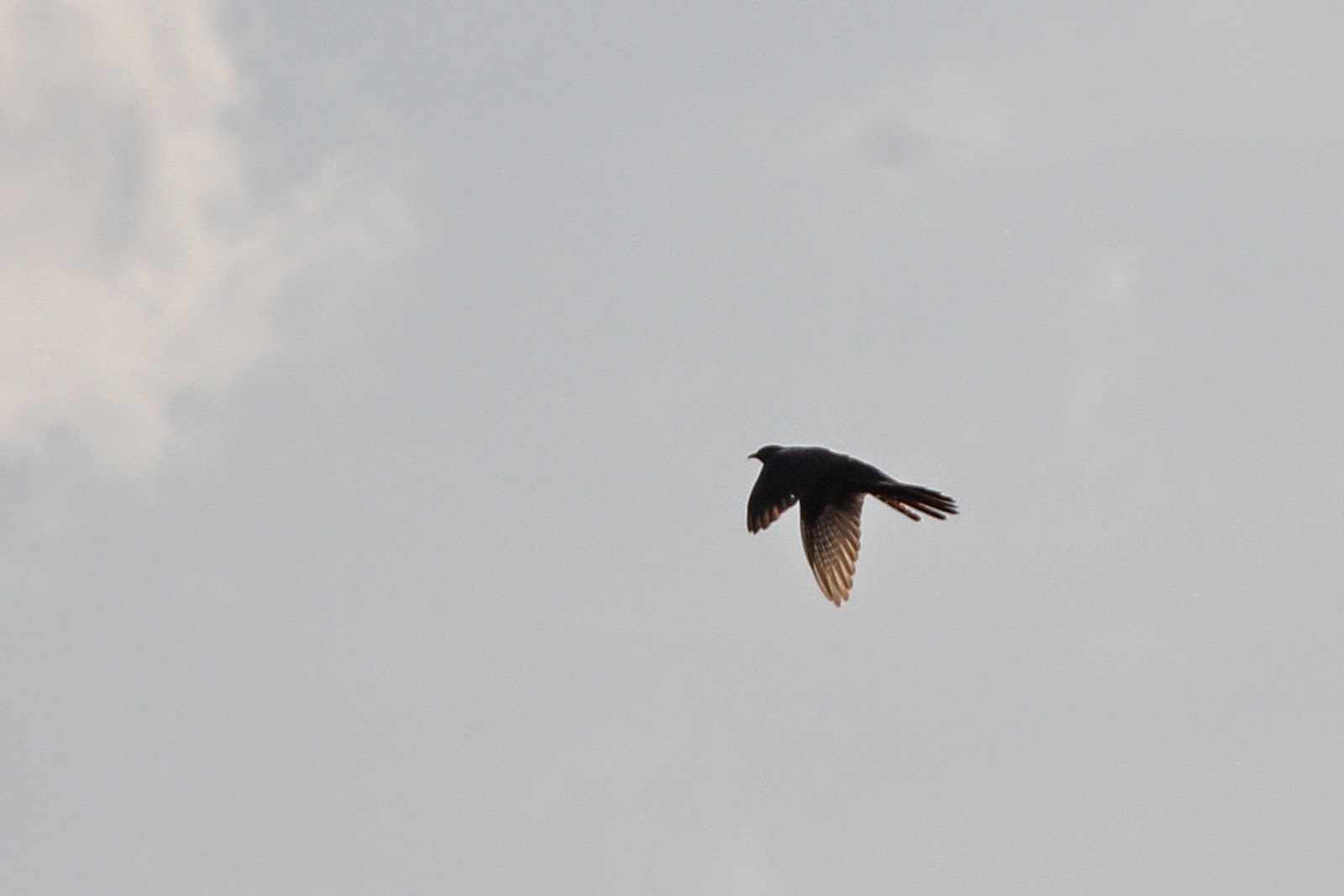
I ran to the bridleway, and walked along it, stopping when the Cuckoo called. As I walked I disturbed plenty of Wood Pigeon, but the Cuckoo was still there. By the volume of the call I knew I was close when suddenly I saw movement in the large oak ahead of me, and out of the branches came the Cuckoo, flying straight at me. I lifted the camera and fired.
not the best, but unmistakeably a Cuckoo. It flew over my head and then away sticking close to the tree line, and calling. I turned back in the hope I could relocate it as it was still calling. As I reached the end of the bridleway I could see a distant shape in a tree on the other side of the field. It was the Cuckoo.
I walked along Lye Way to get a better view, and this is a cropped view.
If you look to about 7 o'clock in the picture you can see a small bird. There were in fact two, and they were repeatedly mobbing the Cuckoo as it sat calling. I am not sure what they were.
After a while the cuckoo decided to move to the next tree, and I caught it as it flew across the gap.
It was there I decided to leave it still calling. This was a bird I have wanted to find and see on the patch above many others. The fact that they have become so rare here is probably due to the lack of the normal birds they use to nest with. We do not have a large Willow Warbler population, and the Meadow Pipits only seem to be present in the winter, although I am sure they are about, but again in low numbers. The Cuckoo has a legendary status in British folklore, letters being written to the Times on first hearing the call, but in many places today the Cuckoo is never if seldom heard, and the traditional sound so much associated with the coming of spring and summer goes unheard.
The swallows continued to fly around me as I left, as if to say don't forget me, so I photographed one on a wire.
I then turned for home, and when I reached the turn for Kitwood I heard the Cuckoo again, but close. I looked back and there it was sitting in the same spot I had just photographed the swallow on. I crept closer once again, and managed to get probably the best photograph of the lot, but it isn't fantastic, but it does record the event, my first Cuckoo here.
I walked down the lane and stopped when I thought I heard a Garden Warbler singing. However it turned out to be a male Blackcap. Garden Warblers will be about, and once I hear it I will know it is one, but there will probably be a few more of these mistakes. The Blackcap made sure I could see it to confirm my error.
A little further on, and two brown blobs in the field got my pulse racing again, they couldn't be Dotterel could they, but no they weren't they were just a brace of Red-legged Partridges.
I headed past the school on my way back home pleased once again with an evening walk. Why Cuckoos have declined is a mystery, it may be due to problems in the wintering grounds, it may also be due to the drop in the numbers of caterpillars the young need to feed on, and as with other late migrants such as the Turtle Dove or Spotted Flycatcher, a shift forward in spring may be putting the birds "out of sync" with their food supply. The BTO has a current project where a selection of Cuckoos are tracked as they migrate back to Africa, this is increasing our understanding of what these birds face as they leave the UK, but fixing these problems remains a huge, if nye on impossible task.
As a youngster I remember hearing Cuckoos all the time, so much a part of my walks across South Oxford. As I walked past Four Marks School I doubted if any of the pupils there had even heard a Cuckoo let alone seen one. The cuckoos place as the quintessential sign of the coming of spring is at risk, even I have referred to other species being the sign for me. All we will be left with soon will be a set of old rural stories and sayings growing less and less relevant every year.
A big surprise on Friday morning as I lay in bed looking out of the window. What I thought was a slim Wood Pigeon flying towards the window set off alarm calls from the resident birds, and as it came closer and eventually flew over the house, I could see the unmistakeable moustache of a Peregrine. It was over so quickly, and I wonder if the local birds survived.
After a Good Friday of cleaning up the garden, we set off for a walk this morning. Heading down Lymington Bottom the birds were in full song, and turning up Brislands I saw a brief glimpse of a brown bird down by the new fence put up around the construction site. I waited and it turned and I could see a beautiful Song Thrush, a treat to get so close as they are usually shy birds.
We carried on along Brislands, a Blackcap was singing in the trees and we stopped to try and locate it, finally we found it singing at the top of the Oak tree.
A little further on we stopped by the rhododendrons, to see if the Firecrests were about. I could hear the male singing and we managed to lure the male out of the cover, but it was very busy moving about all the time and never stopping to pose. When I finally managed to get some pictures I realised it was of the female, which was nice as I haven't been able to get good views of her up to now.
The orange on the crown is not as vivid as in the male, but does not take from this lovely little bird.
We left them with the male singing and headed toward the wood. The Ash tree which over the last two years has been the site of battles between a nuthatch and Great Spotted Woodpecker pair once again seems to be the site of a proposed nest hole.
This hole is behind the original hole, that last year had a huge bracket fungus under it. This looks like the work of a Great Spotted Woodpecker, I do not see a Nuthatch having the ability to chisel the wood like this.
Out in the open there were Skylarks singing on either side of us. I counted at least four pairs either in the air or just taking off.
The Bluebells have moved on from Tuesday, and are looking a little more advanced.
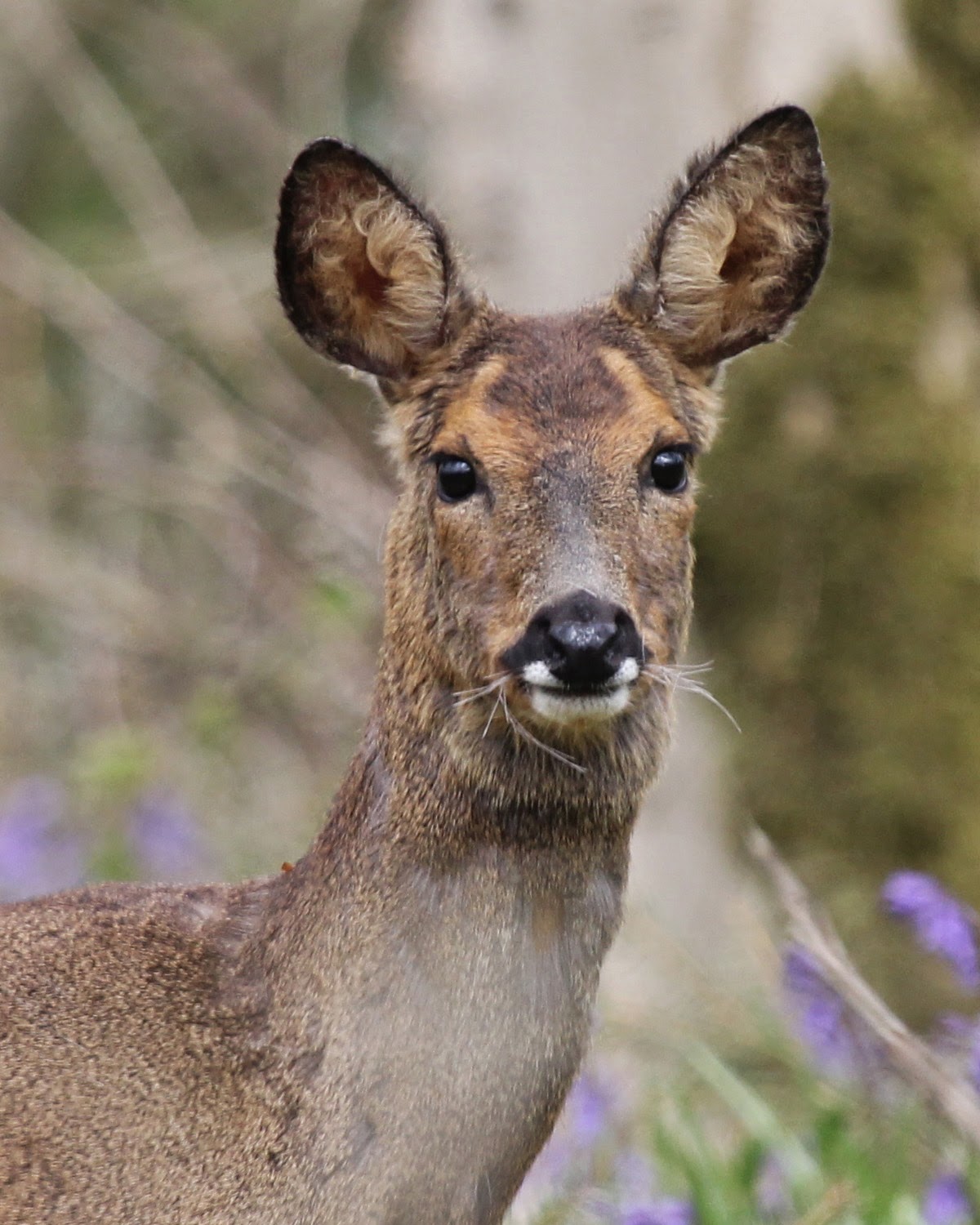
A party of walkers walking through the wood made us change our planned route, so we made our way across the cleared area to the south perimeter path. The walkers must have disturbed a Roe Deer as it came crashing past us. When we finally reached the main path we came across a pair of Roe Deer. They both stood and watched us, and I was able to get a lovely portrait picture. They are a lovely deer, with quite delicate markings around the face.
The Bluebells here are developed well too, and the sun on the Dog Mercury highlights the blue.
We walked down through the paddocks. There seems to be more lambs than earlier in the week, but they were all sleeping, and it was quite quiet. As we walked down towards Andrews Lane several Swallows past us heading north, in fact there was a general trickle of Swallows north all day.
On Andrews Lane I stopped at the gate as usual, but could only find this female Blackbird searching for food amongst the dandelions and daisies.
The Shire paddocks were back to normal, with only a Magpie on the grass, heading up the lane it was very quiet, so we turned our attention to the verge and the flowers. Helen pointed out this Vetch, the first for the year.
It was as quiet at the top of the lane and as we walked along the path by the edge of the field. No butterflies or any bird song, very unusual, but then there was a keen north easterly wind and the sun was stuck behind the clouds.
The Horse Chestnut are just coming into flower, probably their best time of the year. The candle like flowers give then a majestic look.
We walked along Lye Way where there were more lambs, but like those in the Desmond paddocks they were all mostly sleeping. I checked the hedges but other than goldfinches and Linnets there was nothing. The copse by the farm also only produced a singing wren.
We decided to take the bridleway at Lye Way cottage, but looking back down Lye Way the leaves and blossom produced a lovely scene.
The bridleway was sheltered from the cool wind, and as a result it produced the first butterfly of the day a rather worn Peacock.
The edges of the path were also showing several Bracken fronds emerging, showing that lovely shape as they unwind as they emerge from the ground yet again for another summer.
We turned onto Charlwood and headed towards Plain Farm. As we came out into the field the usual scan produced something, not what I have always hoped for though, but something I haven't seen for awhile, a Hare. It scampered off, but paused to see what we would do.
Shortly after this photograph it was off again following the tractor lines, then it veered off and made its way across the field. The background was a lovely vivid yellow from the rape in the field beyond.
We stopped for coffee, and was accompanied by a Great Tit, Chiffchaff, and Blackcap. Along the footpath past the gorse and bushes it was quiet. This is another of those spots that always look it should have plenty of migrants, it hasn't delivered yet, but I have confidence that it will one day.
At the cottages a Wren sang from the pylon. I managed to catch it as it dropped down. When birds do this they hold their feet up, but do not retract them fully into their body as you can see here.
As we walked down the lane I heard a Whitethroat sing. This is the earliest I have found one on the patch, but it was not prepared for me to capture this with a photograph. I could see it on the hedge, it was gone. It flew up to the wire, but hardly stayed a second. It led me a merry dance and in the end I had to admit defeat, definitely a Whitethroat, but no photograph!
At the barns there is usually a Kestrel, but today it was replaced by a lovely looking Collared Dove.
As we came down the hill towards the grain dryers I noticed a pair of large birds above the field, getting on them I could make out a pair of Ravens. I only managed to get one individual as it soared above me.
At the dryers a Kestrel flew above us, and as we walked along the road towards Kitwood a pair of Buzzards were displaying above the tree tops.
Looking across the edge of the field at the Mountains Plantation there were patches of yellow, closer examination revealed these to be patches of Cowslips, these would be a huge attraction to butterflies, but unfortunately there is no way to get close.
We walked the road to Kitwood and then took the bridleway. This is south facing and was sheltered from the cool breeze. Consequently the butterflies appeared. We saw Orange Tip, Brimstone, Small White and the first Speckled Wood of the year, but none of them stopped and allowed a photograph. We carried on along the bridleway in the hope that one would, but the number of butterflies reduced the closer we got to the road. Needless to say not one obliged.
We walked down past the school and then along Lymington Bottom. A Robin was calling it alarm call, and when I found it in the hedge I could see it was turning its head and looking to the sky. I turned to look in the direction it was looking and found a Sparrowhawk circling above us.
A very keen eye was warning all around that a predator was about. A little further on a Blackbird was rattling out its alarm call, and this turned out to be because of Magpies. The Magpie was clearly aware the Blackbird was protecting something a would fly at the smaller bird. We managed to scare the magpie off, but if there is a nest there it won't give up.
We carried on making our way back home.
Over the last few nights I have had the moth trap out. Thursday night saw quite a few, last night a small amount of the same species. As I have always said this is new to me, and I can spend hours trying to identify them, and in some cases as was indicated this week I get it wrong, so if you know what species I have, or if I have made a mistake please let me know, I am anxious to learn, and it will take a bit of time.
These are the moths I feel confident o have identified correctly
A Nut Tree Tussock
A Muslim Ermine looking like something from Game of Thrones.

These are I am struggling with, so if you are able to identify them please let me know. I think now that this is a Frosted Green
And thanks to Ian this a Spectacle
I will continue to research them, and will update should I find out.
I put the moth trap out last night. There was not much activity but these two were new. This I think is a a dark Clouded Drab.
And this one I can't identify I have now, it is a Waved Umbar
The forecast for Thursday was for it to turn overcast through the day. I was keen to see if I could find butterflies while the weather was sunny so I set off at lunch time when the sun was still out and it was warm.
As I walked along Lymington Bottom I noticed three small birds overhead. At first I thought they were Swallows, but a closer look revealed them to be Sand Martins, another year tick.
As I walked up Brislands I had to avoid the construction trucks that are now frequently moving in and out of the building site. A little further along I heard my first Blackcap song over the sound of the diggers and trucks. I managed to see the Blackcap, but it managed to dodge the camera.
I turned into Gradwell, and paused to watch the Swallows flying around the fields. I walked towards the wood, crossing the field, and then in by the gate. I was greeted by Chiffchaffs and Robin's singing all around me, and every so often I could hear the burst of song from a Wren. The rides are much more open, and bright, and a Small White passed me, not stopping. I then flushed an orange butterfly that settled down again to show it was a Comma. You can see the white comma sign on the under wing.
Butterflies were everywhere, and the majority were Peacocks. This one on a Bluebell for me is a lovely sign of spring.
Another Blackcap was singing, and this time I did manage to find the bird, and it stayed in one place sufficiently for me to get a picture as it emerged from the holly.
I carried on along the path to the crossroads, and walked on across the path to the west. The Bluebells are out, but in patches here as a result of the winter work. Again as with the Bluebells are saw on Tuesday they are about 50% out, but still provide a wonderful show.
A Small White appeared from the brambles, and this time it settled on the wood chippings on the floor. I could only get this one shot as when I walked closer it was off.
With all the wood around the smell and feel of the air is of warmth. Dead wood holds the heat while the sun is out and is an attraction to the insects and butterflies, and who knows maybe reptiles too.
The fallen trees and branches are proving a bonus to one bird. The Wren could be seen and heard everywhere, darting into the undergrowth and perching at the top of the branches to proclaim its territory through its loud song.
I made my way back to the crossroads and headed towards Swellinghill. The cleared area to the west of the path has been planted with saplings, and the area is now covered with the protective plastic tubes.
Looking inside the tubes I could identify oak and hazel saplings, all mixed up with the majority being hazel. There were also a few that I couldn't be sure what they were as there are no leaves yet.
As I came out of the wood past the cottage am Orange Tip flew past me, again not stopping. I walked down the the pond where the banks were all bathed in the mid day sunshine. The only butterflies I saw though were a Peacock and another Comma. On the far bank a pair of Moorhen were engaged in a mock fight, where they would run at each other, and then break off. So engaged in this they were they didn't seem to be bothered buy my presence which is unusual as they normally bolt for the back pool when I so much as lift the camera.
When I turned to leave the pond I noticed that the Peacock butterfly was nectaring on the laurel flowers. I was able to get below it to get this different view of a lovely butterfly.
A Chiffchaff sang as I left and it gave me a fleeting chance at a picture. So far this year they have not been that confiding. I hope one poses nicely before the leaves are fully out.
I walked along the side of the field in the hope that I could disturb some butterflies in the sunshine. The hunch was good as I quickly found this Small Tortoiseshell on a Dandelion.
As I walked on I saw yet another Orange Tip flying towards me. As it came close it was accosted by a Small White, and they flew up in a duel. I thought that was it, but the clash must have taken the effort out of the Orange Tip, as it came back down, and settled on its favourite flower, the Cuckoo Flower.
This is probably my favourite butterfly for a combination of reasons, the delicate orange tips fringed with green, the feisty nature they show when two meet, and above all the fact that it says, spring is here!
I walked back into he wood, and along the main path towards the Brislands exit. Blue Tits were in pairs and feeding on the buds of the trees. Studies have shown that the male Blue Tits with a brighter yellow bellies are more successful in getting a mate. This pair both had quite dull breasts and bellies, but they seemed quite happy together.
The Beech trees are showing the first leaves, and in amongst them are the you birches. Against the dark background and the sunshine the leaves look so delicate.
I walked down Brislands watching a lot of Peacocks and Tortoiseshells on the Dandelions in the roadside verge. As I reached the houses a Nuthatch sang above me in an Ash Tree. I watched and listened and then finally it revealed itself. It was feeding as it sang, and went through all sorts of contortions to peck amongst the lichen.
It amazing how they can hang from the branches.
As I walked past the rhododendrons I heard a Firecrest sing, this was quite pleasing as on the last two visits I have neither heard or seen them. I left it singing.
Magpies were calling from the garden to the left, but as they flew off this Jay appeared briefly in the small tree.
The bird song today has been dominated by that of the Blackcap and the Chiffchaff. The latter could be heard again, but this time in a small cherry tree close to the lane, and not high up. At last a good picture of a 2014 Chiffchaff.
By now the sunshine was becoming watery, the cold front was approaching, its a shame it didn't go through overnight because it may have brought down some good migrants. However today has been very nice, and I was able to get some nice spring photographs.