On Monday evening we flushed a Tawny Owl from a tree on the corner of Gradwell and Brislands while running. It flew off towards Swan Lane.
Overnight we had some snow again, about a couple of centimetres, but before it was light there were Blackbirds everywhere in the garden. I counted at least 12 in the gloom, and they were beginning to position themselves strategically to guard their share of the food.
At about 08.00 it started snowing again, and it became quite heavy, the Blackbirds moved to what pieces of apples were left either in the trees or on the ground. When it stopped snowing I went out and replenished the apples and mixed seed on the feeding tray. I wasn't back indoors for long before the Blackbirds returned, and it was then the garden became a battle ground.
They are always on the look out for any bird, not just Blackbirds getting too close. The first sign of aggression is the fanning on the tail feathers, and then the dropping of the wings. Finally the invader is charged away.
There was one particular female that was larger than the many males, and you could see the bravado of the males fall away when she moved in, and they would let her take over.
While the fighting and chasing was taking place other birds would move in to take advantage, but if the Blackbirds saw them they were chased off as well.
The Blackbirds though were not the only aggressors, the female Blackcap was also very protective of either the fat balls when she was on them, or the apples on the branches.
The Goldfinch numbers have been well down over the last few weeks, but today they were present in very good numbers using all the feeding ports on the seed feeders, and the niger feeders. Greenfinches have been absent as well recently so it was nice to see them also back in the garden.
The House Sparrows came from the hedge to take seed from the feeders and tables, and the Starlings of course would engage in coordinated raids on all the feeders, causing mayhem when they arrived and leaving just as quickly.
The apples were going quickly, and are very popular with all the birds, this piece was bigger than the Blue Tit that was eating it, and it could hide behind it.
The Blue Tits were very wary, and crept about in the middle of the trees, very rarely coming to the top.
A single Coal Tit appeared and performed the usual smash and grab on the seed feeders, they zip in, and then fly off almost immediately. What was unusual was the lack of any Great Tits, I didn't see one all day.
In the afternoon a single Fieldfare flew in but didn't stop. Normally they are the largest bird, and will guard any apple or food source from all comers, this one obviously didn't like what it saw.
The snow was almost gone now, but the sky was clear, and the temperature dropping. At 16:30 the flock of Long-tailed Tits arrived and moved around all the feeders, calling constantly in the gloom. Lets hope they found a warm roosting place for the night.
More snow flurries overnight, but it did not hang about, it was though still very cold with a fresh north wind. Yesterday was much the same, but Ian and I did manage some good birds away from Four Marks, details are here. The morning was taken up with a trip to Basingstoke, but there was time for a walk in the afternoon after we had got back.
As I walked along Lymington Bottom it was quiet, no bird song at all. Turning up Brislands I looked back to the trees to see several Jackdaws perched in the tree, all facing into the north wind.
From Brislands I turned into Gradwell, and headed towatds the horse paddocks, yesterday these were where the thrush flocks were feeding, and I felt there would probably be the same here.
There were a few Blackbirds, and one Song Thrush, a small group of Redwing materialised from the mud, and flew into the trees along side the fence. Once in the tree they just disappeared merging into the branches, can you find them?
I noticed something larger in the paddock further back, a Green Woodpecker. There was a break in the hedge on the other side that was closer so I walked round hoping that the woodpecker would still be there.
It was and it was showing well as it fed amongst the long grass.
As it fed it would continually look around, being out in the open has its dangers.
I headed off into Old Down. I was hoping I might be able to find some Roe Deer, but the first thing I found was a Robin. I scraped away the leaf litter backed away and waited to see if the Robin would drop down to take advantage. However it just sat there looking at the open patch, but never actually went down.
It was extremely quiet in the wood. There would be the odd snatch of a Wren's call, but that was the only sign of life. The only sounds were that of the wind blowing the trees about, and the squeaks and creaks from the trees that rubbed together. As for movement this came from the Larch trees bending in the wind. It really was the depth of winter and everything was fast asleep.
Then I noticed a little bit of movement lower down, a male Roe Deer was scratching its antlers on a twig. The antlers are still covered with velvet, and were probably irritating the deer.
This was what I had hoped to find, and the deer stopped to look at me, and I noticed it was not alone as two others were also staring at me.
Roe Deer antlers grow at a different time to the other deer, starting in December then stop in April or May before falling off in September. The antlers are much softer than bone and grow covered with the velvet which provides the blood source. This velvet is much thicker than other deer, because they have to keep the antlers warm through the winter.
As I approached the main path I noticed green shoots appearing amongst the leaf litter, a sign that while we are in the depth of winter, spring is not that far away, and the Bluebells are just around the corner.
I came out of the wood, and decided to walk up to Lye Way by the path that cuts across the field. Away over the field a large flock of probably Common Gulls were circling.
I flushed two Wrens from the grass as I walked, this one stopped in the hedge.
As I walked I scanned the fields, and noticed something strange sticking up by one of the fences.
Closer inspection revealed what was sticking up were actually ears, and in fact there were two pairs.
As I walked past I looked back and found that they were still watching me. This was probably a female with here yearling, so the yearling will be chased off as the female prepares to give birth to the yearlings sibling.
I walked along Lye Way, and decided to walk out to the fields, I hoped there might be a Hare in the fields, but was more than pleased to find a huge group of Redwing and Fieldfare in the sheep paddock.
This gives you some impression of the numbers, I estimated there was around 800 Redwing, and slightly fewer Fieldfare at around 500. An incredible sight.
I did find a hare, but it was keeping very low in the field. From this picture you can see how difficult it was to find.
I headed back through Lye Way Farm. Where the sheep are being fed on root crops in the field, Common Gulls were feeding with them.
I suspect as the sheep feed they turn over the soil and worms and insect larvae appear, the gulls taking advantage. This now explains the large flocks of gulls circling above the field earlier.
Looking along the line of the hedge between the two fields on the east side of Lye Way, the dull earthy winter colours provide an interesting scene that typifies the season.
As I reached the junction with Kitwood, Great Tits were calling in the tree close to the road. They are wonderful birds and if they were a rarity we would all be enthusing over them, as it is we just pass them by as just another Great Tit.
As I came around the corner at Kitwood I noticed a strange shape on a pole. As is always the way the strange shape turned out to be a bird, and it was looking for its dinner. I moved to a better viewing point, and as I was photographing it, the sun came out and lit up this lovely falcon.
The sun was out, but away to the north the skies were a dark grey, further enhanced by the low inter sunshine. As I walked towards the school I flushed a Buzzard from the tree, it flew out across the field, and then back away from me.
I turned to walk up Gradwell, and noticed some Jackdaws above the trees, behind them I could see two larger birds, I thought they could be geese, but when I got on them with the bins I was amazed.
Yes, two Mute Swans, a patch tick, and one I didn't think I would get. Never have two Mute Swans been greeted with so much joy, I raised my hands and shouted out, Good job there was no one else about, as they would have thought I was mad.
They flew across in front of me, and then I lost them as they flew behind the trees.
I walked home with a big smile again, now I am up to 101 birds, and I didn't expect that today. Now you know why I have titled it what I have!
Garden Watch this weekend but we have been away, you can get the details here. Keep checking back as there will be two posts
Arrived back this afternoon, and took the time to count in the garden, but as is usally the way the birds have decided to stay away. All last week it was busy, but today there has been very few.
The Woodpigeon was here though as you would expect.
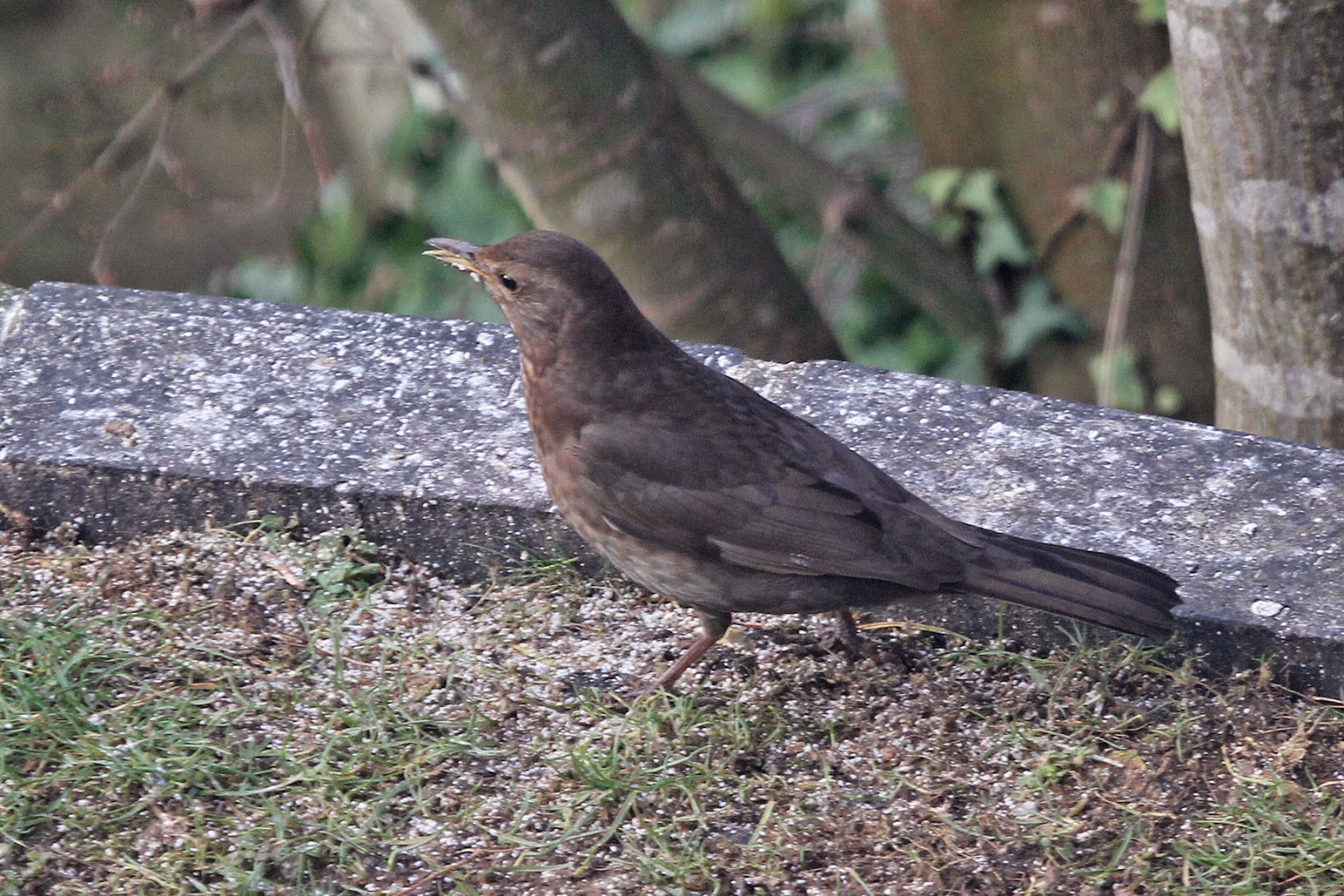
While the female Blackbird was clearing up some of the food dropped from the feeders.
The maximum number of Blue Tits in the period watched was three, a very poor turn out, the apples though were their main attraction.
Three Long-tailed Tits came through, again a very small number compared to the flocks in the teens I had in the week.
A Song Thrush was singing in a tree nearby, and two Robins squared up to each other before one backed down and flew off
So my very poor count for the afternoon was as follows:
Blue Tit - 3
Long-tailed Tit - 3
Blackbird - 4
Song Thrush -1
Woodpigeon - 2
Collared Dove -1
Goldfinch - 2
Greenfinch - 1
Chaffinch -1
House Sparrow - 4
Robin - 2
Starling - 5
Lets hope this is helpful for the RSPB, but for me it was very dissappointing
The start of the week saw clear skies, sunshine and freezing temperatures. While the temperature has increased a little bit today, it was gloomy, damp and probably rfelt even colder despite the slight rise.
As you would expect on a day like this in the middle of January the garden was busy at first light. Our female Blackcap is still monopolising the apples that I have skewered onto the tree branches, and this morning she was tucking in to some welcome sugar energy.
And she was taking some quite sizeable chunks out of the apple.
A little later on I noticed a large bird drifting towards me from my office window, once again it was a Red Kite, not sure what the attraction is around here, but they are now becoming very regular. It came towards me very quickly and I just managed to get the camera out before it disappeared over the house. Yet another poor Red Kite photograph, but at least it is a little better than last Sunday.
Thinking it was going over the house I raced downstairs to see if it would come over the garden, but it was nowhere to be seen. I half expected it to be perched on the apex of the roof, but unfortunately it wasn't to be found anywhere.
There was though a lovely view of a male Bullfinch in a bush a couple of gardens down.
For once out in the open, it was stripping the newly emerging buds on the branches, and then rubbing its bill to clean it. I managed to get a little closer, and also to get a better exposure in what was a very grey and dull day.
Then as if from nowhere the Kite reappeared over what was probably the gardens off Lymington Bottom. This time a little more distant, but of the last three I have taken probably the clearest to show some of the "red" in a Red Kite.
I waited to see if it would come back, but it continued on towards the new development and down along what was probably Brislands.
I turned my attention back to the garden where a small flock of Long-tailed Tits had arrived. Over the last few weeks I have been out in the garden when they have arrived without the camera, and have got very close to them. Today I had the camera, and would you believe it they were a little nervous of me. I stood very still calling to them in re assurance and finally managed to get this one on a branch in the tree.
Another became a little braver and posed for me at the top of the tree.
They made there was around the garden, visiting mainly the fat balls and feeders, and then as quickly as they came they were gone, one leaving first calling out as it left, and then the rest all follow, their long tails flapping as they head away to another food source.
I went back into the warmth of the house. I kept an eye out during the rest of the day for anything else of interest, but it all went quiet as a few showers passed through. Saturday and Sunday is the Garden Bird Watch. I will be taking part on Sunday, and it will be interesting to see what turns up, and in what numbers.
I have been away for most of the week, and missed the storms and high winds. Fortunately there was not much damage locally. Over the weekend the temperatures have dropped significantly, and we have even seen the first real snow of the winter. This seems to be the signal for a regular winter visitor to the garden to turn up.
Creeping through the branches of the trees she has taken up guard around the apples I have skewered onto the the branches, and has defended them from even the advances of the Blackbirds. Once upon a time she would have only been with us through the summer, but nowadays over wintering Blackcaps are getting more and more a common feature of the winter garden.
She sat like a sentinel watching for anyone who dare come too close.
There was rain and sleet during the morning, but this cleared through by midday. I had some jobs to do first thing, and by the time these were finished the sun was out, and despite the cold, it was quite pleasant. A Red Kite drifted very close over the garden, the tail working overtime as it twisted and turned while continually looking down.
We set off for an afternoon walk and as we walked towards Lymington Rise there were two Red Kites over the trees in the distance. This though has to be one of my worst Red Kite photographs.
We headed up Brislands, and then out towards Old Down. It was cold, and quiet as you would expect. Looking across to the north the fields looked a beautiful green in the afternoon sunshine.
By contrast looking to the south, the view was a dirty winter brown.
The field may look empty, but just before I took the picture there was a flock of about 20 Skylark flying low over the stubble, and then dropping out of sight, there must surely be many more all over the field.
A little further on movement in the field caught my eye, and I found a pair of Mistle Thrushes feeding. The pair quickly turned into two pairs.
We carried on down the lane, declining to go through the wood as it would have been very wet and muddy. The hazel alongside the lane were already displaying a good show of Catkins.
Looking back up the lane the sunshine was turning the bare trees and lane a golden colour.
We could hear House Sparrows at the cattle barns but they were tucked away in the hedge, and would only chirp every so often. Apart from them there was nothing else, it was very quiet.
As we walked down the lane Robins and Dunnocks flitted from the hedge to the dirt by the side of the road. At the bottom of the hill a couple of weeks ago there were a couple of Meadow Pipits, today I heard the familiar seep call, and there was one again in the same area, but sitting, today on the grass.
Turning up Court Lane, we stopped at the orchards where they were quite a few birds attracted by the trees and a set of feeders in one of the gardens.
As usual there were Goldfinches looking splendid in the sunshine.
This is a good spot for Bullfinch, and as I thought it I heard the soft piping call. Then a male and two females broke from the trees and flew across the lane to the orchard. They are always secretive birds, and it is almost impossible to get close to them in the open. I could see the male, and I was close, but he was sitting in the middle of the tree.
Once again a flash of crimson pink through many branches.
A male Chaffinch was much more confiding, sitting out in the open.
There was also a pair of Dunnocks, this one being the closest.
A feature of this winter has been the number of Blackbirds about. As we left this afternoon there were eight birds in the garden. As we headed down the road towards Andrews Lane you could see the ivy moving as Blackbirds were stripping the berries from the ivy. They get quite animated as they do this, attacking the bush to tear the berries off.
Gilbert Street was proving to be quite good for birds. In the hedges more House Sparrows chirped away giving away their presence, from the volume I would consider this another good sized colony. Robins sang everywhere, and Great and Blue Tits called from the gardens.
A Rook sat in the sunshine on the overhead wires.
A little further on we came to the Desmond Paddocks, the field lit up by the afternoon sun. In the field was a large flock of Fieldfare, I counted a total of 82 birds, one of the largest winter flocks I have seen. In amongst them were a few Redwing as well.
Some came a little closer, and you can see the characteristic way they hold their wings low from the body. They also have this gorgeous maroon plumage on the back and wing contrasting against the grey blue head, neck and rump.
Head on they have the chest and belly spots of a thrush with a lovely orange brown hue.
There was more activity in the laurel and conifer bushes as we walked up Swelling Hill. Robins everywhere again, and Long-tailed Tits calling in the branches. The Snow drops are now out in full, and looked wonderful in the dappled light.
The walk up the hill is always a slog, and today there was nothing to distract us as walked. We paused briefly at the pond, where the water level is very high, but that was about all we observed.
We headed down towards the school, in the trees above were a few Yellowhammers, and in the stubble field, a Song Thrush, and yet another Mistle Thrush.
We decided to walk along Lymington Bottom, and were immediately rewarded when suddenly the alarm calls rang out, and a Kestrel flew in front of us. The calls though were too late for probably a vole, as the Kestrel held one in its talons as it flew low past us, and then away to a convenient post where it would become an evening snack.
A Great Spotted Woodpecker called, and then flew away across the top of the trees, Long-tailed Tits called as they streamed across the road, and the Starlings were beginning to collect at the top of the trees as the sun began to drop away in the west. The Starlings were joined by a lone Redwing, calling as it flew into the top of the tree.
A typical winter walk, cold and mainly quiet but with enough about to make it interesting.