Winter has returned, overnight the rain has passed through leaving blue skies but a very cold northerly wind. In the garden the feeders were busy, the Goldfinches and Greenfinches dominating them. It was nice to see that the Siskins are still about, a pair have been quite regular through the week, the male looking quite smart in a lovely green and black plumage. Just before I left the house this morning I managed to capture the male in the Amelanchier tree, framed by the blossom that has just started to come out despite the cold weather.
I had the day today to explore, this date is usually when the main influx of summer visitors occurs around the patch, but with the overnight rain, and the cold northerly wind there was a doubt that I might find them today.
As I walked down Lymington Rise I actually saw the Firecrest before I heard it, once again it was in the Ivy.
Tucking myself into the side of the hedge I was able to watch as it moved around the Ivy and the tree.
That one has to be one of the best shots I have taken of this lovely little bird. It seemed unaware or unconcerned of me as it went about singing and feeding.
I walked away with it still singing away, and headed up Brislands Lane, just before the turn to the recreation ground I noticed movement in the hedge, and there was the pinkish red flush of a male Bullfinch. Fortunately it stayed in place as I tried to focus through the branches of the tree.
It wasn't alone, a female was there too, a much drabber looking bird in comparison to the male, but a little easier to focus on.
Then they were off, across the road and I expected them to just disappear as they always do, but the male landed on a branch that was just above the hedge, and posed nicely for me, and stayed there as i took quite a few shots.
A little further on and more movement, this time I thought it must be a Wren as it was low down in the hedge, but what appeared was a warbler, and in keeping with the morning, it too posed well for me.
From the short primaries, and the dark legs this was a Chiffchaff, and just to confirm it flew up into a nearby tree, and started to sing.
From Brislands I turned into Gradwell Lane, and stopped at the stables where there were two Swallows sitting on the fence. It was cold and they were adopting an energy saving approach to hunting insects. They would watch the area around them, and then fly up every so often, chase whatever they had seen, and then return to the fence.
I crossed the field and walked towards Old Down. Over to the right three pigeons flew up, nothing unusual there, but two were smaller and flying differently, as I got on them I could see they were two Stock Doves, the first of the year.
Despite Friday's rain the path was a lot dryer than the last time I had entered the wood here. I decided to take the perimeter path, it would be easier than negotiating the central muddy paths.
Blue and Great Tits called from the edge of the wood, and then this Coal Tit appeared in the branches above me, moving through them searching for insects and small spiders.
The Larches were looking wonderful in the sunshine, with the new leaves a lovely lime green against the blue sky.
I crossed the main path and continued around the perimeter path. Close to Old Down House is always a good spot for Blackcap, and as I approached I could hear one singing in a tree close by.
It really is a beautiful song, maybe overlooked, and it is delivered with considerable volume.
Looking out across the field I could see a male Roe Deer close to the fence. They have been hard to find this year, and I have only managed to get some distant views.
I was walking now towards the West End, the Bluebells here are out in a greater density that elsewhere in the wood, but they still are only about 50% out. The area though did provide some nice scenes.
Like the Firecrests and Red Kites I never tire of photographing the Bluebells.
Absolutely stunning.
All the above shots were taken low down, as this increases the blue. Taken from above you can see what I mean about the coverage only being about 50%.
Coming out of the wood and looking out over the field towards Ropley, the clouds and sunshine were sending patterns across the emerging rape field.
I headed down through the paddocks, checking the hedges for any sign of migrants, but without any luck.
I headed up Andrew Lane with a single Swallow flying around the stables, and from the trees there was a Song Thrush singing, and a Nuthatch calling high above me.
A little further on and it seemed like the place was full of Wrens, they were singing from the hedge, trees and even an old shed.
While the majority would sing from cover or the middle of the hedge, one was quite happy to come out into the open.
With a song as loud as the Wren's it needs an awful lot of effort from such a tiny little bird.
I walked along the top of the lane, past the sheep and lambs. A Chiffchaff sang from the copse, and a Blackcap also put in a brief burst of song.
As I watched the Wrens I heard the unmistakable call of a Cuckoo coming from the woods to the west of me. Leaving the Wrens I walked around the back of the field in the hope of finding it, but I couldn't see it anywhere, or even hear it again.
I walked along Lye Way, and again hoped fro a Wheatear in the field with the lambs but I was again out of luck.
With so many Lambs, and with many being quite young I was not surprised to see a Red Kite drift over. It came across and over me quite low.
Again I couldn't waste the opportunity as it came very close to me, never concerned about me, just looking down at the field.
As this bird settled in a tree at the back of the field, another came in from the west, and then did exactly the same as the other bird.
As I was watching the Kites I could hear Skylarks in the next field, and as the Kite drifted away I decided to see if I could find them. I don't think I have managed to get close to a Skylark on the ground around here, and while this is not brilliant, it is a start.
They drop into a field, and then walk through the crops to the nest, so that they can hide and not give away the location of the nest. As I watched this one it walked off out of sight.
I walked along Lye Way, and just before the turn onto the Bye Way the view looking up Lye Way, was changing into a Spring one.
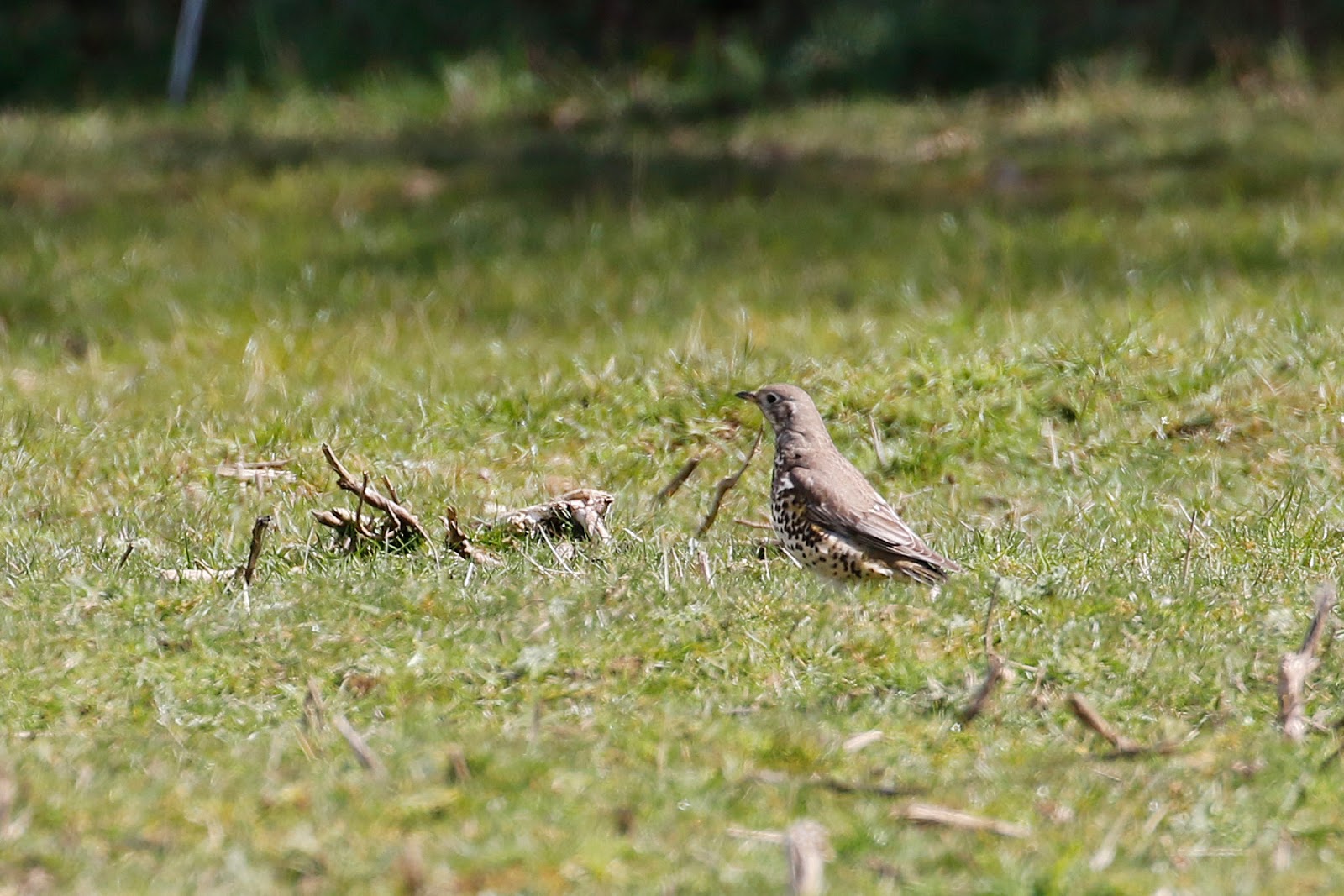
From the Bye Way I turned onto Charlwood, and headed south towards the path into Plain Farm. Where the sheep have been grazing the grass was quite short and this was providing good feeding for a Mistle Thrush.
There were also plenty of Blackbirds feeding, and this lovely Song Thrush.
For once the walk along the lane through the farm turned up very little, a Pied Wagtail at the barns, ad plenty of Linnets and Chaffinches being the only birds of note. Looking across the fields the crops and spring sunshine created a scene of definite contrasting colours.
As I walked down the hill towards the main road two birds flew across in front of me, one sitting up in the hedge. At firs I thought they might be juvenile Great Tits, but on a closer look I could just see that they were Coal Tits, looking at the picture you can see there is a look of Great Tit about it.
I walked up the hill past the quarry, and then across the field to the pond. Looking into the Plantation, the leaves of the Silver Birch were being picked out by the sunshine.
At the pond with the attraction of the water, this is a good spot for migrants, and I could see warblers at the back of the pond. As I watched and waited for them to appear I could sight of a white butterfly coming over the water. It wasn't just white there were orange tips to the wings.
On a really cold day as today (when the sun went in I had to put a hat and gloves on, only to take them off when the sun came out again!) I had not expected to see any butterflies, let alone the first Orange Tip of the year.
The underwing is as spectacular as the vibrant orange tips.
The Orange Tip flew off, and I returned to the trees in search of the warblers. They appeared and I could see that these were in fact Willow Warblers.
It was decision time now, do I go through the estate, or head down the hill and back along Lye Way again. I decided on heading to Lye Way. I stopped half way along and sat on a log to eat my lunch. While sitting there Goldcrests called around me, a Buzzard drifted over and a Raven announced itself with a "gronk" as it flew across the field.
As the Raven flew away I noticed two Brown Hares at the far side of the field.
I t was back to the sheep in the fields around Lye Way farm, but there was still no Wheatear unfortunately. As I said early a lot of the lambs are very young. This one though looked like it had just been born, there was no number sprayed on it, and there was still signs of the umbilical cord. Welcome to the world little one.
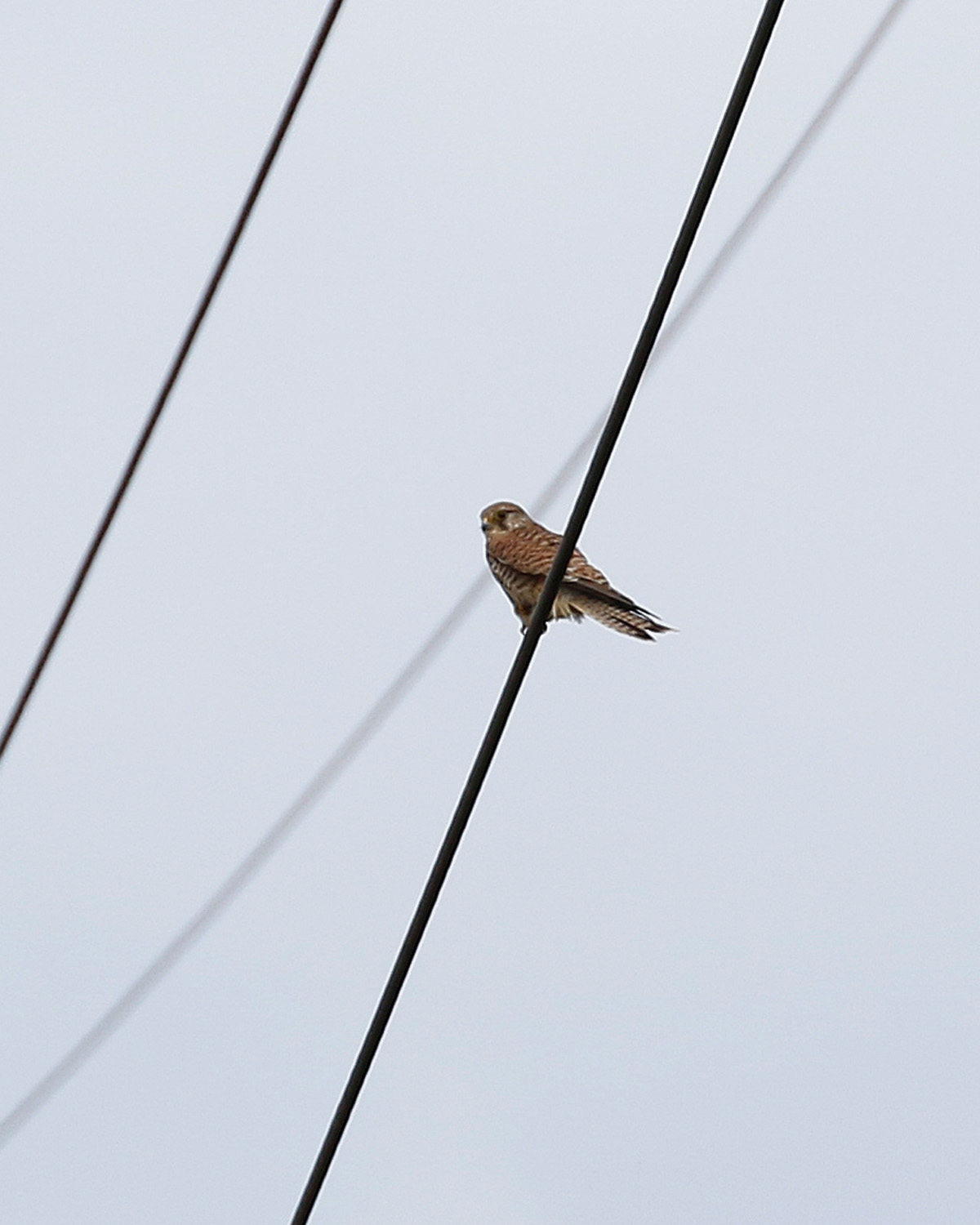
From Lye Way I walked alongside the field heading towards Swelling Hill. A female Kestrel flew from a tree, sending out alarm calls from the song birds. It flew around the trees, and then out across the field and up onto the power lines.
A little further on I disturbed another Kestrel, this times a male, it headed in the opposite direction towards Andrew Lane.
I walked around Swelling Hill Pond where there was nothing about at all, and then through Old Down Wood where there seemed to be Robins everywhere. I came out of the wood onto Brislands Land and across the field yet another Red Kite was drifting east towards the village. From the feathers in the wings this looks like a different bird to those I saw on Lye Way
As I walked along Brislands another warbler flew up in front of me. At first I thought is was a Willow Warbler, but then it sang, and it could only be a Chiffchaff.
In the paddock opposite the recreation ground there were a lot of Blackbirds feeding, and this one male Pied Wagtail.
I made my way home, the weather as I suspected had conspired to block anything unusual turning up. I still haven't found any Whitethroats, they are usually here by now, but there hasn't been any sign of them. Still I have managed to get some wonderful pictures today, and to hear Cuckoo, and find an early Orange Tip for around here, it wasn't too bad a day.
Now I was off to meet the newest arrival to the family...Meet Boycie
As a postscript to Saturdays sightings. On Sunday morning while painting the fence in the garden, suddenly the Starlings got all upset, and started calling along withe Robins and Blue Tits. Looking up there was a Peregrine drifting over the house. A little later a Red Kite was being mobbed by a Rook. Not bad for garden birds!
The cold weather of the weekend slowly moved away, and the temperatures warmed slightly through Monday despite the overcast conditions. Today started overcast but slowly the clouds broke up and the sun appeared and by the middle of the afternoon it was clear blue skies, perfect for the late afternoon walk. There had been quite a bit of bird activity on the south coast, with good numbers of common migrants arriving in conditions not recognised to produce a fall of migrants. As always I was hopeful, but at the same time resigned to the fact that the prime arrival time for migrants in Four Marks is usually around the 23rd to the 25th of the month.
Nevertheless I set off from the house in the sunshine determined that I would find something of interest. I had only gone about 50 yards when a burst of song told me that I had found something. In an oak tree covered in ivy a Firecrest was singing. I waited and in no time the bird appeared.
This is now the seventh location that I have managed to find a singing Firecrest, they seem to be spreading, and numbers increasing around the patch.
I can't say that I am disappointed.
I never tire of seeing and watching them, and absolute gem of a bird.
Leaving the Firecrest I walked along Lymington Bottom with plenty of Robins and Blackbirds singing. Walking up Brislands I found this male Blackbird singing while carrying worms. I would imagine that the young have hatched and he has to feed them, but hasn't quite got out of the "singing to declare his territory while the female sits on the nest" habit.
As I came out into the open, with fields on both sides, Skylarks were singing in the sky above the fields. The crops are now growing and seeing anything in them is now difficult. The hope was that there could be Wheatear about but there was no chance of any in the surrounding fields.
On the main path into Old Down I counted eight singing Robins, and several could be seen feeding on the path. I took the perimeter path around the north side of the wood, the path winding through this year's Bluebells. The recent cold weather has probably held them back, and i estimated that they were currently at about 50% coverage.
Once again it was that time of year to take the photographs of the lovely blue haze amongst the soft grey of the Hazel branches.
the sunshine and shadows adding to this iconic spring woodland scene.
In the distance I could hear Chiffchaffs singing, and there was the quick burst of a singing Blackcap, the first unusually of the year. For the last four years I have had a pair of Blackcaps visiting the garden during the winter, but the winter just passed there has been none. They have also been late arriving on the patch, this singing bird today being the first for the year, and about 10 days later than any singing bird over the last five years.
With these summer visitors singing away in the background the main chorus was provided by the Wrens. Every so often one would appear and burst out a song, and then chase off any other Wren that came to close.
With the forestry work over the last few years, and the fallen branches and trees the Wrens seem to have thrived, and their numbers in Old Down have definitely increased.
This bird was being wound up by another singing quite close, and in what I can only consider was an act of aggression it turned its back to the singer and waggled its tail in an upright position before flying off.
As I watched the Wren a Blackcap burst into song close by, and there was movement in a tree above me of a bird with a black head, but it turned out to be a Marsh Tit.
i carried on through the Bluebells and stopped to see if there was any sign yet of the Early Purple Orchids, but I couldn't find them. As I reached the edge of the wood there was a large flock of mixed finches flying over the tree top, the calls were mixed up and I thought I heard Redpoll, but as I came out of the wood to check the trees on the edge all I could find were Yellowhammer and Linnet.
There were about 30 Yellowhammers and quite a few more Linnets. They were coming off the ploughed field into the trees as I walked around the wood to get a better view. There was no sign or sound any more of any Redpoll, and I doubt there had been any, the behaviour just didn't fit with them.
As I walked towards the paddocks there were butterflies on the dry soil. This is always a good spot for butterflies when the sun is out as it is sheltered and in the afternoon facing the sun. First was a Peacock resting on a fallen branch.
Then a Small Tortoiseshell taken from an interesting angle.
I walked alongside the hedge at the top of the paddocks. A Blue Tit was fly catching from the top of the bushes, but more interesting was a bird in the hedge that was dropping to the ground and then back. I have seen Redstart here, and as I watched a flash of red raised my hopes, only for it to turn out to be close relative, the Robin.
As I walked back to the path Yellowhammer called from the top of the hedge.
Crossing into the next field I checked the hedge at the top of the field but with the same results only a Robin. As I walked past the rabbit warren a warbler called from the Blackthorn. The call was different to the familiar one the Chiffchaff has, and I stopped to see if it would appear and it did.
Pinkish legs and relatively long wings meant that this was a Willow Warbler, and it was feeding on the small insects attracted by the blossom of the Blackthorn.
Willow Warblers are not a common bid around the patch. Typically there are one or two singing birds a year, but mostly around the Plain Farm area where there are youngish trees in plantations. Last year struggled to find one until late June. The fall I referred to along the south coast today was dominated by Willow Warblers so I could assume this was a passage bird passing through.
It gave some of the best views I have had of Willow Warbler here on the patch.
From the paddocks I crossed the road and headed up Andrews Lane. Over the horse stables there were at least six Swallows flying around.
One settling on the wires and conducting some evening yoga poses.
Where the lane is sided by hedges the birds became quite numerous. Goldfinches and Chaffinches in the trees, Wrens singing from within the hedge and Blue Tits and Great Tits in the branches and on the hedge.
As I walked up the hill I pushed them all along in front of me and as I reached the last house I stopped to check the field and the surrounding hedges without anything unusual being found.
At the top of the hill a Willow Warbler burst into song, but as I searched the tree I didn't find the owner of the song, but a male Blackcap feeding around the tree's blossom.
The Willow Warbler was on the other side of the tree, and there was at least two feeding high up, confirming my thoughts that we were witnessing a passage of these warblers, as we never get three birds in the same location at any other time.
in the field at the top of the hill I was confronted once again with the bleats of lambs. It would seem that these recently born as they were smaller and younger than those I had seen previously, the earlier lambs having been moved on to pastures new. These lambs did not seem to concerned by me being close so I took the chance for some more pictures.
These two seem to be in conversations as they lie in the warm evening sunshine.
The copse at the top of the path is normally a good location to find warblers but it was quiet, and I walked around to Lye Way to look for Wheatear but again there was nothing there, so I headed back through Lye Way Farm, and then down towards Kitwood. Yellowhammer were singing on the telegraph posts, but a little further I was able to capture one singing in a more natural location.
The Red-legged Partridges were still in the field opposite to the school. One pair were visible on the horizon, but closer to the road were three, two of which were clearly a pair or it was a male with two females. The one at the back looks a little shifty to me!
As I reached the crossroads I noticed colour in the tree above Alton Lane, and it turned out to be the male Kestrel once again.
Same tree, probably the same bird as previously, I would assume a nest nearby. We shall have to wait and see. Last year I found three Kestrel nests, and not in this area so this could be good news for the local population.
I walked home to the chorus of Blackbird, Robin, Chaffinch and Greenfinch around me. It might not be in the same magnitude as the south coast falls, but I think I can safely say I have been able to record some migrant passage today. It would have been nice to get a Redstart, but there is still plenty of time.
Probably one of the warmest days of the year so far and we escaped the sunshine setting off those annoying April showers. As a result I set off to Plain farm for the late afternoon, but before I left a male Brimstone flew through the garden.
As I parked at the bottom of the hill, I noticed patches of yellow in the grass on the field opposite, the Cowslips were out in force here.
I walked up the path towards the pond, where there were Chaffinches and Blue Tits but no sight or sound of the hoped for Warblers. As I turned to walk to the barn two Peacock butterflies came off the wall, and flew around the grass, one settling on the ground to show off the wonderful markings and colour, they are a truly beautiful butterfly but suffer for being so common almost throughout the summer here in the UK.
Then suddenly two smaller orange butterflies flew past and caused absolute mayhem. The Small Tortoiseshells seemed to upset the Peacocks and they just chased after the smaller butterfly, but it seemed to be the tortoiseshells that came off better, the Peacocks leaving the sun trap, and the Small Tortoiseshells taking over as they settled in the sunshine on the grass.
I left the barn and headed down the footpath towards the quarry, a single Chiffchaff sang from the Mountains Plantation, its song coming through the many singing Blackbirds. At the quarry I walked around the top and looked down. Another Chiffchaff was singing along with a distant Nuthatch and a Wren every so often. I watched a Long-tailed Tit collecting the remains of an Old-man's beard, and around my feet a White-tailed Bumble Bee queen was searching the small purple flowers for nectar.
From the quarry I crossed the road, and stopped to watch two Brown hares in the field. From their behaviour I would think these were young leveretts just away from the parent, probably siblings they seemed to be exploring the field.
i had seen a Red-legged Partridge and tried to get closer using the hedge as cover, but when I peered over it was gone, and above me could have been the reason for its disappearance as a Sparrowhawk glided past me.
There was no sign of any swallows around the farm buildings, in fact the only birds about was a male Chaffinch and the usual chirping House Sparrows. I stopped to catch up with the gamekeeper, and he informed me that there has not been any sign of the Barn Owls locally this winter which was a little disappointing. I did though get some more information that could be interesting as we move into spring and summer.
Walking up the hill and past the workshops the tree in the middle of the field dominates the view, the stark bare branches against the pale blue sky an indicator that we still have some way to go before we can claim spring is truly here.
i checked the fields as i always do, but the only bird to report was a rather handsome male Pheasant in amongst the rapeseed in the field to the south of the lane.
The hedge seemed to be full of mainly House Sparrows although I could hear the song of a Yellowhammer. i looked for the Yellowhammer on the wires but the only bird present there was this Linnet.
Pairs of Linnet could be seen and heard flying around, and dropping down into the fields.
In the trees by the cottages at the end of the lane another Chiffchaff was singing, and for the first time this year I was successful in getting some reasonable views and as a result some photographs.
By the way it was shaking itself and preening I think it must have just had a bath in one of the many puddles. In between shakes it would reel off a few lines of song, before resorting to the contact call.
From the cottages I walked down the lane, it was very wet and muddy and as i walked I pushed a large flock of Yellowhammers and a few Chaffinches ahead of me, from within the bushes yet another Chiffchaff sang.
Along the lane the Gorse was in flower. Gorse is a very opportunistic plant, flowering almost immediately the temperature warms up and the sun comes out. This is why you almost see it flowering all year long.
i made my way through a very sticky, muddy field, and out onto Charlwood. As i walked along the lane the bleats of the now much older looking lambs could be heard from the field on my right. I stopped at the junction with the bridleway to scan the fields, and as i did so I was almost dive bombed by the first Swallow of the summer on the patch.
Just as the Swallow appeared a pair of lapwing went into display in the distance over the field, their calls alerting them to me. I watched the Lapwing to see if they would come close but they kept their distance. Returning to the Swallow it was winding low over the field, winding in and out of the sheep. Very soon one became two Swallows, and then as I walked towards the house two became three, four, five and six. I could hear them twittering as they flew around the house, and came low over the horse paddocks.
If you have been reading the "Away Blog" from Portugal you will know that I just can't resist trying to perfect my photography of hirundines in flight so of course I settled in to try with these newly arrived Swallows. This one of quite a few attempts was not too bad.
Obviously the exertions of migration and the evening search for food took its toll and one had decided to rest on the overhead cables and that provided the easier opportunity to capture a new arrival.
I left the Swallows and carried on back towards the car. Yellowhammers sang away in the distance and I watched pairs of Buzzards over the woods in full looping display flight. All around I could hear the songs of the resident birds, Blackbird, Robin, Great Tit and Wren, and every so often the quick snatch of a Chiffchaff high at the top of the Beech trees.
i returned too the car and drove along Lye Way in the hope that there might be a Wheatear in the fields but I couldn't find anything. So far the two new arrivals were Swallow and Chiffchaff. I had hoped there would at least have been a singing Blackcap, they are late this year. If the warm weather continues for the next few days then I am sure they will arrive. But for now I will just have to be content with the Swallows, but remember six do not make a summer!