Monday, 11 April 2016

10th April - I'm Gonna Call Up Some Of My Buddies

The weekend has been quite dismal, Saturday was all about April showers and a cold wind, today was about sunshine but still with that cold wind.  All this was a long way from the time we had in Portugal, the details of which you can see here.  But its that time of year again, the time when Red-legged Partridges decide they want to become a garden bird, and not a bird of fields and farmland.  Looking out of my office window over the weekend I was amazed to see two of these dumpy birds walking nonchalantly along the roof of my neighbour's house.  Unfortunately by the time I could get the camera one had dropped off, leaving the other to perform acrobatics by standing on one leg.  I don't know what the attraction is of the gardens to them at this time of year, but over the last five years they have turned up like clockwork, I can only think that in pairs they are looking for a suitable nesting site. 


Lots of things about in the county over the weekend, so this afternoon after a family event I wondered this afternoon if there might be something about in Four Marks.  There was a decision to be made though, the weather wasn't inspiring and it was Tottenham v Man Utd on the television, then the news came in that the kick ff had been delayed so I set off to see if I could find something.  As I headed down Brislands I could see dark clouds gathering in the west, I wasn't going to be out for too long.

No Chiffchaffs singing along Brislands as I walked towards Old Down, but at the back of the field a female Roe Deer was grazing.


The daffodils are now wilting, and the Lesser Celandines look a little sad, but there was another yellow flower appearing in the verge, a small clump of Cowslips the first for the year.


As I came out into the open fields along Brislands I could see that the wild flowers were also beginning to show here.  There is always a good show around this time of year before the bracken grows too high and covers everything.

Along with the sad Celandines, Wood Anemones have now burst into flower.  They love the sun, the petals staying closed when its overcast.  This afternoon there was some watery sunshine and they were all in flower, petals open pointing towards the sun.


One interesting feature of the wood anemones is that Brislands Lane runs east to west with a hedge on either side, you can only find the significant clumps of Wood Anemone on the north side of the lane, this is where the sunshine gets.

I walked into Old Dow in almost silence, except for the odd burst of Wren there was no bird song, this was not a good sign.  Most of the trees are still to show their true colours, the leaves only just beginning to bud, however one Silver Birch for some reason was different to the rest showing a profusion of golden green leaves.


From the crossroads I headed to wards the cottage entrance and could hear what  I thought was a strange Blackbird song, you could hear the blackbird notes but they were not necessarily in the right order.  I scanned the trees because I knew it had to be a thrush of sorts somewhere.

I found it tucked away in the middle of a large Beech Tree.  It was a Mistle Thrush, first time I had found one singing here.  Sometimes known as a Storm Cock due to their habit of singing just before and during rain storms, this was not a good sign.


The path was quite muddy as I headed towards the style.  Once again I could see the ploughed field right to the edge and I inwardly moaned.  This was the site of the Blues and Brown Argus last year, I had hoped that they would return this year.  The are is always wet, and sheltered by the surrounding trees so it may not cultivate well, we shall have to see.  As I passed by though I was surprised to see the Mallard pair appear and then slowly walk away from me.  Like the Partridges they seem to get  lost at this time of year.


A Chiffchaff was singing in the Willow trees at the pond, but eluded me once again as I tried to get a photograph.  There was nothing on the water, and there was no sign of any Toad Spawn, maybe the erection of the sign to warn motorists has scared them all away, or just maybe breeding here has failed and they are just not returning.

A sign of spring though at the point  was the emerging Iris leaves, they all look a lovely lime-green at this stage.

From the high Beech trees surrounding the pond a Great Spotted Woodpecker called.  This is a good site for them, and you can either hear them drumming or calling from the trees, and they have nested here for several years.  I finally managed to find the owner of the call, but had to look through plenty of branches to get a view of the red vent feathers.


All the resident finches are now moving around in pairs.  Greenfinches are performing their fluttering display flights which make you think it could be a House Martin, and Goldfinches fly around together with their jingling calls, while Bullfinches hide in amongst the branches, their piping calls the only sign they are there.

Chaffinches are the most  approachable, the males singing from prominent positions while the drabber females skulk though the hedgerows.


As i came down Kitwood lane past the school I saw what  at first dismissed as a Woodpigeon fly up into a tree at the bottom of Alton Lane.  But then a series of alarm calls went out and I decided it might be worth a closer look, and was pleased to find a male Kestrel sitting on one of the branches.
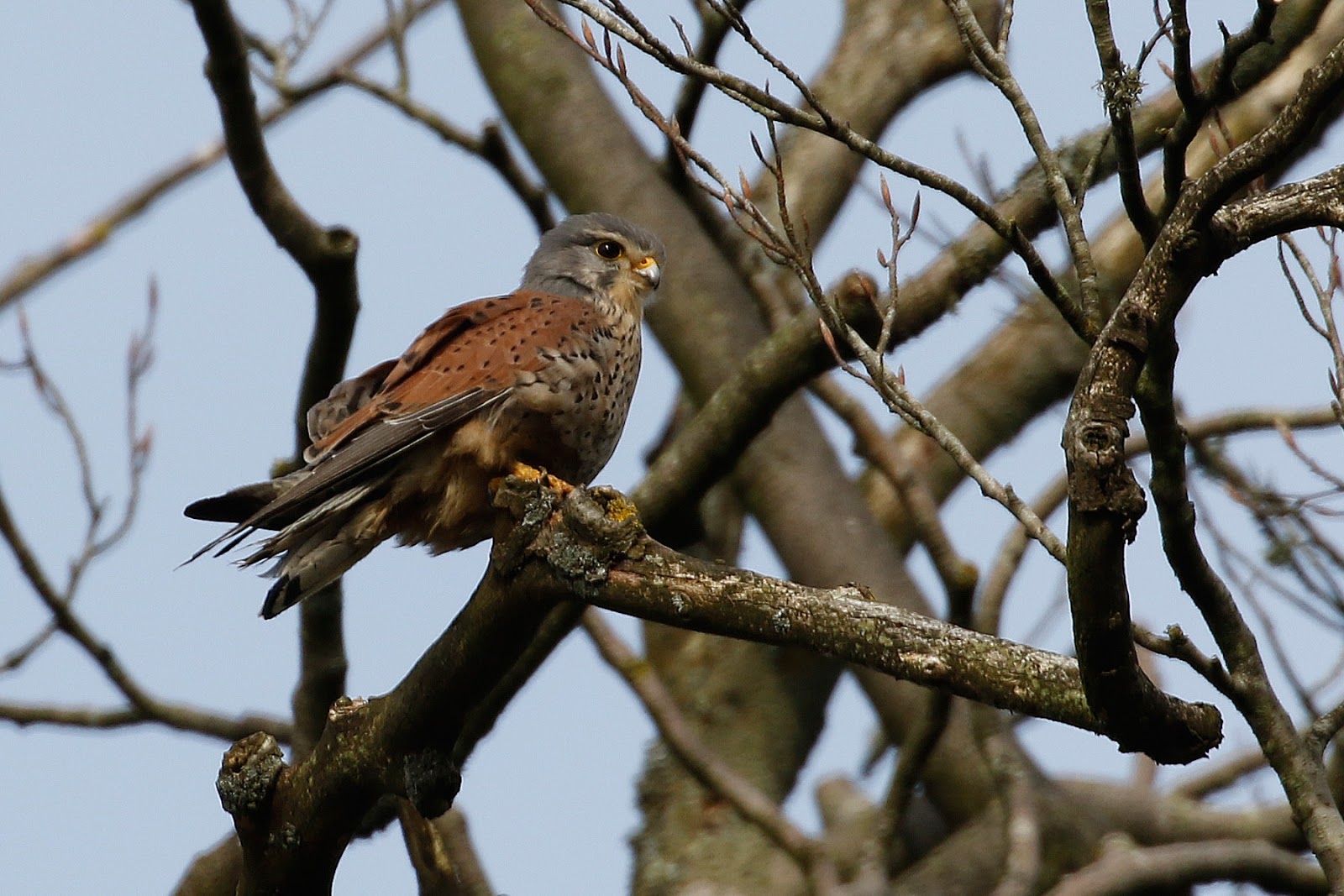


I always love to see these falcons, a strong reminder of my child hood when they were the countries commonest bird of prey.

On a similar topic, when I stopped to find a calling Chiffchaff more alarm calls started up, and above me the current commonest British bird of prey appeared above me, in fact there were two, and they were displaying, the male soaring upwards and then diving down and clasping talons as they tumbled in the air.


I did mange to find the Chiffchaff, but again it flew off, I have not had much luck this year so far.  The Chiffchaff though appears to be the only summer migrant that has arrived in Four Marks.  I have not heard any Blackcaps singing, they are late this year, and there has been no sign of any hirundines.  The northerly winds probably being responsible for holding up any mass movement through the country.

This time last  year a lone Swallow had arrived along Gradwell and had to wait 10 days before it was joined by others.  It would seem that it has learnt its lesson and that it is staying with its friends this year.

I walked home with the dark grey clouds approaching closer.  The forecast is for it to be warmer through the week, with the winds going round to the south so lets hopew that has some influence on things.

Wednesday, 6 April 2016

5th April - Spring Can Really Hang You Up The Most

We have been away for the week after Easter, our travels taking us this time to the south west of Portugal and seven days walking between from the south to north west coast through some wonderful scenery and villages.  as always there will be details later on my other blog as I process the images.

While the weather was not as conducive to that which we have been used to over the past week, this afternoon saw the showers drift away and the end of the evening was bathed in sunshine despite a fresh breeze.  With the longer evening light now it was the perfect opportunity to get out around the patch in the hope of finding some early arrivals.  Spring does not suddenly arrive here in Four Marks, while areas south of here can enjoy sightings on hirundines, leaf warblers and wheatears it takes a while for them to settle in to their breeding areas, or just move through.  As I walked along Brislands Lane though I could hear at least three Chiffchaffs singing in the surrounding bare trees, but could not locate them at all.  Another bird singing was not so elusive, 


This male Chaffinch out in the opening delivering its familiar song, it has been described as similar to a bowler in cricket approaching the wicket and then in a flash a quick delivery.  If you get the chance listen to it and you may see exactly what is meant.


I turned into Gradwell and then took the footpath out towards Old Down.  Just before we left for our holiday the fields were being tilled and then seeded, and as I came out onto the field they looked neat, but I also noticed that the footpath was a little narrower.  As the path crosses the field to the wood I looked towards Brislands and could see that the farmer has now decided to do away with leaving ground along the edge of the field, ploughing and seeding right up to the edge of the hedge.  This was the case all the way around the field.


Here is another part of the village eroding away, not only do we have the meadows being lost to housing developments, the fields are becoming fortresses with gates and barbed wire surrounding them, hedgerows ripped out, and the valuable wildlife areas around the edge being ploughed under, removing the chance for flowers and seeds to grow to feed farmland birds and animals.  While we were walking in Portugal we passed fields with cereal crops with wild flowers growing amongst them, the hedgerows were full of flowers, and Corn and Cirl Buntings were singing everywhere.  A scene now lost to the British countryside, and most definitely here in Four Marks, it is very sad, slowly the area around the patch is becoming very sterile, I have seen the changes in the short amount of time I have been writing this blog.  In five years we have lost many fields and plots to more housing, and now the wildlife strips around the fields are going too.

As I crossed the field I heard the call of a Buzzard and saw two drifting towards the wood.  Coming up very fast behind them was a Rook that had probably been feeding in the field, it chased off the first bird then turned on the second.


The mobbing activity of the corvids can be very agressive, and I always find it amazing that the bird of prey takes no chances with the aggressor, making no attempt to truly fight back but looks to avoid any contact.  The risk is very high that they may become injured, and as a result unable to hunt and survive.  This Buzzard twisted away and then finally managed sufficient speed to escape to its partner in the wood.


I walked into the wood with the sound of more Chiffchaffs singing, in total I counted eleven birds singing within the wood.  I managed to find at least three of these songsters, but failed to photograph any.

I took the main path towards the west through the wood, in places the path was wet and muddy, but the recent rain was not enough to save a lot of the frog spawn.

In the area around the beech trees with the ring of wild Daffodils my feelings of concern about how the countryside is being abused rose once again.  It looks as if a trial bike has used the area to do stunts with all the Bluebell shoots cut up and mashed up, and worst of all, the Daffodil flowers all cut down and lying broken up.

I walked on, and the mood brightened a little as I came across the first significant clump of Bluebells of the season.


No doubt this will be the first of many photographs as the season progresses.

As well as the Bluebells there was also the first flowering Wood Anemones, a delicate flower that can be seen from late march until May, when the canopy becomes to dense to allow the light they thrive on.  The flower heads turn to towards the sun, and are almost translucent with feint pink veins.


I came out of the wood and then made my way down through the Desmond Paddocks.  In the field to my left the sheep had a few lambs, but they were a long way off.  Ahead of me before I crossed the style the small rabbit warren that is under the hedge was busy as the young Rabbit kittens were out enjoying the evening sunshine while feeding on the grass.


There was an adult nearby, and as I approached I heard it thump its leg on the ground, and the little ones reacted almost immediately dashing back to the safety of the burrow under the hedge.


I waited knowing that the young rabbits would probably want to return, and sure enough they began to appear above ground once again.


I scattered them again as I walked past the warren, heading for Andrews Lane.  The hedge was starting to flower, the Blackthorn blossom showing well in the sunshine.


As I walked up Andrews Lane I hoped to find a stray Swallow around the paddocks but there was nothing about.  I checked the paddocks in the hope of maybe a Ring Ouzel or Wheatear but could only find Woodpigeons and Magpies.  Around me two more Chiffchaffs were singing and there was also the nasal song of the Greenfinch, and every so often a burst of song from a Wren.

At the top of the lane it opens up as the path goes along side a large field, once again this was full of sheep, and lots of lambs.  Some dozing in the evening sunshine.


While others were just up to no good.


As I walked past the small copse another Chiffchaff put in a brief appearance after announcing its presence through the medium of song.  Lower down the Periwinkle was in flower, and with them this one Field Mouse-ear.


I walked around to the large fields on the other side of the farm, scanning them for signs of Wheatear, but there was nothing.  Away in the distance a large flock of Rooks were making the most of what looked like a freshly seeded field, but that was about it.  As I walked back a Raven flew over the familiar "gronk" confirming my identification.

The Horse Chestnuts around Lye Way farm are in various stages of growth, with the most advanced being this tree with the newly emerging leaves looking immaculate, but unfortunately by the time the conkers appear in September these leaves will have been ravaged once again by the leaf miner moth.


I could hear Yellowhammer singing from either side of the road, and away to the south the distant trees were lit by the low sun, and behind them the large cumulus clouds so typical of this time of year provided a lovely back drop.


In the field to my right as i headed back to the village there were signs of the yellow Rapeseed flowers emerging, not a good sign for those that suffer from hay fever.  The field looked empty but when a gas gun went off in the distance Woodpigeon burst from beneath the Rapeseed.


While in Portugal I saw two Woodpigeon, and was quite excited to find them.  Clearly the farming techniques there do not support the huge numbers we have here in the UK.  I would much rather we had the sounds and sights of the birds that enjoy the agriculture there in Portugal.

I headed down Kitwood towards the school, on my left there were more Rooks feeding in the seeded field, and also two pairs of Red-legged Partridges.  This is becoming a regular spot for them.


As I headed home I thought about the walk, as I said at the start of this post, Spring doesn't really heat up here in Four Marks until we get past the middle of the month.  Today there were definitely signs, plenty of bird song from the residents (apart from the newly arrived Chiffchaffs), and lots of fresh colour as the leaves start to appear, but nothing that convinces you of the change over yet.  After today we are in for some cooler and breezier weather once again.  This will surely block any progress so lets hope it doesn't stick around for too long.

Wednesday, 23 March 2016

22nd March - They Say There's Always Magic In The Air

The overcast and cold conditions of the weekend lifted at the start of the working week, and we were treated to some sunshine and rising temperatures.  During the morning today this was enough for me to see my first Brimstone butterfly, but unfortunately away from the patch.

It was still sunny and pleasant in the sun by late afternoon and I decided to make the most of it, as the weather was going to revert back to unsettled conditions as we head into the Easter holidays.  This always seems to be the way, but then this year Easter is quite early.

After having covered the woods and the lanes around Lye Way on Sunday I decided this evening it would be worth a walk around the Plain Farm area, I haven't given the area that much attention so far this year, and at this time of year there could be a few surprises.

As I walked up the path towards the cattle grid I could hear the calls of Goldcrests and the occasional burst of song.  I stopped and listened to see if there was any sign of a Firecrest, but couldn't be certain.  I was heading for the small pond, its sheltered there and may be a place to find an early butterfly.  There was no butterfly but I did hear the contact calls of a Chiffchaff, and managed a brief view before it disappeared into the branches at the back of the pond.

Also tucked away under the branches at the back of the pond were a pair of drake Mallard.  They were quite nervous and finally burst from the water only to circle around as I walked away, and then fly straight back down onto the pond.


I walked on along side the Mountains Plantation, and then down the hill past the quarry.  Unfortunately the quarry seems to have had a make over and is now being used to dump waste slurry, I didn't hang about and crossed the road and walked up the hill.  A Brown Rat scurried across the path in front of me and disappeared into the grain dryer.  On either side of the path House Sparrows chirped away, most now settled into breeding pairs, the males responsible for the singing while the females probably sit on a nest.

From the barns the lane opens up, and in the evening sunshine I scanned the fields for Brown Hare with no luck, but what I did hear, and then eventually see were calling and displaying Lapwings.  As they display you can see the unmistakable slow wingbeats and flickering black and white plumage as they twist and turn sometimes in unison


There are a number of theories about how lapwings got their name, but it is thought to be a derivation of "flapwing" or "flopwing." This could refer to their lazy display flight, or to the way they hang their wing, as if broken, to deter predators away from a nest.


Across the field I counted three birds displaying, and a little further on I saw another two pairs displaying in another location.  Last year I found none at this time of the year, so it is a welcome sight to see them displaying and in good numbers over the fields this year.  Not sure why they were not about last year, maybe it was down to the type of crop grown in the fields.

I walked on past the workshops where a Pied Wagtail flew over, and along the lane towards the cottages.  As I reached the line of trees two large raptors appeared, at the time I could only see the long tail, and the wings held out as they soared and my hopes rose that maybe they were Marsh Harriers, but then they turned and I saw the unmistakeable forked tail, and then the lazy wing beats of the Red Kite.


They drifted towards me, and then split up with one deciding to circle above me.


Giving me some lovely views once again and this in the lovely evening sunshine too.


As i watched the Kites I could also see a pair of soaring Buzzards much higher in the sky above the field.  There was then the calls of Grey Partridge as if in alarm and two crashed out of the hedge and flew across the path into next field.  I could still hear others calling so I went to investigate, and as I came through the hedge I disturbed a Brown Hare, and it raced away from me across the field.


This was my first hare of the year, and hopefully there will be better views.  The Partridges continued to call, but I could not find them.  I think they were settled down behind the long grass in the strip that runs across the field.

In the end I gave up, and settled for the fly past I had as I watched the kites.  I carried on down the path, and as I reached the trees and cottages I could hear the "chuckle" of a Fieldfare.  It is normally difficult to find these thrushes in the trees despite their larger size.  This one however was perched at the top of the tree calling in the sunshine.


I walked to the end of the path and then went through the gap to view the field that leads down to Charlwood.  As I walked the path a Green Woodpecker had flown past me calling, and I found it in the middle of the long grass feeding amongst the tussocky grass.


As I watched this bird another called from the line of trees on the edge of the field.

Looking across the field I found another distant Brown Hare, then another three more lying down in the short crops/  At least five individuals, a good count for the day.

I turned around and headed towards the path to Charlwood.  from the bracken and bramble there was a rustling noise, then something burst from the undercover.  At first I thought it was another Hare as it ran from me, but it was very dark, and quite large, and I realised that is was in fact a Fox.


I am quite sure that foxes are not welcome around the estate, especially at this time of year.  While I am convinced there is quite a healthy population of Foxes around the patch, it is not an animal I see that often, I am more likely to hear them at night from the bedroom.  This then was a very welcome sighting, this walk was turning out to be quite eventful.

Things continued in the same vane as I noticed a large bird flying slowly across the field, as I got the binoculars on it I could see it was a Grey Heron.  Again a strange location for an adult bird to be so far from any significant water or marsh.  It headed north in the evening light, and I had another year tick.


Coming out onto Charlwood Lane I could hear the calls of Redwing, and I scanned the field behind the cottage and found a large flock of about 100 Redwing feeding amongst the sheep.


Once again this seems to be, like Andrews Lane and Lye Way a regular spot where the winter thrushes gather as they prepare to make their way north.

I made my way along Charlwood with the sound of a tractor drilling seed in the field to my left, but in the field to my right I could see the sight that lets you know that Spring is definitely here or at least around the corner.  There were lambs in the field, some running around and springing into the air with the joy of new life, others sticking close to the mothers.


i know why the lambs are numbered and matched to the parent, but it is a shame when such lovely new white coats have a large red number sprayed on them.


I made my way to get closer to the lambs, and could see two that were enjoying a game on top of a pile of straw.  The excitement getting to them as every so often they would spring into the air.


It was as if they were fighting for the higher ground, trying to push the other off by head butting.


But it would always end in a spring and a jump as if they play was getting to them.


The first of the year these lambs do not look new born, but maybe up top a week old.

Reluctantly leaving the antics of the lambs I walked on.  The birds now were looking for suitable roost sites and Goldfinches and Greenfinches could be seen flocking together in the tree branches.

I passed one tree that was full of lovely pussy willow buds.


Turning into Lye Way and heading east the sun was behind me and lit the lane and the bark on the Silver Birches giving them a slight golden hue against the silver.


Despite the time of day, I could hear my first Yellowhammer song of the year, two individuals were singing from the wire overhead, but this one preferred to deliver from the branches of this bush.


Once back at the car I decided to drive back along Lye Way and through the farm.  This though did not deliver any new wildlife sightings, but stopping at the gate to the field I had a wonderful view of the setting sun away to the west.


While on the other side, to the east a full moon was rising emerging through the clouds.  This time of year provides the perfect amount of light to enjoy both spectacles by just turning around through 180 degrees.


On the way home I stopped at the pond to look for signs of the Toads but there was nothing showing.  The Mallard pair were in the middle of the pond, I wish they would get on with nesting.

A lovely evening's walk with three bird year ticks, and my first sight of a Fox for a while and the Brown Hares, but the moment that really made me smile and lit everything up was when I saw the year's first lambs.