At last a change in the weather, the rain and cloud has gone, and this morning blue clear sky, a rising sun, and ice, lots of it. The first real cold weather of the winter around here, and it looks like it is here for the next few days.
As I have reported previously the birds and wildlife around the patch is very subdued, and in fact the best place to watch anything is around the gardens of the houses, so there is no better place than the garden. Helen saw a Firecrest in the week, and I was hoping that it might turn up again.
There was quite a bit of activity early on, Great Tits being the busiest unusually to start with nipping in to take the black sunflower seeds.
As I watched the early activity a Red Kite drifted over, but not in a position where I could get a suitable photograph.
A reminder of the mild condition we have been having, at the bottom of the garden the daffodils and Snowdrops are shooting. This area is quite cold and sheltered and the flowers here are always later than those in the light so to see them here at this time of year was quite a find.
Following the Great Tits were the Coal Tits and the Blue Tits, the Coal Tits adopting there "now you see me, now you don't" approach, while the Blue Tits would perch at the top of the trees in the weak sunshine.
There were up to six Blackbirds, all males in the garden, they would patrol the lawn expending more energy than they surely need to, chasing the others off.
Another Black but much larger bird was hanging around the other gardens, but never comes anywhere near mine. A Rook just sat in the nearby trees watching, but never coming any closer.
Inevitably the Long-tailed Tits arrived, heading straight for the fat feeders, but also takingthe chance to sit in the sun.
Then another small bird, and if you ever wondered how these small birds keep warm in sub zero temperatures then here is a good example of what they do. This Goldcrest has fluffed up its feathers to hold the air in close to its body. The feathers being an excellent insulation.
In doing so it also appears bigger as it sat in the sunshine.
Having warmed up it went straight to the fat feeder, where it surprisingly for such a small and cautious bird spent some time.
Goldfinches were also present, and after feeding on the sunflower seeds they are always keen to take a drink, the seeds must be dry and difficult to swallow! Fortunately I had been out and melted some of the water, although it was freezing once again.
It was though able to still manage to drink from a part that had not melted yet.
Things took a little break then, and as I sat in my office I noticed a Sparrowhawk fly pastthe window, I quickly went to the other side of the house, and watched as it flew up into a nearby tree where it sat hidden by the branches.
The cold weather bringing not only the small songbirds in to feed, but also attracts the predators to prey on them.
The skies remained clear, and the temperature cold, and with this came a lovely sunset away to the west.
Off to the south coast again tomorrow in search of the birds not seen last week. But I am also hopeful of gettingout around the patch in dryer and more wintry conditions
Friday, 15 January 2016
Tuesday, 12 January 2016
11th January - Said You Took a Big Trip
Said you moved away, happened oh so quietly, they say.....
Nothing much has changed the weather still stuck not knowing whether it is spring, summer or autumn, but definitely not winter. I haven't been out around the patch, I suspect hat little has changed since my last walk on New Year's Day. The garden has seen the same birds taking advantage of the feeders, with now two wrens to support the two Goldcrests that creep amongst the shrubs on the bank.
Rain appears to be the constant as well, and heavy showers have rolled in from the south west, bombarding the back windows and leaving patterns on the glass that light up as the sun invariably decides to emerge just as the darkness is about to engulf once again.
I did get down to the south coast this weekend to enjoy the variation in wildlife that brings and you can see what was about here
But all is not lost, it looks like we will be getting a blast of winter towards the end of this week, with temperatures reflecting where they should be at this time of year, and hopefully some clear skies and dry weather. With those clear skies the stars will look very different tonight, and I will see you in the sky, tonight.
Nothing much has changed the weather still stuck not knowing whether it is spring, summer or autumn, but definitely not winter. I haven't been out around the patch, I suspect hat little has changed since my last walk on New Year's Day. The garden has seen the same birds taking advantage of the feeders, with now two wrens to support the two Goldcrests that creep amongst the shrubs on the bank.
Rain appears to be the constant as well, and heavy showers have rolled in from the south west, bombarding the back windows and leaving patterns on the glass that light up as the sun invariably decides to emerge just as the darkness is about to engulf once again.
I did get down to the south coast this weekend to enjoy the variation in wildlife that brings and you can see what was about here
But all is not lost, it looks like we will be getting a blast of winter towards the end of this week, with temperatures reflecting where they should be at this time of year, and hopefully some clear skies and dry weather. With those clear skies the stars will look very different tonight, and I will see you in the sky, tonight.
Friday, 1 January 2016
1st January - A World in White Gets Underway
Spent the New Year on the south coast, and the first bird I heard of the year was a singing Robin, and the first bird seen was a flock of Brent Geese. It may very well be a new year but the weather is still very much the same, overcast with th threat of rain. The temperature this morning though was a lot colder.
Back home I decided to go out for a walk through the woods while the weather stayed dry, but there was always the sense that the rain was not too far away. I was not expecting too much, but there was always the thought that maybe there could be that New Year's Day Mega.
As I walked along Brislands the sun was trying to break through the cloud, but never really succeeded
Looking across the fields as I walked along the lane I could see plenty of Woodpigeon, but also a collection of smaller birds that turned out to be Chaffinches.
I decided to enter Old Down from Gradwell Lane, and as I walked to the footpath a Robin was the only bird I could hear,
The path alongside the paddocks, and then pout across the field was very wet and muddy, and it was very difficult to walk, taking three steps forward and slipping two back! A head there were Woodpigeon and crows on the fields, and then three smaller and duller birds slowly making their was across the field. These were Red-legged Partridges and the firs I have seen around Old Down for some time.
It was very quiet in the wood, the colder weather silencing the singing Great Tits. I walked along the perimeter path, and soon found a small flock of calling birds.
Moving quickly through the trees they were difficult to pin down, it was a mixed flock of Long-tailed Tits and of course Goldcrests, this winters influx bird, they seem to be everywhere. One appeared above my head.
On reaching the Kitwood path, I turned back into the wood, pausing to listen, the best way to find birds in the wood. I soon heard the "seep" calls of Redwings and scanned the trees to see if I could find them, they always seem to be able to merge into the bare branches. Finally one moved and then another and as they settled back into the branches I was able to see them. Distant, but recognisable as Redwings.
I walked around to the the crossroads with just Wrens calling and darting out of the dead bracken. I turned down towards Old Down Cottage, and then along the short path to the perimeter. This is a good spot for Marsh Tits and very soon I was hearing a pair calling, one coming close as they foraged in the branches looking for small insects.
At the perimeter path I could hear Fieldfare and picked them up on the field, but as soon as I moved to get a better view they flew up into the trees and disappeared. There were Blackbirds in the field, and they were unconcerned, there was also a Jay, but that too flew off as I tried to get a better view.
All around there were birds, Chaffinches, Goldfinches and quite a few Great Tits and Blue Tits. I then managed to find the Fieldfare in the top of the tree, but again as I moved into a better position they flew off across the field to the trees on the other side. I found them perched at the top of the trees with a crow, again a very distant shot unfortunately.
I walked slowly on disturbing Bullfinches from the brambles, and Goldfinches from the low dried out weed stems, one bird appearing in the open and allowing me the chance to photograph it.
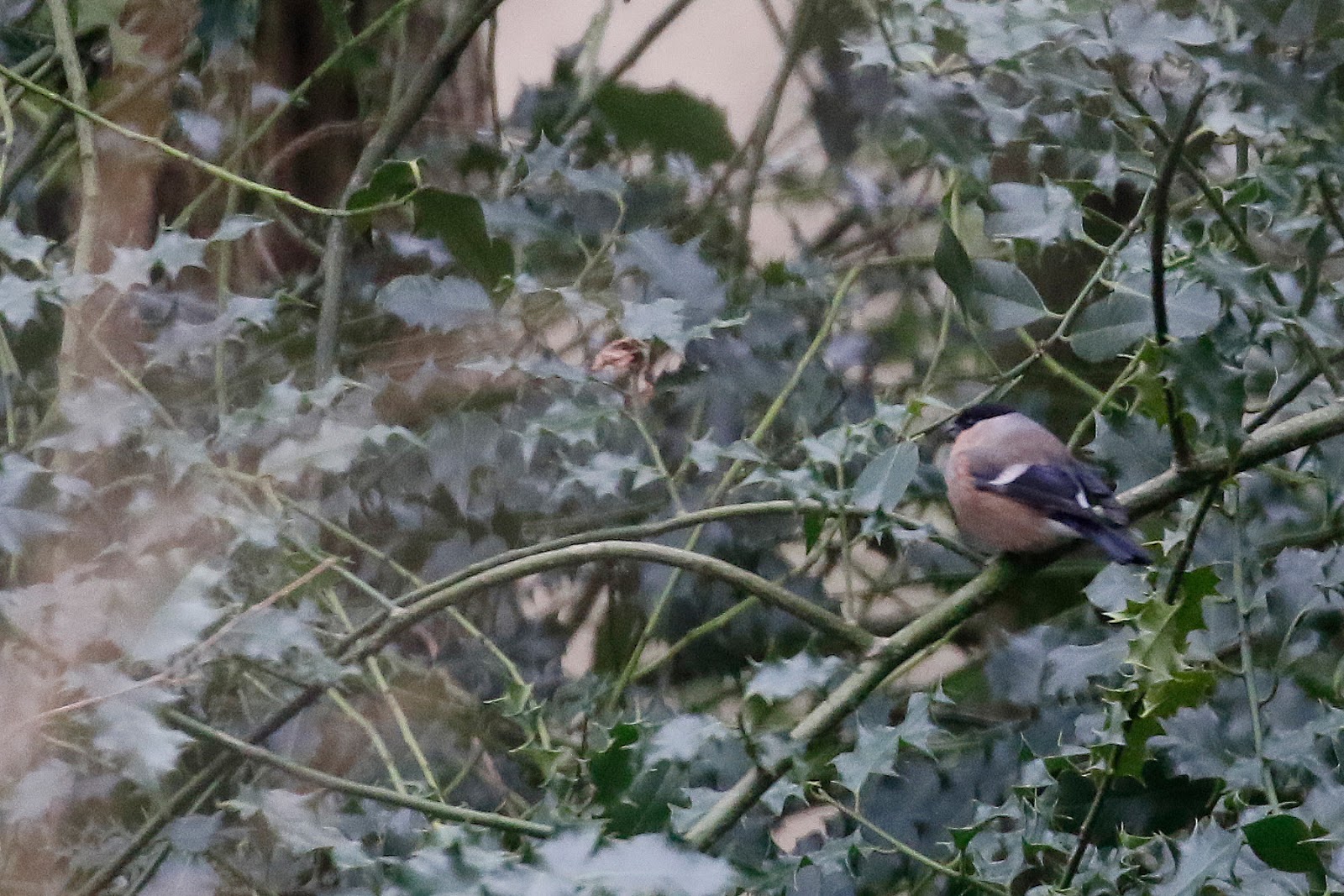
Bullfinches seemed to be everywhere and as I walked more came out of the bramble. A female sat long enough for me to get a closer look and I could see that they were feeding on the rotten blackberries, her mouth full of seeds.
The males were not performing and would drop out of sight once they had flown up. The females though appeared to be quite happy out in the open.
Looking out across the fields to the west I could see a hazy cloud rolling towards us, not a good sign, the rain seemingly not to far off. I decided that it was time to make my way home, and headed out of the wood through to the Brislands path, then down Brislands through the puddles and home.
A brief New Year's Day walk, and the chance to get five tit species and four thrushes on the new 2016 list.
I have been asked if I could publish the list of birds seen in 2015, so here it is, the new birds for the patch are in bold. There are of course some notable omissions, namely Barn Owl, Little Owl, Sand Martin, Great Black-backed Gull, all birds that should have been found but eluded me
Back home I decided to go out for a walk through the woods while the weather stayed dry, but there was always the sense that the rain was not too far away. I was not expecting too much, but there was always the thought that maybe there could be that New Year's Day Mega.
As I walked along Brislands the sun was trying to break through the cloud, but never really succeeded
Looking across the fields as I walked along the lane I could see plenty of Woodpigeon, but also a collection of smaller birds that turned out to be Chaffinches.
I decided to enter Old Down from Gradwell Lane, and as I walked to the footpath a Robin was the only bird I could hear,
The path alongside the paddocks, and then pout across the field was very wet and muddy, and it was very difficult to walk, taking three steps forward and slipping two back! A head there were Woodpigeon and crows on the fields, and then three smaller and duller birds slowly making their was across the field. These were Red-legged Partridges and the firs I have seen around Old Down for some time.
It was very quiet in the wood, the colder weather silencing the singing Great Tits. I walked along the perimeter path, and soon found a small flock of calling birds.
Moving quickly through the trees they were difficult to pin down, it was a mixed flock of Long-tailed Tits and of course Goldcrests, this winters influx bird, they seem to be everywhere. One appeared above my head.
On reaching the Kitwood path, I turned back into the wood, pausing to listen, the best way to find birds in the wood. I soon heard the "seep" calls of Redwings and scanned the trees to see if I could find them, they always seem to be able to merge into the bare branches. Finally one moved and then another and as they settled back into the branches I was able to see them. Distant, but recognisable as Redwings.
I walked around to the the crossroads with just Wrens calling and darting out of the dead bracken. I turned down towards Old Down Cottage, and then along the short path to the perimeter. This is a good spot for Marsh Tits and very soon I was hearing a pair calling, one coming close as they foraged in the branches looking for small insects.
At the perimeter path I could hear Fieldfare and picked them up on the field, but as soon as I moved to get a better view they flew up into the trees and disappeared. There were Blackbirds in the field, and they were unconcerned, there was also a Jay, but that too flew off as I tried to get a better view.
All around there were birds, Chaffinches, Goldfinches and quite a few Great Tits and Blue Tits. I then managed to find the Fieldfare in the top of the tree, but again as I moved into a better position they flew off across the field to the trees on the other side. I found them perched at the top of the trees with a crow, again a very distant shot unfortunately.
I walked slowly on disturbing Bullfinches from the brambles, and Goldfinches from the low dried out weed stems, one bird appearing in the open and allowing me the chance to photograph it.
Bullfinches seemed to be everywhere and as I walked more came out of the bramble. A female sat long enough for me to get a closer look and I could see that they were feeding on the rotten blackberries, her mouth full of seeds.
The males were not performing and would drop out of sight once they had flown up. The females though appeared to be quite happy out in the open.
Looking out across the fields to the west I could see a hazy cloud rolling towards us, not a good sign, the rain seemingly not to far off. I decided that it was time to make my way home, and headed out of the wood through to the Brislands path, then down Brislands through the puddles and home.
A brief New Year's Day walk, and the chance to get five tit species and four thrushes on the new 2016 list.
I have been asked if I could publish the list of birds seen in 2015, so here it is, the new birds for the patch are in bold. There are of course some notable omissions, namely Barn Owl, Little Owl, Sand Martin, Great Black-backed Gull, all birds that should have been found but eluded me
Mute Swan
|
Great Tit
|
Mallard
|
Coal Tit
|
Red-legged Partridge
|
Marsh Tit
|
Grey Partridge
|
Skylark
|
Pheasant
|
Swallow
|
Cormorant
|
House Martin
|
Grey Heron
|
Long-tailed Tit
|
Red Kite
|
Chiffchaff
|
Sparrowhawk
|
Willow Warbler
|
Buzzard
|
Blackcap
|
Kestrel
|
Garden Warbler
|
Hobby
|
Whitethroat
|
Peregrine
|
Nuthatch
|
Moorhen
|
Treecreeper
|
Coot
|
Wren
|
Golden Plover
|
Starling
|
Lapwing
|
Blackbird
|
Woodcock
|
Fieldfare
|
Black-headed Gull
|
Song Thrush
|
Mediterranean
Gull
|
Redwing
|
Common Gull
|
Mistle Thrush
|
Lesser Black-backed Gull
|
Spotted Flycatcher
|
Herring Gull
|
Robin
|
Rock Dove / Feral Pigeon
|
Redstart
|
Stock Dove
|
Whinchat
|
Woodpigeon
|
Stonechat
|
Collared Dove
|
Wheatear
|
Cuckoo
|
Dunnock
|
Tawny Owl
|
House Sparrow
|
Swift
|
Grey
Wagtail
|
Green Woodpecker
|
Pied Wagtail
|
Great Spotted Woodpecker
|
Meadow Pipit
|
Magpie
|
Chaffinch
|
Jay
|
Greenfinch
|
Jackdaw
|
Goldfinch
|
Rook
|
Siskin
|
Carrion Crow
|
Linnet
|
Raven
|
Lesser Redpoll
|
Goldcrest
|
Common Crossbill
|
Firecrest
|
Bullfinch
|
Blue Tit
|
Yellowhammer
|
Here is to finding them all again this year, thirty are already in the bag!
Thursday, 31 December 2015
31st December - Should Auld Acquaintance Be Forgot
As the year ends it is time to reflect on what has happened this year as a way of looking forward to the New Year of 2016
January saw the mild wet conditions continue into the New Year, there were some good counts of local resident birds notably, 75 Yellowhammer along Gradwell Lane and 15 Grey Partridges at Plain Farm. The big surprise of the month though was of a Grey Wagtail at Manor Farm along Brislands Lane, my 100th bird for the patch. With the mild weather Snowdrops were early flowering on Swelling Hill, while in the woods the green shoots of Blue bells were appearing.
Into February, and a new bird for the patch with two Mute Swans flying over Gradwell Lane on the 1st. Winter thrush flocks peaked in the fields along Lye Way with 800 Redwing and 500 Fieldfare on the 5th. At Plain Farm four Red Kite on the 14th was my highest count around the patch. In the woods the resident birds continued to gather in feeding flocks as they waited for spring to arrive.
In contrast to the mild conditions at the start of the year, March saw cold northerly winds throughout, suppressing any thought of an early spring. What activity there was restricted to the end of the month as the days lengthened. The rookeries in Alton merged with one large colony of 52 nests. A pair of Ravens were regular around Desmond Paddocks, just when the sheep start lambing.
Lesser Celandine and Wood Anemone were flowering from the 22nd when the first butterfly of the year a Small Tortoiseshell was seen. Common Toads were spawning from the 23rd. At Plain Farm ten Brown Hare was a notable count.
More weather records were broken with April being the sunniest since records began. The first Swallow appeared on the 7th, but was alone until the the 17th when others joined it. Blackcaps and Chiffchaffs were singing in the woods with a Garden Warbler present on the 17th, and a Whitethroat arriving on the 25th. The sightings of the month though were three Wheatear on Lye Way for two days, and a Coot on Swellinghill Pond from the 25th and well into May.
Peacock and Brimstone butterflies were seen from the 7th, and by the end of the month there were Orange Tips, Speckled Woods and Comma. The end of the month also saw an explosion of flowers in Old Down with the highlight being a wonderful carpet of Bluebells ably supported by Primroses Violets and Ransom's. In the paddocks around the patch Lambs could be heard bleating as they enjoyed the sunshine.
From the sunshine of April to a cool almost autumnal May. House Martins finally turned up on the 9th, when the only Cuckoo was seen along Charlwood Lane. The cool weather suppressed the number of moths caught in the garden. The cool weather also affected the bird passage with very little of interest, however there were little windows of improved weather, and I was able to find three roding Woodcock in the Maryanne Plantations, and there was Spotted Flycatcher in Old Down Wood on the 30th,
The Bluebells continued to put on a lovely show in Old Down, the forestry work having open up the canopy, and the flowers thrived. It was also possible to catch up with several different Roe Deer in the woods too.
The cool weather was maintained into June, conditions that were still not conducive to attracting significant numbers of moths to the trap. The woods were full of the calls of young birds as they begged for food from their parents.
Of the butterflies about I finally managed to find a Holly Blue, my first for two years, but more significant was a single Painted Lady the first for at least eight years.
Five Mediterranean Gulls were the birding highlight of the month, seen in the Desmond paddocks, a first again for the patch.
I finally managed to catch up with doe Roe Deer and her two kids at the beginning of the month, they spent their time in the long grass in the fields next to Old Down. In the woods Foxgloves replaced the Bluebells, their long pink red spikes seemingly almost everywhere.
July was a month of extremes with the hottest day recorded on the 3rd, but by the end of the month it was cool enough for the central heating to come on. A Willow Warbler was the birding highlight of the month with a single present at Plain Farm. Typically this month sees the attention turn to butterflies and they were all about despite the strange weather, the numerous Meadow Browns and Gatekeepers were joined by Ringlet, Silver-washed Fritillary and Large, Small and Essex Skippers.
The moth trap was still very quiet, but I was rewarded for my persistence with a gorgeous Green Silver Line, a first for the garden.
The contrasting weather continued into August, the summer never really establishing itself. The local Swallows seemed to have a good year with large flocks of young birds being seen around the paddocks and stables. The end of the month saw the start of the autumn migration with Willow Warblers and Spotted Flycatcher seen at Kitwood.
Butterflies continued to dominate the sightings with my only White Admiral on the 4th, and then a Brown Argus, the first for the patch on the 7th, with also Small Coppers and Common Blues
I had been aware of the presence of Violet Helleborines in the lanes around the village, but only managed to find them this month on Swelling Hill.
The month of September turned out to be one of the best birding months I have had since I started this blog. It started with my highest counts of six Spotted Flycatchers in Old Down Wood on the 6th and six Firecrests at the Mountain's Plantation on the 17th. On the same day there was another Grey Wagtail on Lye Way. The 19th saw two Common Redstarts, a female at the Desmond Paddocks, and a male at Plain Farm, a Peregrine hunting Woodpigeon along Lye Way, and a pair of Stonechats in Charlwood where there was also a Whinchat. At the end of the month, there was a Hobby and a pair of Cormorants over my garden.
The end of the month saw sunny and warm weather which brought out Southern Hawker, and Common Darter dragonflies at the pond, and a Hummingbird Hawkmoth in the garden.
October was dry and bright, with much lower than average rainfall. A pair of Stonechats were present at Plain Farm for most of the month, and yet another Grey Wagtail was seen there on the 18th. The last Swallow left on the 17th, but the Redwing were late with a pair being seen as late as the 22nd.
Last year saw a large count of 65 Mallard on Swelling Hill Pond, this year the maximum count was 20. A male Siskin was on the garden feeders at home along with an ever increasing flock of Goldfinches
The last dragonfly of the year, a Common Darter was seen at Plain Farm on the 18th.
Wild storms heralded the start of November, putting an end to the dry weather and bringing in some very mild and dull conditions. The high winds very quickly removed the leaves from the trees ending the autumnal colour. The mild weather though did suit the Comma butterflies that were present throughout the month.
Getting out and about was not easy, and walks were confined to the roads and lanes. Large flocks of Yellowhammer were present in the hedges, and Bullfinch flocks seemed to be everywhere. In the fields along Brislands on the 21st there was a significant count of 94 Skylark, and over the fields of Lye Way was a flock of 186 Golden Plover. My only Lapwing sighting of the year was this month with just two birds.
Fieldfares finally arrived on the 13th, and numbers of both Fieldfare and Redwing built up through the month.
The very unseasonable weather continued into December. Temperatures on some days being the same as they were in May. A Red Admiral was seen on the wing in Old Down Wood on the 5th, my latest ever here, and catkins were appearing on the Hazel trees. in the gardens around the village daffodils and primroses were flowering in the crazy weather a contrast to the festive lights.
The autumn saw an influx of Goldcrests and large groups could be seen with tits in the woods, and a pair were even on the feeders in the garden. Lesser Redpoll and Siskin have been absent from Old Down Wood since the forestry work started there two years ago, so it was nice to see both of these delightful small finches there on the 23rd.
Despite the fact that I have not spent as much time out and about the patch as in previous years I have managed my second highest year total for birds seen at 82, and my highest count of butterflies at 25 just one short of the patch total.
I would now like to say a Happy New Year to you all, and for the hope of more wonderful wildlife in 2016, and to leave you with a compilation of all the best bits throughout the year, enjoy both the photographs, and the music. Every day is truly an Amazing Day in 2015 Around Found Four Marks
January saw the mild wet conditions continue into the New Year, there were some good counts of local resident birds notably, 75 Yellowhammer along Gradwell Lane and 15 Grey Partridges at Plain Farm. The big surprise of the month though was of a Grey Wagtail at Manor Farm along Brislands Lane, my 100th bird for the patch. With the mild weather Snowdrops were early flowering on Swelling Hill, while in the woods the green shoots of Blue bells were appearing.
Into February, and a new bird for the patch with two Mute Swans flying over Gradwell Lane on the 1st. Winter thrush flocks peaked in the fields along Lye Way with 800 Redwing and 500 Fieldfare on the 5th. At Plain Farm four Red Kite on the 14th was my highest count around the patch. In the woods the resident birds continued to gather in feeding flocks as they waited for spring to arrive.
In contrast to the mild conditions at the start of the year, March saw cold northerly winds throughout, suppressing any thought of an early spring. What activity there was restricted to the end of the month as the days lengthened. The rookeries in Alton merged with one large colony of 52 nests. A pair of Ravens were regular around Desmond Paddocks, just when the sheep start lambing.
Lesser Celandine and Wood Anemone were flowering from the 22nd when the first butterfly of the year a Small Tortoiseshell was seen. Common Toads were spawning from the 23rd. At Plain Farm ten Brown Hare was a notable count.
More weather records were broken with April being the sunniest since records began. The first Swallow appeared on the 7th, but was alone until the the 17th when others joined it. Blackcaps and Chiffchaffs were singing in the woods with a Garden Warbler present on the 17th, and a Whitethroat arriving on the 25th. The sightings of the month though were three Wheatear on Lye Way for two days, and a Coot on Swellinghill Pond from the 25th and well into May.
Peacock and Brimstone butterflies were seen from the 7th, and by the end of the month there were Orange Tips, Speckled Woods and Comma. The end of the month also saw an explosion of flowers in Old Down with the highlight being a wonderful carpet of Bluebells ably supported by Primroses Violets and Ransom's. In the paddocks around the patch Lambs could be heard bleating as they enjoyed the sunshine.
The Bluebells continued to put on a lovely show in Old Down, the forestry work having open up the canopy, and the flowers thrived. It was also possible to catch up with several different Roe Deer in the woods too.
The cool weather was maintained into June, conditions that were still not conducive to attracting significant numbers of moths to the trap. The woods were full of the calls of young birds as they begged for food from their parents.
Of the butterflies about I finally managed to find a Holly Blue, my first for two years, but more significant was a single Painted Lady the first for at least eight years.
Five Mediterranean Gulls were the birding highlight of the month, seen in the Desmond paddocks, a first again for the patch.
I finally managed to catch up with doe Roe Deer and her two kids at the beginning of the month, they spent their time in the long grass in the fields next to Old Down. In the woods Foxgloves replaced the Bluebells, their long pink red spikes seemingly almost everywhere.
July was a month of extremes with the hottest day recorded on the 3rd, but by the end of the month it was cool enough for the central heating to come on. A Willow Warbler was the birding highlight of the month with a single present at Plain Farm. Typically this month sees the attention turn to butterflies and they were all about despite the strange weather, the numerous Meadow Browns and Gatekeepers were joined by Ringlet, Silver-washed Fritillary and Large, Small and Essex Skippers.
The moth trap was still very quiet, but I was rewarded for my persistence with a gorgeous Green Silver Line, a first for the garden.
The contrasting weather continued into August, the summer never really establishing itself. The local Swallows seemed to have a good year with large flocks of young birds being seen around the paddocks and stables. The end of the month saw the start of the autumn migration with Willow Warblers and Spotted Flycatcher seen at Kitwood.
Butterflies continued to dominate the sightings with my only White Admiral on the 4th, and then a Brown Argus, the first for the patch on the 7th, with also Small Coppers and Common Blues
I had been aware of the presence of Violet Helleborines in the lanes around the village, but only managed to find them this month on Swelling Hill.
The month of September turned out to be one of the best birding months I have had since I started this blog. It started with my highest counts of six Spotted Flycatchers in Old Down Wood on the 6th and six Firecrests at the Mountain's Plantation on the 17th. On the same day there was another Grey Wagtail on Lye Way. The 19th saw two Common Redstarts, a female at the Desmond Paddocks, and a male at Plain Farm, a Peregrine hunting Woodpigeon along Lye Way, and a pair of Stonechats in Charlwood where there was also a Whinchat. At the end of the month, there was a Hobby and a pair of Cormorants over my garden.
The end of the month saw sunny and warm weather which brought out Southern Hawker, and Common Darter dragonflies at the pond, and a Hummingbird Hawkmoth in the garden.
October was dry and bright, with much lower than average rainfall. A pair of Stonechats were present at Plain Farm for most of the month, and yet another Grey Wagtail was seen there on the 18th. The last Swallow left on the 17th, but the Redwing were late with a pair being seen as late as the 22nd.
Last year saw a large count of 65 Mallard on Swelling Hill Pond, this year the maximum count was 20. A male Siskin was on the garden feeders at home along with an ever increasing flock of Goldfinches
The last dragonfly of the year, a Common Darter was seen at Plain Farm on the 18th.
Wild storms heralded the start of November, putting an end to the dry weather and bringing in some very mild and dull conditions. The high winds very quickly removed the leaves from the trees ending the autumnal colour. The mild weather though did suit the Comma butterflies that were present throughout the month.
Getting out and about was not easy, and walks were confined to the roads and lanes. Large flocks of Yellowhammer were present in the hedges, and Bullfinch flocks seemed to be everywhere. In the fields along Brislands on the 21st there was a significant count of 94 Skylark, and over the fields of Lye Way was a flock of 186 Golden Plover. My only Lapwing sighting of the year was this month with just two birds.
Fieldfares finally arrived on the 13th, and numbers of both Fieldfare and Redwing built up through the month.
The very unseasonable weather continued into December. Temperatures on some days being the same as they were in May. A Red Admiral was seen on the wing in Old Down Wood on the 5th, my latest ever here, and catkins were appearing on the Hazel trees. in the gardens around the village daffodils and primroses were flowering in the crazy weather a contrast to the festive lights.
The autumn saw an influx of Goldcrests and large groups could be seen with tits in the woods, and a pair were even on the feeders in the garden. Lesser Redpoll and Siskin have been absent from Old Down Wood since the forestry work started there two years ago, so it was nice to see both of these delightful small finches there on the 23rd.
Despite the fact that I have not spent as much time out and about the patch as in previous years I have managed my second highest year total for birds seen at 82, and my highest count of butterflies at 25 just one short of the patch total.
I would now like to say a Happy New Year to you all, and for the hope of more wonderful wildlife in 2016, and to leave you with a compilation of all the best bits throughout the year, enjoy both the photographs, and the music. Every day is truly an Amazing Day in 2015 Around Found Four Marks
Subscribe to:
Posts (Atom)