Wednesday, 15 July 2015

14th July - I Dream In Colour

We have been away over the weekend, the details of which can be found here, but since last Friday there have been some interesting events.  On Thursday there was a pile of feathers on the lawn, and a little bit of flesh, indicating that one of the House Sparrows had fallen.  The numbers of House Sparrows and Blackbirds in the garden has increased to quite large numbers, and with the introduction of the mealworms it has also attracted the local Sparrowhawk.

This was confirmed on Friday morning when I came into the kitchen to see a male Sparrowhawk sitting on the bird bath.  On seeing me it was off, but it is now clear the garden has become a bird feeder all the way up to the apex predator.

It is though amusing to see the Blackbirds and House Sparrows feeding on the worms.  The Blackbirds clearly gathering them to feed a brood somewhere close, as they take as many as they can.  Just recently a female has appeared up to now it was just males that were collecting them to feed juvenile fledged birds.  I watched this female gather up the worms and head off to the nest 5 times within the space of 10 minutes.


Anything is seen as a threat to take the worms away, even this Collared Dove that arrived happy only to eat the fallen seed from the feeders.


The House Sparrows perform a smash and grab approach, confident that the Blackbird is pre-occupied with trying to get as many worms in its beak to be concerned about them dropping in.


It is only the female Sparrows that collect the worms and take them off, the male will drop in, but only to eat for themselves.


There have been at least three juvenile Blackbirds, and they will feed from the basket, or take them from the grass when they escape, but when the adults appear they will beg to be fed.  Sometimes they go to the wrong adult, and get chased off for their mistake. 

Another Juvenile appeared by the bird bath, a Robin.  It has been quite shy but this morning I managed to get it to feed on worms I threw down close to it, early days but we never know we might be able to get it to come closer.


As I have said there have been several male Blackbirds about, all collecting the worms and feeding the young.  This one though looks the most worn out, and is probably very grateful for the easy pickings the mealworms afford.


When the mealworms ran out I was sorting out the moth trap, so you would not be surprised that I had some onlookers that had to be moved on.  The conditions overnight were ideal, overcast, humid with a little misty rain.  It proved to be correct and the trap was busy this morning.  Of the larger moths there were seven Elephant Hawk-moths, and two Privet Hawk-moths.  It was though the smaller types that provided the mornings interest with four new moths for the garden, and several firsts for the year.

This Buff Arches was a first this year.


It is a fairly common moth in southern Britain, but a lovely marked and coloured moth.


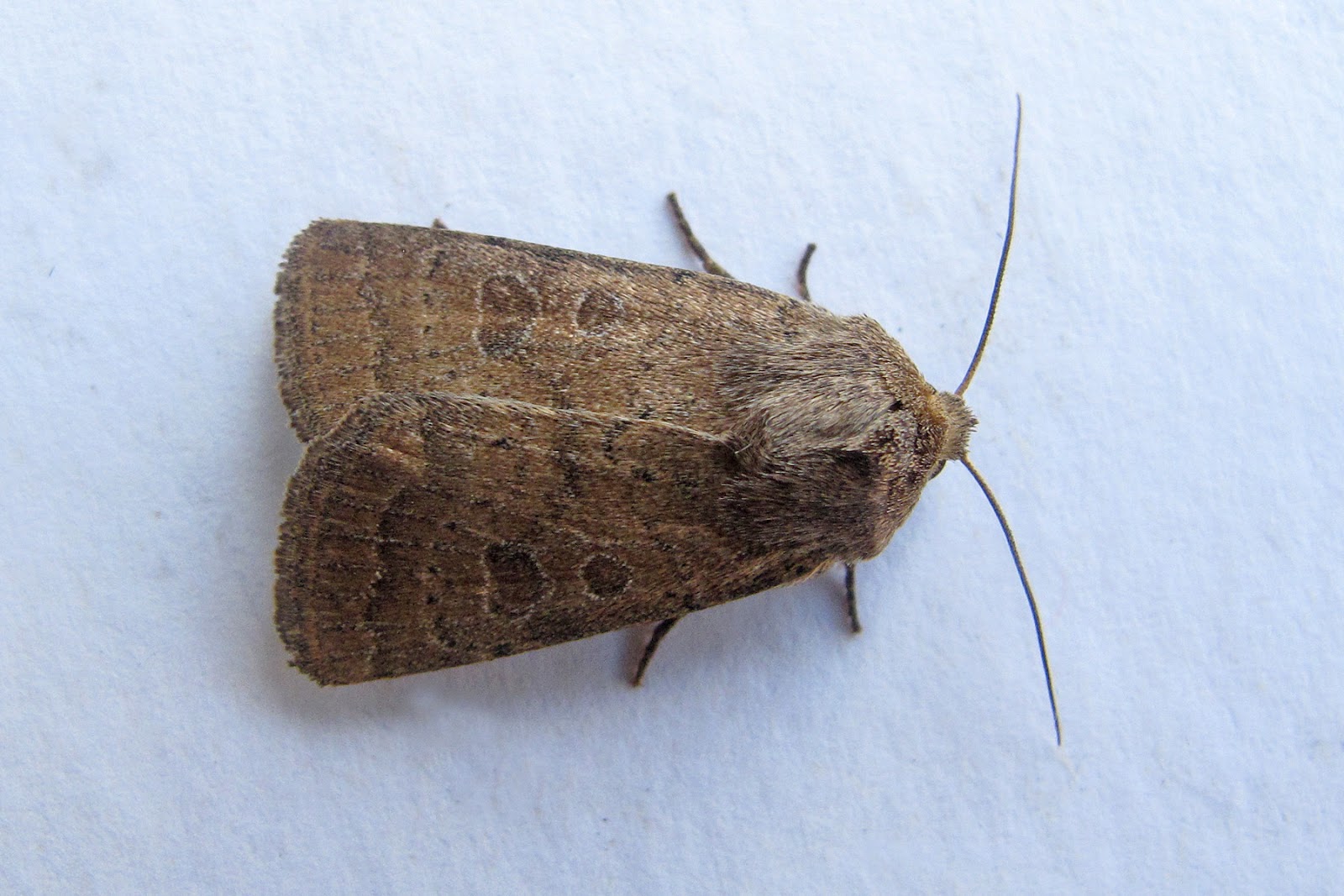
Other firsts for the year were this Coronet.


And this similar Dot Moth.


The micro moths can prove to be difficult, but some can be easily identified by colour, this is the V Pug, a small moth about a centimetre across but quite a vivid green.


Now for the new moths, this one only seems to have a Latin name, the Udea Prunalis.  Another common small moth that can normally be found around Blackthorn, plenty of which can be seen around here.


Another micro moth but with a striking pattern is this one, the Crambus Pascuella.


Flying from June to August, the adults are on the wing at night, when they are attracted to light, but are easily disturbed during the day from their grassy resting-places.

The next is a little larger, but one of those moths that can be confused with similar species.  From the wavy patterns on the wings this is I think a Brussels Lace.


And finally the best moth caught over night, and again a new one for the garden, a Green Silver-lines.


One of the very few British green moths, this species is fairly common in wooded areas over much of England and Wales.  The larvae feed on oak and birch.


At lunch-time I was treated to another first when not just one but two Red Kites were over the garden.  At one time one came very low over me scanning the ground all the time, they seem to be getting a lot bolder.


They drifted around the area for some time, often together.


A blurred TV aerial adds a little more urban scenery to the presence of these beautiful birds of prey.


The overcast and humid conditions have proved to be ideal for the hunting House Martins, they now have young to feed in the nest on the house, and these conditions must have come at the right time.


By the late afternoon the heavy overcast conditions were lifting, the clouds were higher and there were patches of blue sky about that let through some sunshine.  These conditions were a lot more hopeful than earlier in the day, so I decided to set off for a walk around Old Down and the fields.

A Chiffchaff and the Song Thrush was singing as I headed along Brislands, and a few butterflies on the wing lifted the spirit, one of which was a gatekeeper.  I turned into Gradwell Lane and came across a Comma butterfly the first for awhile, and one of this year's emerging adults.


I could hear the chatter of Swallows above me, and as I turned onto the footpath I could seen many birds flying low over the barley field.  The Swallows were collecting in th4 Hawthorns trees on the edge of the field, and the numbers were definitely swelled by lots of newly fledged juvenile birds.  As I walked towards the trees all the Swallows went up, and I estimate there must have been at least over 50 birds present.  They were flying around the trees, and then low out over the barley.  As they came over the trees they would hang in the breeze, giving me once again the opportunity to try and get a picture.


These are juvenile birds, easily separated from the adults by the remains of the yellow flanges on the bill, and the lack of credible tail streamers.  For the record I was not aware this one was chasing insects.  It is difficult to get the colour in the monochrome conditions, but I was pleased with these two attempts.


Even at this young age the agility and flying skills were immediately evident.

As I watched the Swallows Meadow Browns, Ringlets and a few Marbled Whites were flushed from the grass by the side of the hedgerow.

I turned back and headed into Old Down.  Whilst there were patches of sunshine about it was still quite dull and muggy.  Butterflies would fly up as I walked along the path, but these were always the commoner species, and typically the browns.  I turned down the Kitwood path in the hope that maybe there was a fritillary or even a White Admiral about, but there was no such luck.

I decided to cross the field to the meadow in the hope that there could be something there.  As I walked I could sense the cloud building up again once more, and away to the west it was looking quite dark.  From the path I flushed a pair of Skylark, and several white butterflies flew past me.

The meadow was still and quiet until I ventured of the path a short way.  This flushed the Meadow Browns, and once one was on the wing it seemed to encourage other out as well.  I could only find Ringlets and Meadow Browns though in amongst the grass and on the thistles and knapweed.


Just as I was about to leave a Small White appeared on the flower of a knapweed, and made a welcome break from the brown images that were fluttering about.


The walk towards the pond was quiet apart from yet another Song Thrush in song at the top of a tree.  If the amount of singing birds is an indicator of breeding success this year then they should have had a good year.  I have heard Song Thrush singing in the morning from home almost every day since late November.

I turned to check the cut lawn close by, and a rather tired looking male Pied Wagtail scampered across searching for small insects.


I walked around the pond in search of dragon and damselflies, but there was nothing about, then headed back into Old Down.  On the main path a Red Admiral stood out with its striking red markings in the yellow grass as it rested on a leaf.


Again along the main path it was Ringlets and Meadow Browns flushed from the grass, but at the crossroads I came across some small orange skippers.  These always warrant closer inspection, and I did find some Small Skippers, but also a pair of Essex Skippers which are slightly smaller and with the black clubs on the end of the antennae.


A little further on I finally managed to get a Gatekeeper to sit with its wings open to show the lovely orange markings.


As I made my way along the main path towards Brislands I could hear the calls of both the young Kestrels, and the mews of distant Buzzards.  Out on the lane I picked up a Buzzard flying towards me, high and heading in the direction of the wood.  As it came over I could just make out that it was carrying prey, and from the tail it was probably a rat.


A little further on another large bird of prey approached, the Red Kite again, and one of the birds that was over the garden earlier.  It drifted over with that relaxed wing beat that seems to require hardly any effort.


By now the dark clouds were giving up a miserly rain, not heavy but the sort of rain that had the potential to soak you. Fortunately I was not too far from home.  As I came around the corner in Lymington Rise, movement on the lawn.  For the first time this year it was a Green Woodpecker.  There has not been any sign or sound of young about, maybe they were later this year.


I tried to get a little closer while at the same time shielding the lens from the drizzle.  However it flushed and flew up into the tree where I suspect it has a nest.


As I mentioned earlier these conditions suit the House Martins, and there were plenty flying above the houses as I reached home, but then in amongst the smaller and stocky Martins was a much slimmer bird.  I had hoped the conditions might produce one, and here it was a Swift.


It is amazing how difficult it is to see them here when there are plenty in Alton, and they can easily be seen from Ropley to Winchester along the A31.  By July I have usually given up on them so it was nice to see this one today.

An interesting day, which for a mid summer July day delivered some good stuff despite the weather conditions.

Wednesday, 8 July 2015

7th July - It Turns By Day and Then By Night

Firstly I need to correct an identification of a moth from the previous post.  I had identified it as a Silver Y when in fact the moth was a Beautiful Golden Y.  There have been several Silver Y about in the grasses around the patch, and in saying this was the first I had caught probably was an indication that my identification was wrong.  The beautiful Golden Y being a resident moth seen fairly commonly around this time of year fits the situation much better.  In my defence I was taking the shape and the fact that colour seems to vary so much in certain moths.  Thank you Ian at least I didn't call it Azure!

The weather changed overnight and there was a few showers around in the morning, but they did not provide anything like the rain the gardens need at the moment.  This little patch of Hampshire seems to have avoided the storms of the last few days.  By the afternoon the sun was out, but with some menacing dark clouds as well.  Late afternoon I set off for Plain Farm in the hope that the sun would stay out, and that the rain would not start now to re-address the balance.

Parking at the bottom of the hill up to the Rotherfield allowed me to search the grassland at the edge of the Mountains Plantation.  I was hoping that I could see the groups of Common Spotted Orchids that were here last year, and they were, their pinkish red flower spikes standing out in the brown grass.


As I looked at the Orchids I could see Marbled Whites flying in front of them.

I set off up the hill with the sun out and it feeling warm.  Ahead of me the dark clouds were rolling away, but unsettlingly, behind, more were making their way towards me.  I walked up to the pond but it was very low in water, surrounded by thick vegetation and the surface covered in pond weed.  A few Meadow Browns flew about but that was very much it.

I checked the hut for signs of the owl, but couldn't decide if they were new or old pellets on the floor.  There was definitely no sign of any bird.  I walked along the side of the wall where Meadow Browns and a few Small Tortoiseshells could be seen on the hedge and ivy.  The only birds about seemed to be Woodpigeons, these all seemed to be flying in different shapes as if to get my attention so that maybe I would think they were something else.

The grass here has been left to grow, and in amongst it are Thistles and Knapweed.  The majority of the butterflies were brown, but an orange movement caught my eye and revealed this tired looking female Large Skipper.


I turned back on myself, and made my way back to the path that leads to the quarry.  The sun was still out but the clouds were coming ever closer, and more worryingly away in the distance there was the blurred grey of rain falling visible.

Again the grass was quite tall, but also there were plenty of Common Hogweed in flower.  This plant has pinkish or white flowers with 5 petals. They are arranged in large umbels of up to 20 cm of diameter with 15 to 30 rays, and are a huge attraction to all sorts of small bugs, insects, and hover flies.  On this flower there was a False Oil Beetle, or as it can also be known Swollen-thighed Beetle.  There is also a Red Soldier Beetle present and lots of small black flies.


The sun had now gone but there was still quite a few butterflies about.  The first to settle was this Small Skipper, the first for the year.


But it was the Marbled Whites I spent the time watching and photographing.  A lovely butterfly with exquisite black and white markings.


Despite its name, the Marbled White is more closely related to the subfamily known as the "browns" that the "whites".  Its black and white markings distinguish it from all other species found in the British Isles. This butterfly is found in distinct and often large colonies, south of a line between Glamorganshire in the west and North-east Yorkshire in the east, although it is not found in much of eastern England. 

Early morning is usually a good time to see this species, as it warms up with wings held open. They can be quite conspicuous, even from a distance, as it may be the only white object among the grassland. At good sites it is not uncommon at good sites to see a flower head containing several adults all vying for space as they feed.  Just before I took this photograph there were two others present as well as a Meadow Brown


The female differs from the male by having more brown and white markings on the underwing as can be seen in this photograph.


It had become quite dull now, and in these conditions the Marbled Whites will rest on grass stems, as well as the flower heads of any of their nectar sources, such as Thistle or Knapweed.  This individual seemed to be looking for somewhere to settle having dropped down into the grass stems.


The dullness finally gave up its rain, and I headed down the hill towards the quarry wrapping the camera in its cover and zipping up my kagoule. 

I waited a while in the quarry sheltering under the trees, but as the rain eased I decided to head on up the lane through Plain Farm.  It has been a while since I walked around here, in fact the last time was in May, and coincidently that was the last time I walked in rain around the patch.

The only thing of interest as I walked up the hill was a couple of male Pheasants that were squaring up to each other in the field.  I waited to see if there were any fireworks, but they both backed down, and moved away.  By the time I reached the workshops the rain had eased off and I was able to get the camera back out.

I could hear birds calling in the hedgerows, several House Sparrows a single Bullfinch and Chaffinch.  I stopped to check the fields and came across a group of Great Tits.  This was a family party the young birds following the adults. who seemed to be calling them.


The young birds collecting together to beg back at their parents.  Interestingly there was a bedraggled looking Blue Tit congregating with the young Great Tits.


I could now hear a calling Whitethroat, but there was no sign of it, just movement in the bushes.  On the overhead wires were several Linnets and a few Goldfinches, and what seemed like a Yellowhammer family.


I walked on and past the cottages and then headed towards Charlwood Lane.  On the path in front of me I thought I saw two Hares, but on closer inspection they turned out to be cousins, a pair of Rabbits.  One shot away leaving the other frozen on the path.


A little further along I could hear a quiet snippet of sub song, that as I got closer I was able to identify, at last a Willow Warbler and it was in the site I had hoped to find it earlier in the year.  I had given up hope and did not expect to find  one today.  As I approached closer to what seemed the source of the song it changed to the two syllable call, then the bird appeared all too briefly at the top of a small bush, and flew away over my head.  All I could see was a greenish wash, and if I hadn't heard the song I would have to put it down as an unidentifiable warbler.

I paused then to look around.  The fields were full of cereal crops, barley close in and wheat away in the distance.  Not the best conditions to see wildlife, we need the harvest to clear the fields.  The sun was coming back out, and as a result was lighting the distant trees and contrasting them against the steely grey clouds away in the distance.


I walked around to the stile into the lane, and stopped for awhile to watch a lone Buzzard circling above the trees.  Like the trees the sun was catching the plumage as it circled against the dark distant clouds.


And that was about it, apart from a few Yellowhammers in song, and a Chiffchaff and Blackcap singing at the small pond there was very little else of interest as I walked the lane on my way back to the car.

As I came down the hill towards my car I could see a patch of poppies that were growing on the edge of the field, an injection of colour on a day that was dominated by the various shades of blacks and whites.


I made my way home driving around the lanes in the hope of something else of interest, needless to say it did not happen.  However a short rain interrupted walk of one bird and butterfly year tick, I shouldn't be too despondent.

Monday, 6 July 2015

6th July - Days of Speed and Slow-time Mondays

More moths over the weekend in keeping with the warmer weather, and one new moth for the garden.  However there still does not seem to be the numbers that were around this time last year.

As ever there were several Elephant Hawk-moths.  One thing that strikes me about these moths is the variation in size.  Sometimes I get a really small one and think it might be a Small Elephant, only to see the dashed pink lines on back of the abdomen.

In this picture you can see the difference in size of these two.


There are several moths that get overlooked mainly because they are brown or plain.  They are also usually the most numerous moths to be found in the trap.  One of these is the Uncertain.


A moth seen out by day in the grass areas but one I have never found in the trap is the Silver Y.  A well-known immigrant species, this moth can turn up in thousands under the right conditions, especially at coastal migration watch-points. It can occur anywhere in Britain, and in autumn, the breeding population from spring migrants is swelled by further migration.

A nice bit of information on the Silver Y, but it turns out I had this completely wrong.  This is in fact a Beautiful Golden Y, and indeed a new moth for the garden.  This moth is a resident species and can be found quite commonly in the UK flying between the months of June and July


Next was the brightly coloured Cinnabar.  It is generally nocturnal, but is quite often disturbed during the day from long grass, low herbage etc. At night, it comes to light.


A first for the year was a Clouded Border, these are not easy to move, and I took the opportunity to photograph it on the egg boxes.


Another moth difficult to get out of the trap and photograph is the Footman.  This was the first for the year, and as soon as I tried to move it then it was off, fortunately it settled on the patio.


A small pretty moth was yet another year first, this one is the Marbled Beauty.  This moth shows a good example of protective camouflage, this species rests by day on stone walls and rocks.  However in this instance I was able to photograph on the plain background.


Finally the one new moth was a Broad-barred White.  Found throughout England and Wales, though more commonly in the south and east, it has a scattered distribution elsewhere.  Its preferred habitats are downland, wasteland and suburban areas, where it flies from June to August.


The garden has been a very interesting place over the last few days, with a lot of the attention focused on the tray of mealworms.  These are proving to be a great attraction, and not only for the mealworms, others watching the comings and goings.

The House Sparrows have been taking a lot away, one female taking 9 trips from the tray away to young in a nest nearby.  Another observation is the fact that the male House Sparrow will change the tone of its chirps when the mealworms are put out as if to signal to the females there is food available, and then suddenly the females arrive.

The other visitor to take advantage is the Blackbird.  There are at least two males about, and also two young juveniles.  One of the males will collect the worms and hold as many as it can in its beak.  Its quite amusing to watch it try to pick one up while dropping another, as it drops them the sparrows nip in and take them.  It is only the male Blackbirds about, there is no sign of any females who are either still sitting on yet another brood or are away recovering from the breeding season somewhere else.  Blackbirds are known for guarding food, and in one instance a juvenile was fighting off the Sparrows, but when the adult appeared immediately started begging for food from it.

As well as the Mealworms there are also plenty of berries on the Amelanchier trees, and the Blackbirds can be seen feeding these to the young birds, performing acrobatics to get to the berries on the thinnest branches.

All this seems not to have escaped the attention of the local Sparrowhawk, and on Saturday evening then was an attack that we thought had resulted in the taking of one of the male Blackbirds.  Helen had watched it happen and said she saw a bird carried off.  The next day though both the birds were still there, both being recognisable by the white in the feathers, and the general state of the feathers, so we don't know if it managed to get away, or it was something else the hawk had taken.

Finally, Sunday evening saw another scene that I missed.  We have been visited by a very small Blue Tit, it seemed as if it was a juvenile.  It would come to the bird bath and wade about.  On Sunday evening Helen tried to get my attention as she had seen at least eight baby Blue Tits in the bird bath, in a scene she described as a like kids in a paddling pool.  I managed to see two of them, but missed the main event.


And another looking on.


The garden is providing plenty of entertainment at the moment in all manner of different ways.

Update: As we ran around badger Close this evening a cat was behaving strangely bythe side of the road.  As we got closer it was clear it had caught something and was trying to deal with it.  Even closer and the victim could be seen to be a Slow Worm without its tail.  I moved the cat on, and picked up the Slow Worm which seemed fine, and then took it to the end of the close where I let it go in a patch of long grass and shrubs.  A lucky reptile!