Monday, 6 July 2015

5th July - But To You In Your Little Dream World

After the midweek heat wave the temperature has become more seasonal over the weekend.  This area has also managed to avoid the thunderstorms and rain that moved through on Saturday, and Sunday.  The morning started off dull and overcast, but towards midday it started to brighten up as forecast.  As we got ready to head out of the house there were distant signs of blue sky, and gradually it became sunnier and also quite warm.

We walked along Brislands with the distant song of a Chiffchaff.  Bird song is now quite hard to hear, but there is a Song Thrush that can still be heard singing in the morning, and is probably the same bird that has been singing now for eight months since December.  I wonder if it will still be heard in August.

We turned into Gradwell and were greeted with the calls of young Long-tailed Tits in the oak trees. 


Still with their juvenile plumage they foraged in the trees.


From Gradwell we took the footpath towards Old Down.  The Barley has grown quite high, and Swallows flew low over the cereal crops, and a few butterflies came up out of the grass to settle in the Barley.  One of these was a first for the year, a Ringlet that settled on the crops.


Time for a moan, the borders of the fields have been seen as a way of allowing space for wildlife, providing the opportunity for wild flowers to grow along with grasses to hide small mammals that kestrels and barn owls hunt.  However this year it seems the farmers are cutting them down, with no real reason for doing so.  If the cut grass was collected for hay I could understand it but that does not seem to be the case.


This recent practice also seems to be in contradiction to the policy of restring walkers to the access these border strips bring.  It is now much easier for the dog walkers to use this area. What with the "tidying" up of the hedges and road side on Blackberry and Alton Lane this summer we are greatly reducing the areas for wildlife>

Moving on, the sunshine and warm weather has suddenly accelerated the growth and colour of the cereal crops, the barley though always has a lovely soft look about it.


The crop also provides many different shades of green as you look at it.  The path towards Old Down fringed with a dark green that melts away to the more familiar yellowish lime green.


As we both looked across the field Helen picked up a pair of ears sticking out of the field.  They belonged to a female Roe Deer who was obviously laying down in the middle of the field.


As we walked along the path the aspect changed with the deer, and as we reached the entrance to the path we stopped to watch her again.  As we watched it was possible to make out movement close to her, and on several occasions a smaller pair of ears would just flick above the barley.  It was not possible unfortunately to get a better view.


After being startled by a collie that came bursting down the footpath we walked into the wood.  Walking through the cleared path the sun began to emerge and there was plenty of butterflies coming out of the long grass, although they were all one species, Meadow Browns.

We turned down the Kitwood path where the Foxgloves are still quite spectacular but it is clear that they are now getting to the point where they are past there best.


This though did not deter the bees.

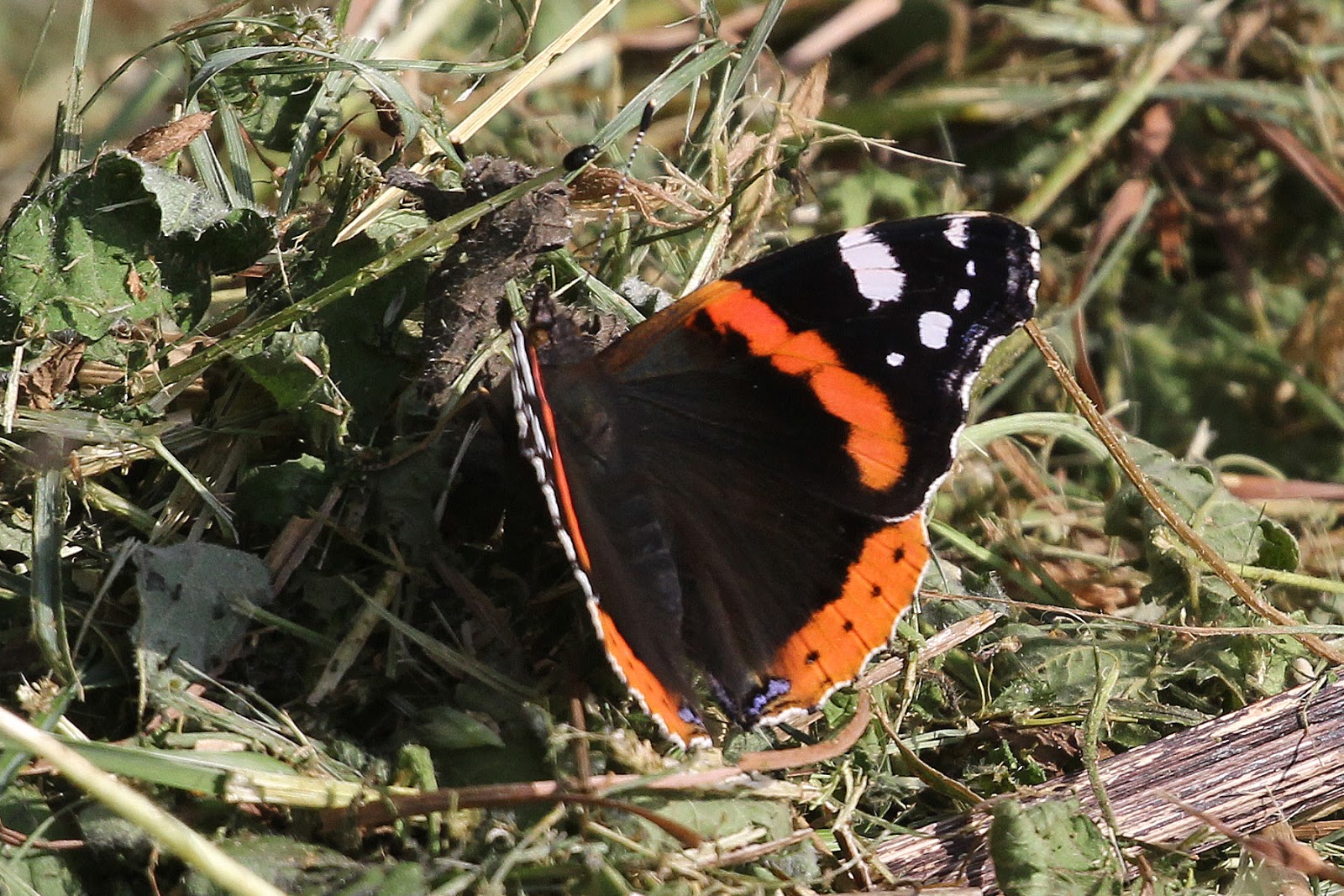
A Red Admiral appeared from the nettles and settled on a broken branch, another of those undervalued superb butterflies.


 We walked around the perimeter path towards the main track that runs south to north, and turned north.  Once again there were many Meadow Browns in the grass on either side of us.  Some of the "brown" butterflies were darker than others and were probably Ringlets, but they never stopped to allow confirmation.  However a Meadow Brown was photo bombed by a Ringlet as I tried to photograph it on the bramble.


The bramble is about 25 to 50% in flower, and was attracting several bee species and of course the Meadow Browns.  But if you stood and watched others would appear like this Large Skipper.


A little further along the path a bee caught our eye, it looked grey as it flew past us, but when it settled it was clear it was covered in dust or pollen.


We turned down the path towards the West End.  We could hear the calls of the young Kestrels to our left, and a little further on we could hear the mewing calls of young Buzzards.  As we stopped to watch and listen the adult birds flew low over the top of the canopy calling back.

From Old Down we made our way down through the Desmond Paddocks, and then up Andrews Lane.  The sky was now clear and there was plenty of sunshine making it feel quite warm.  As we walked up the lane the shelter from the trees was quiet welcome.  Swallows flew low over the paddocks and we could hear their chatter as we walked.  The hedge was quite high and where the bramble was flowering there was a hive of activity involving mostly Meadow Browns, but in amongst them was the butterfly I was hoping to see today, the Marbled White.


There were in fact to here, but only one was busy nectaring and allowed me to get quite close.


In fact very close as it made its way around the bramble flowers.


Along with the Meadow browns there was also a few Ringlets.


The rings not easily visible in flight, but at rest they clearly identify the butterfly.


We carried on up the hill, stopping at the open gates to look across the fields.  At one gate there has been a tree come down, and in amongst the fallen branches and broken bark were several Chiffchaffs foraging.  They were probably recently fledged birds.


As we looked back down the lane, the Swallows were settling on the wires to preen and have a chat.


Almost at the top of the lane we were surprised by a large dragonfly, fortunately it seemed to want to rest frequently and I was able to get close to this beautiful insect.  It is a male Southern Hawker.


At the top of the lane it was back out into the warm sunshine, and we walked past several sheep that looked quite uncomfortable in their woolly jumpers.

We turned back down towards Swelling Hill along the footpath by the hedgerow.  The field was full of broad bean plants.  Above us were three Buzzards, and at one time they were being mobbed by a Kestrel.

Fortunately the field border here had not been cut and as a result there was plenty of butterflies about.  Once again they were mostly Meadow Browns, but every so often there would be something else of interest such as this Small Tortoiseshell


And this male Common Blue.


This area is always one of the first spots for Gatekeeper, but as we approached the road I was wondering if we were going to see one today, then a small brown and orange butterfly flew from the grass.  When it settled it would not open its wings, but you can see from the under-wing markings that it is a Gatekeeper.


We turned onto the road and made our way to the pond.  The hope was that it would be quiet there and we could sit and watch from one of the benches, but unfortunately it was not to be, there were several fishermen present.

Out over the water another large dragonfly was flying around.  This one was a lot bluer, and was an Emperor dragonfly.  Out in the middle of the lily pads an adult Moorhen was feeding.  Once again there was no sign of any young.


We left the pond, and stopped a little further on to check the meadow.  Once again many Meadow Browns, but also one single Marbled White.  

We carried on along Kitwood as we passed the farm buildings I heard a familiar chirping call, I looked around and picked up four birds overhead.  They continued to call, and I knew they were Crossbills.  I watched as they flew away from me and settled briefly in the top of a distant tree, then flew off again calling.  They had come from the direction of Dogford wood, but also may crossed from Winchester Wood.  This was an unusual sighting as I haven't seen or heard any on the patch for sometime.  Hopefully there will be more about in the autumn to see, but for now it was a welcome year tick.

We carried on down onto the main road with out anything else really catching the eye.  As we walked towards Willis Lane the alarm calls went off, and a Kestrel flew up and then settled on a dead branch to survey the field below.


From here we walked on to the garden Centre where we stopped for a welcome cold drink, then it was across the field towards Blackberry Lane.  The field has been cut, and all we could see were more Meadow Browns and Swallows flying low over the short grass.

At the bottom of the path there was no sign of any orchids in the field on the left hand side.

We made our way back home having added three more butterflies to the growing year list.

Monday, 29 June 2015

29th June - I'm Back On Dry Land Once Again

Despite the promising conditions overnight the moth trap was very bleak.  There was a Brimstone, a couple of Uncertains and a couple of Riband Waves, but that was it.  Hopefully as the week warms up there will be a little more variety later on towards Friday.

The weather today has seen sunny spells but quite a bit of cloud about.  When the sun did come out it felt hot quite quickly.  With two calls either side of lunch time I had an hour to see if there was anything about around the pond, the wood and in the meadows around Kitwood.  I drove to the pond, parked up and walked around a little way.  There was a dragonfly hawking around the Iris bed and over the lily pads.  In the sunshine it was a bright blue, I watched it closely as it flew around and managed to get some shots.  It was a male Emperor Dragonfly, always one of the first to appear here at the pond.


I set off for the wood, and a Small Tortoiseshell was flitting about on the bramble by the side of the road.


I walked into the wood and took the perimeter path to check on the Kestrels.  Almost immediately I heard the call of a crow, and saw a Buzzard being mobbed by a crow, and also a male Kestrel.  


The Kestrel was a lot more serious about the mobbing, and it actually hit the buzzard.  


The Buzzard drifted away but was pursued by the Kestrel who was looking to make sure it stayed away.


I walked to the best place to view the nest, and could see two young Kestrels close to the entrance, probably enjoying watching Dad chase off the Buzzard.


I turned back on myself, and made my way along the main path.  Up above me Dad was patrolling the area, carefully watching all around him.


There were several Meadow Browns in the grass.  I stopped to check the large bramble bushes, always a good area for the butterflies.  Today though there was mainly Meadow Browns, but I did see a Large Skipper, the first of the year, but it was very elusive and unfortunately I did not have much time to stand and wait for it to behave.

I turned west at the cross roads, and walked again in the sunshine.  The Foxgloves still putting on a wonderful show.


Once more the area was full of Meadow Brown, but little else other than a few Speckled Woods.


I went as far as the bend, then made my way back and headed towards the Gradwell entrance.  The clearing was in full sunshine and there were plenty of bees and one large Hornet.  I disturbed a Large Skipper on the path, but once again it was not going to play ball for me and the camera.

Again I turned back on myself in the interests of time, and walked down the Kitwood path.  As I passed a clump of Bramble a bright orange butterfly flew up, and circled the Bramble, and then headed away from me.  I had hoped but wasn't confident I would find a Silver-washed Fritillary today, but here was one, and I hoped I could relocate it it.

I walked slowly along the path, and watched as Meadow Browns flew up from the Bramble flowers.  There was quite a gathering on the newly opened flowers and I moved into to take a few pictures when I noticed a flash of orange.  The Fritillary was sitting on a flower, and there it stayed as I moved closer to photograph it.


The bright orange male is quite distinctive as it flies powerfully along woodland rides, pausing only briefly to feed or investigate anything with an orange hue that could be a potential mate. This butterfly is our largest Fritillary and gets its name from the beautiful streaks of silver found on the underside of the wings.


Pleased with that find I headed to the field to cross towards the meadow at Kitwood.  Toime was against me and I decided to jog along the path as the area was a little barren at this time of year, just barley growing.  After awhile the jog returned to a walk and I flushed a butterfly from the path in front of me.  I saw immediately what it was, there was a hint of pink and black and white checkers.  A Painted Lady, the first for some time I have seen here in Four Marks.  Unfortunately it flew across the field and dropped out of sight amongst the barley.  Hopefully this will be the first of many that will make their way through the area s the expected migration from Europe really gets under way with the warm weather.

Elated but disappointed I couldn't get the photograph, I climbed the style into the meadow.  I was immediately greeted with the sight of many Meadow Browns.  I scoured the grass for any sign of a Marbled White but could only see brown butterflies.  I walked around to the far side where there were lots of thistles coming into flower, and providing an attraction to the bees as well as the Meadow Browns.


The only different species of butterfly present was a Small Tortoiseshell.


It seemed like every flower had a butterfly on it, and if it didn't it was because there was a bee there already.


I walked around the cut paths scanning for any sign of something not brown or dark.  Finally I saw a small flash of orange and followed it, it settled and I managed to photograph a Large Skipper at last.


When you consider the number of Marbled Whites I saw at the weekend away from Four Marks it is amazing there were none here it what is a very suitable habitat. I decided to check the fields belonging to Homestead Farm, last year they were left to flower and there were lots of Common Blues and Marbled Whites.  This year though all the fields had recently been cut for hay, and all I could find were more Meadow Browns settling on the cut grass
I headed back to the car, but before I returned home I looked around the pond again.  There were several Azure Damselflies about, some copulating.


On the lily pads I also counted up to five Red-eyed Damselflies.


As I returned home I pondered on the events of the last hour.  The Painted Lady was a great find, I had hoped that there would be some this year.  To see Silver-washed Fritillary in June is a first too, and very unusual to see one before a Marbled White.  The whites though will turn up, and I just need to look in the sites more suited to them.

Later on in the afternoon a Red Kite drifted over the house, the first one I have seen here for a good while.


It drifted away, then headed back again towards the house.


Drifting away over the rooftops, but always looking and searching, I am sorry but all I have is mealworms.


A lovely end to June.

Sunday, 28 June 2015

26th June - Eins Zwei Drei Vier Funf Sechs Sieben Acht

The week has been relatively pleasant, but there was rain forecast for Friday.  I put the moth trap out overnight and was pleased with the results in the morning, some new moths for the year, and a brand new moth for the garden.

There were two Elephant Hawk-moths present but I decided against putting them through the camera, and released them into the conifers.

For once I managed to get one of the commoner moths to stick around for a photograph. This is the Riband Wave, a creamy white moth with ribands that wave through the wings Two distinct forms occur of this species, roughly equal in numbers. The typical form has a dark band across all four wings, whereas the plain form, which was also in the trap but flew off, only has narrow cross-lines.


Next was the Willow Beauty, Again a moth with several forms, typical forms are brownish with darker streaks and markings, but there is also a greyish form.


The next two moths have been seen before, the Shoulder striped Wainscot.


And the lovely Burnished Brass.


The new moth though was the Figure of Eighty, so called for the marks on the wing that look like the figure eighty.


This attractive moth adopts a cylindrical posture when at rest, with the wings curled tightly around the body. The white '80' mark on the forewing, varies in shape and intensity.


I have bought some live mealworms for the birds and it has been entertaining watching the sparrows and the Blackbirds feed on them.  Both have been taking them to feed young.  The Blackbird will look to collect as many worms as possible, while the sparrows will pick them over choosing to take at maximum two up to their young in the nests.

There was also two other events, one was a Sparrowhawk that appeared zipped through the trees, and then was ambushed by a female Blackbird that effectively chased it away.  The other was this lovely male Bullfinch that appeared on the feeders.


With weather turning hot over the coming days hopefully there will plenty more to see and photograph, watch this space.

Wednesday, 24 June 2015

23rd June - Little Seas Can Be Big Seas

Sunshine, clouds and a light breeze was the order of the day, and as the afternoon wore on the skies cleared to give some nice long spells.  The decision to be taken though was do I try somewhere different or do I return to the Foxgloves in the woods?  The choice was a walk around Plain Farm, or the woods and meadows around Old Down.  

 decided on driving to the pond, and then walking back down to the small meadow at Kitwood and then into the woods.  But before I did so I walked around the pond.  A Moorhen scuttled across the lily pads and into the Iris on the far side and a couple of Swallows could be heard flying around the tops of the trees.  The surface of the water was alive with small flying insects and I searched for any sign of dragonflies.  There were no big ones, but I did come across the first  Red-eyed Damselfly settled on one of the lily pads.


There were also a few, mostly male, Azure Damselflies around the Iris flowers, the flowers are now past their best and dying back.

In the water the tadpoles have advanced to most of them now having developed back legs, and could be seen just below the surface under the lily pads.

I headed down the road towards Kitwood, and then crossed over into the meadow.  The grass is now about 50 centimetres high, and the main flowers are buttercups, but there were also a few red clover heads hiding amongst the grass.  As I walked around the outside the sun went in, but there were several Meadow Browns flying in between the grass stems, an settling on the buttercup flowers.


In places there were quite high thistles growing, and the flowers were just beginning to emerge.  These were attracting the bees and i could see both white-tailed and Red-tailed Bumble Bees but it was this buff coloured bee that caught my eye.  I think this maybe a brown banded Carder Bee, but I am not sure, and would be open to any comment on this.


if it isn't its still quite a nice picture!

As i walked around the outside of the meadow the sun stayed behind the clouds and all that moved in the grass were the Meadow Browns and the bees.  I walked around to the main path through the centre and the sun returned lighting up the grass and yellow buttercups.

With the sunshine suddenly came the movement of blue butterflies, I counted at least six flying around and I frantically followed several in the hope they would settle.  Finally I managed to find one that settled on a grass seed head, and I could get in closer.  It was a Common Blue and the first for the year on the patch.


I scoured the area in the sunshine in the hope that there could be a few other species but there was nothing else I could find.  I set off from the meadow through the barley field and onto Old Down Wood.

As I entered the wood I was struck by the silence, there were hardly any birds singing.  My last evening visit there had still been a considerable amount of bird song, but this evening there was barely a wren singing.  The calls of a crow seemed to alert three possible young birds on the path of my presence and they flew off.

I did not visit this part of the wood last week when I came into to see the foxgloves, the amount here being just as spectacular.


As I walked along the path I was surprised to find a flowering Bluebell, I can't recall seeing one in flower this late in the year before.


I checked the trees for the owl, but there has been no sign of it now for over a month.  I suspect it uses the tree to roost in while they have young, the time period seems to fit.

I made my way towards the main path, always in the hope that I could find a Roe Deer in amongst the Foxgloves, but there was no such luck.  However at the Cross Roads the Foxgloves under the area of Beech Trees looked impressive against the dark imposing form of the Beech trunks.


I moved closer to the flowers wanting to get a view from below looking up of these beautiful spikes.


it gives a different perspective to the flower and its pink bells.


As I "played" amongst the foxgloves a large orange butterfly went past me as I disturbed the foliage. Unfortunately despite my searching I couldn't find it, and then doubted myself, had it been a falling dead leaf?  I will never know.

I left the foxgloves and walked to the West End.  Despite the openness of the path there was no sign of any more butterflies, not even a Speckled Wood.  As I came out into the open I could feel the warm sunshine, and the grass around area alongside the field had been recently cut and was providing a good source of warmth for a Red Admiral.


While the Red Admiral sat enjoying the sun a Large White drifted along the side of the hedge pausing momentarily on the leaves.


Another sign of summer was a couple of Poppies in bloom on the edge of the field.  These individuals seem to be regular in this spot every year, but looking out across the fields there did not seem to be any explosions of red to signal a good poppy year around here.


I headed through to the Desmond Paddocks, and scanned across the paddocks, Almost immediately I found what I had secretly hoped I would find here after I had seem them from Magdalen Hill on Sunday.

Flying above the fields to the west were five Mediterranean Gulls.  There were four adults with full black hoods and one sub adult which at the distance I was viewing them from was impossible to age.


As they circled around you could see the full black hood and all white wings.


From August onwards as the fields are harvested I have looked for these birds, but have only ever found Black-headed and Common Gulls.  Most recently there have been significant reports from Cheriton, and seeing them on the football field from Magdalen Hill on Sunday set the seed that it might be worth having a look around here today.


A very rare UK bird until the 1950s, it is widespread in winter and breeding in ever increasing numbers.  Most of the breeding population nest within black-headed gull colonies at coastal wetlands.  By 2010, there were over 600-700 nesting pairs, mostly on the south and south-east coasts of England.

It can be distinguished from the incorrectly named Black-headed Gull by its jet black hood in summer, as opposed to the brown of the black-headed (the satin name for the Mediterranean Gull is Larus melanocephalus, which means "black head").  There is also no black or grey in the wings which appear like a snowball in the sky


These were probably adults that have either not been able to breed or have failed and wandered away from the breeding sites.  The nearest to here probably being around Titchfield.

This was the fourth patch tick of the year, I love it when a plan comes together!

I looked through the fields to see if there were any on the ground that would be worth trying to get closer to, but I could see nothing.  I watched as the gulls wheeled around and made their way off to the west and out of view.

Iturned back into the wood and made my way around to the perimeter path.  I had heard there were four chicks in the kestrel nest I wanted to see if I could make them out.  But when I arrived I could see that they have grown quite a bit and any chance of seeing all of them would be difficult as one was almost blocking the entrance.


The downy feathers are now giving way to the proper feathers on both the body and the wings.


lets hope all four make it to fledging successfully, while they are in the box they are now too large to be threatened by much else.

I walked back to the car, and walked around the pond once again in search of dragonflies but again with now luck.  

I had made the decision to come here in the hope the gulls may show, and it paid off, plus the bonus of the Damselfly and the Common Blue, however I do need to spend sometime at Plain Farm, I am sure there are still some surprises available there.