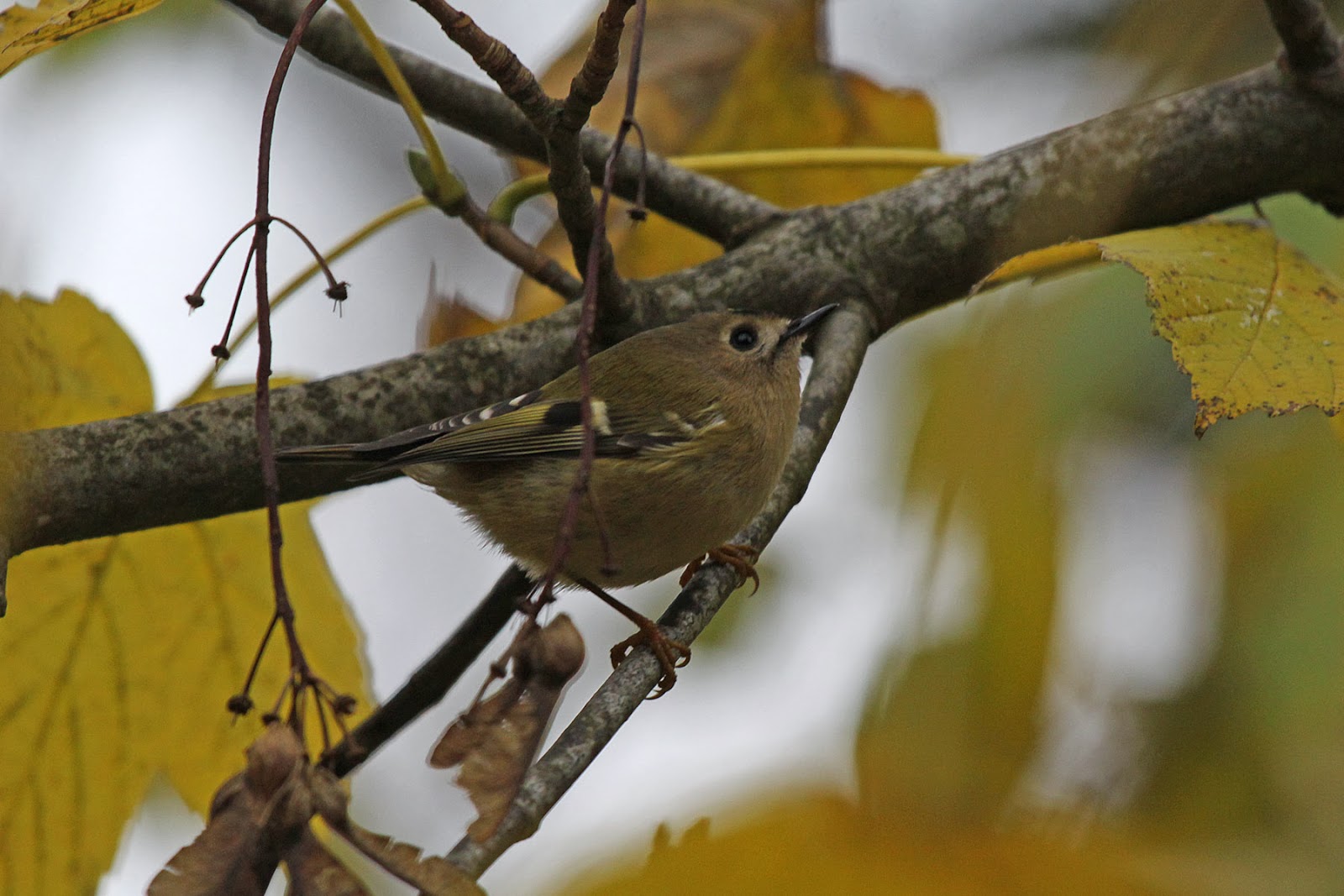
Saturday, 21 December 2013

20th December - A Pair of Partridges Under a Tree

It was a clear and frosty start, which was a welcome relief after the storms that have swept through over the last few days.  However as the sun came up slowly it created a strange sky with the moon still out and bright.  The reddish orange tinge that was surrounding the moon, was probably a sign that there were yet more storms on the way, and it was likely to be a wet and windy Christmas.


The garden was alive with birds before the it was completely light.  Four species of tit were on the feeders, and the Long-tailed's would disappear to the pond for a drink, and wash and brush up.

As it became light and the sun shone weakly through the trees our mini murmaration of starlings arrived.  They take their turn in visiting the feeders, watching from the surrounding trees, waiting for the feeders to become free.


All around the house you could see birds perched at the top of the tall trees, looking to catch some warmth from the winter sun.  Woodpigeons, Rooks and Jackdaws can be seen every morning when the sun is out sitting in the sunshine.  These Magpies were also in this same spot for at least 15 minutes enjoying the rays.


The birds were in full swing in the garden, and I saw the first Blackcap of the winter, a red headed female on one of the fat balls.  I have also put apples in the tree again and the Blue Tits found them straight away.

There are about a dozen House Sparrows in the garden, and they use the feeders, but I had to look a little more closely at this female as she has lost her tail feathers.  How, is open to consideration, possibly a Sparrowhawk, or maybe even one of the local cats, which is probably more likely, we have caught a little black and white hiding under the Acer tree before.


With a horrendous forecast for Saturday, and the sun trying to warm up a blue sky, I decided on a walk at lunchtime around Plain Farm, I hadn't been there for awhile, and the conditions today would suit it well.

I walked up the hill towards the pond, and Blue Tits and Goldcrests called from the Yew that was by the path.  I could hear a buzzard mewing, but never saw it, and at the pond there was nothing about, so I continued on down the hill, past the quarry and through the farm.

A Robin sang from the trees by the sheds, and in the Poplars I found this pair of Collared Doves sitting in the sunshine.  They seemed quite happy preening and enjoying the sunshine.


As I came up the hill I could see that the large Oak in the field had finally given up it's leaves and succumbed to winter.  In the winter light it does look quite spectacular though.  You can almost see the trolley wheels turn.
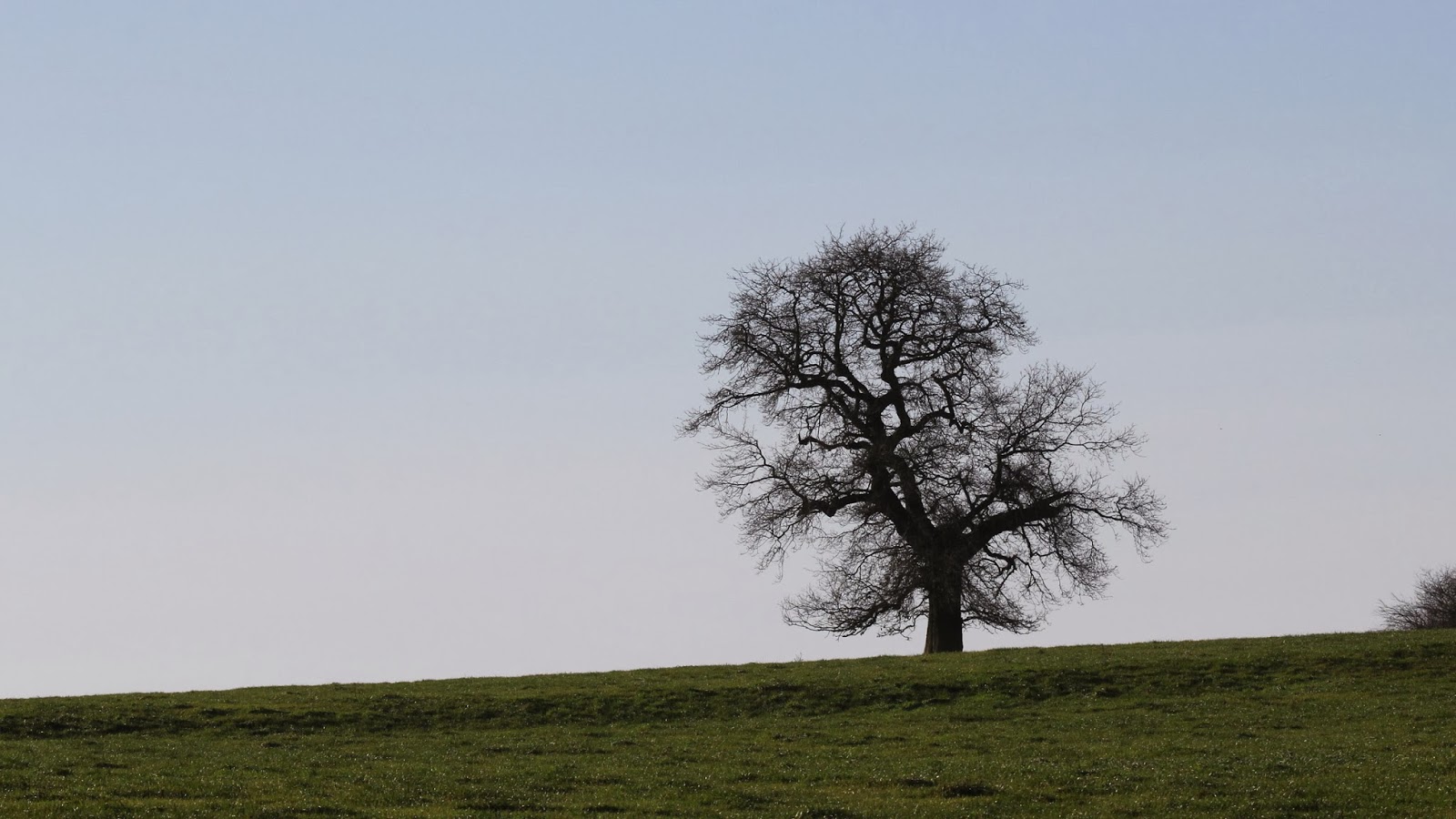

As I reached the workshops I flushed a kestrel from the pole, it flew around me, then headed off towards the barns.  A little closer and I saw some movement beneath the tree.


I had been thinking it would be nice to see some Grey Partridges today, I haven't seen any for awhile, and then two oblige.  They sat in the long grass, then as I got closer they exploded along with six others that had been doing a good job of hiding.  They called as they flew off, finally settling around the corner of the cottages.  One though did land a little closer to the fence, and I was able to get a closer shot.


It quickly had enough too, and flew off to join its friends.  With the sun so low, and approaching the shortest day of the year it was creating some different landscapes.  Across the field the hedge was covered in places buy Old Man's Beard, and the sun was highlighting this on the top of the hedge.


I walked down the lane, and was soon being serenaded by the piping call of the Bullfinch.  I saw two males, and then two more females, they would just keep moving in front of me, but eventually flew from the hedge across the lane and away into the field to my left.

I could hear Skylark, but I couldn't see them.  I stopped to scan the fields, and also the hedgerows. As I did so I heard the Skylarks again, then saw a flock come up from the ground.  There was at least 30 of them, quite a healthy population.  Yellowhammers were also everywhere in the hedgerow.  I could hear them calling, and every so often pairs would fly over.  It was difficult to count them but there were at least 20 plus.  This male sat nicely for me.


As well as the smaller birds, another kestrel sat on the wire watching the ground, then suddenly flew from its perch, and glided slowly low across the ground before dropping quickly into the ground, then it was up, with something in its talons and away over the hedge.

As I reached the copse by the cottages I could hear the piping call again, and another pair of Bullfinches flew over, and for once perched in the top of the trees at the back of the yard.


The male looked extra special in the sunshine.

I walked down the footpath after stopping to talk with the Game Conservancy guy.  We shared some information on what we had seen, of which of interest to me was the report of a Short-eared Owl a week ago, if only, if only!

I checked the trees for finches, but there was very little moving at all.  I also stopped to scan the field, and found a distant blob, that must be the kestrel I watched catch prey earlier.  It appeared to be pulling something apart as it sat in the field.  It bough back memories of the grey blob of last year that must have been a Hen Harrier!


I crossed the field to Charlwood, and walked along the lane.  The hedges have been trimmed and it is now possible to see better across the fields, its a shame though that there was nothing to see.

The horse paddocks have always looked like they could be attractive to something, a Chat or Wheatear in the spring, or maybe even a Hoopoe, but up until now there has never been anything.  Today though I saw this Song Thrush feeding.


As I watched it I noticed other birds, close to the Song  Thrush a couple of Fieldfare, and away in the distance a group of about twenty Fieldfare.


It was about midday, and the sun was still below the surrounding trees, sending a glowing orangey light through the trees and scattering across the lane.


The leaves are all off the Beech trees, and the wood now seems much light, and the darkness that was a little foreboding has gone.  Where rain drops were still hanging on the branches it created a magical scene with the low sun picking them out.


I walked on, listening to Blue and Great Tits calling out as they made their way through the hedges by the side of the road.  Chaffinches would also fly out of the leaf little calling as they settled into the branches.  I am not sure if it was because there is light in the wood now, or whether it had just emerged, but I came across this tree that was covered in Jelly Rot, something I don't recall seeing along here recently.


I walked down the hill, and back to the car, there was some thin cloud building up, a sign that the forecast storm was on its way.  I hope there is the chance to get out Saturday, I will just have to wait and see.

PS It's now 13.00 on Saturday and as I write this the rain is still falling and the gales blowing oh well!

Tuesday, 17 December 2013

17th December - Woodman Spare That Tree!

The rain from Sunday finally came to an end this morning, and after a morning of high cloud, blue sky put in an appearance to the west.  It briefly gave some sunshine around lunch time, and I took the opportunity for a walk.  However prior to that the garden had been busy both back and front.  From my office window up to six Blackbirds were removing what berries there were left on the Rowan tree.


At the back there were plenty of Goldfinches on the feeders and picking up the drops that were on the lawn.  At one time I counted twelve actually in the garden with eight sitting in next door's tree waiting their turn.


The Robin was about, and continued in its feisty ways.  It seems it doesn't like the Starlings, and while one Starling fed on the fat balls it would launch itself at it in an attempt to scare it off.  The Starling resisted though and left in its own good time.

As I walked along Lymington Bottom several Blackbirds flew off in front of me, we do seem to have a lot at the moment.  Along Brislands the dinosaurs were in full swing, clearing more of the land.


They have also removed more trees as fresh stumps were visible.

More Blackbirds were along Brislands, and I could hear Redwing above me and from the hedges.  As I scanned the fields I noticed a Song Thrush feeding in the grass.  Its always nice to see one, hard to believe that once they were a common garden bird.  There does seemt ot be a pair around this location though.  In a short time the male will be singing his song, a good sign that spring is on the way.


The Rooks and Jackdaws were still feeding in the fields, and as ever they were very jumpy, and flew off calling at my slightest movement.


Another thrush called from the trees, this time the larger Mistle Thrush.  It sat in the open watching me before flying off to join the Rooks.


Movement beneath the thrush caught my eye, and I was surprised to find a Jay in amongst the Ivy, I can only assume it was after the berries like the thrush.


The Jay flew off as I walked by, but then appeared again in the Ivy that covers the big Oak tree along Gradwell.  It did come out of the Ivy, and jumped to a more open perch and called in alarm at me.


As well as the Jay, I could hear the soft piping call of a Bullfinch behind me.  For once I could see it, a male but again difficult to get a complete view as it sat perched in the middle of the hawthorn bush.


I walked into the wood via the Gradwell entrance, and as usual these days took the untouched south perimeter path.  I could hear the call of a Wren, and every so often in the distance the soulful song of a Robin.  A tit would call, and so to would a Goldcrest, but other than that it was very quiet.

As I reached the Old Down entrance I could hear Nuthatch calling, and in the distance the calls of Long-tailed Tits.  I paused just to see if there was anything else, but the wood fell quiet once again.

As I walked out on to the road I could hear once again Redwing calling above me, and a small group of six birds flew into the trees surrounding the pond.


As I approached the pond, I heard the mew of a Buzzard and one came across the water and sat on the telegraph pole in front of me.  The mewing continued to my right so there were two birds in the area, possibly a juvenile from this year's brood still pestering the parent.


I walked around the pond, and came across some Blue Tits, a Nuthatch and a Goldcrest.  The Goldcrest was flitting and hovering amongst the holly leaves in the dark at the back of the trees.


It seems that everywhere I go at the moment there are trees being felled.  Around the edge of the pond and by the picnic tables the large Oaks have been cut down.  


They were probably considered a risk, as over the last two years large oaks have blown down here.  I see the advantage of this though as it has let quite  bit of light in to the area, and this may make the water more visible and an attraction to passing birds, we shall have to see, but a Snipe or Woodcock would be nice.

I stopped to check the trees at Thrush corner, there were no thrushes, but at the top of the Leylandi conifer was a Greta Spotted Woodpecker, they really love it at the top of the trees.


I walked down towards the school, and stopped to admire the scene to the north, with the colours you would more associate with the evening sky present at noon.


I turned up Gradwell, and in the field was a tractor with cutting equipment. It looked lkike it was removing the grass strip around the outside the field, if so it is another attempt to stop the public walking these strips, we shall have to see.  

I took the footpath to Lymington Bottom, scattering yet again a good number of Magpies, I am not sure what the attraction is here, but you can guarantee to see good numbers, helpful I suppose if you are looking for a wish!

My attention was then taken by movement again in the sky above me, this time though two  bi-planes that I think they are tiger moths, but I am sure if I am wrong I will be corrected.


A quick walk, with a bit more activity than on Sunday, but a typical winter's day.  On Saturday, Ian and I visited Blashford lakes, the highlight of which was the Starling Murmarations in the late afternoon.  Have a look here, but if you get the chance go and see it for real.

Monday, 16 December 2013

15th December - "Badger... we should run!"

We were away last weekend, up in North Norfolk.  Once again we picked a dramatic time, and you can see the details here.  As well as the weekend away I was in Germany this week, so today was the first chance to get around some of the patch.  It was misty, and rain was forecast so I decided to limit it to an investigation of the devastation progress.

As I left the house there seemed to be Blackbirds everywhere.  I could hear them clacking away, and counted at least a dozen as I walked to Lymington Bottom.  Their numbers have increased probably due to migrants coming in from the continent along with the Redwing and Fieldfare.

As I turned up Brislands the view down the lane has taken on a real autumn / winter feel, misty and damp.


The development land was my first stop, they have really advanced and where there was long grass, charms of Goldfinches, Cinnabar Moths Essex Skippers and Marbled White Butterflies there now is mud and wreckage.


It is even worse at the old entrance, where there were bushes and trees, with Blackcaps singing, Banded Demoiselle damsel flies and Comma butterflies there is now just stumps and dinosaur like digging equipment in the distance.  The field was used by Roe Deer, there were probably hundreds of Slow worms too, Kestrels sat on the poles and wires, and who knows what else lived there the lucky ones have all now had to run away, but what of those that just can't?


A little further on there was a gathering of corvids, mostly Rooks and Jackdaws in the trees and on the wires above the road.  This Jackdaw watched as I walked past.


I wasn't sure if it was the horse paddock that was the attraction or something else, the overnight rain probably having soften the ground and turned up something interesting to feed on.  A little further along I noticed them gathering in the the field.  I haven't seen this many here for some time, so something must be an attraction


When I set off it was misty, and felt damp, but there was no rain, and in fact the early morning had seen some clear skies, but these were quickly replaced with what was probably more low cloud.  As I came out into the open once passing the houses on Brislands the breeze was evident, and you could see the cloud being blown by.  

The field to the south has been left to fallow for now, and as a result has thrown up some interesting patterns and colours.  Looking across to Old Down Wood in the mist it looked quite eerie.


A little further on and I began to doubt whether in fact it was low cloud, as looking across the north fields towards the Watercress Line was a complete white out.


It has been ten days since I last walked around the patch, and fifteen since I had come this way, and I was struck how quickly everything has sunk into winter.  We have had differing weather from rain, to wind, and frost, and this has finally killed off the bracken, and it is now sinking down, to rot and breakdown along the roadside verge.  The cycle of growth will start again next March, but for now the dark brown leaves will provide some cover as they rot down, opening up the lane for the winter.


In the mist and cloud the air was becoming much wetter, I turned off the lane to go into the wood, and was greeted by a muddy track leading into the wood.  The path was lined with tree trunks still, but now they were mostly Beech.  There was only a small stack of Larch, so maybe that part of the "management" was over, and now it was the turn of the Beech trees to be felled, stripped and piled up to wait before loading and shipment away.


One of the logs in the stack in the stack of Beech had a mass of fungi coming from the centre of the trunk.  Strange that this was the only one, and probably a sign this particular tree was going to fall any way.  I am not sure if the wood is still of any worth to the end user,  The fungi in question is a Branching Oyster, and has probably only just recently emerged.


As I walked down the path I could hear drops of rain falling, and assumed this was as a result of the mist collecting on the branches and then falling, it didn't seem like rain yet, just in case though I covered up the camera, the day was becoming very quickly not the best condition for photography was not. 

The wood was silent, and as I looked around there were huge swages of mud where caterpillar tracks or tractor tyres had thrown mud up as they ploughed their way through the wood.  I made several attempts to cross one of these tracks to reach the north perimeter path.  Finally I managed to get across without losing a Wellington boot.  the path was strewn with branches, and in places the course has already been changed as parts are just completely blocked.  

I stopped every so often, and could hear the calls of Long-tailed Tits.  As I watched parties of these energetic little birds stream through the tree tops, I could also pick out Blue and Great Tits with them.  A Nuthatch would also call, and in one spot I could hear Bullfinch, but was never able to find it.  As I approached the west end, the path ran into yet another huge barrier of mud, and I had to take a route that brought me out at the field.  I scanned the field, but by now it was very misty, and I could see it was also raining.  I headed back into the wood and walked along the main path.

This forestry work was advised on the signs in October as "essential management", however for me there is no management at all, it just seems like an excuse for mindless vandalism.  Surely management would not just break trees and leave them half intact, or cut trees and leave them suspended amongst others?  Surely management would clear some of the fallen branches and trees.  The other statement was that it would remove non-native trees, so why then have the young conifers been left, and the native Beech removed?  In the UK there are only three native conifers, the Scots Pine, the Yew and the Juniper.  For management I would read commercial gain, without any care for the wood at all.  I have tried to find out who is conducting this work, but there does not seem to be any information.

As I walked around the main path I disturbed at least two pairs of Roe Deer.  they are now in their winter coats which are more grey than the chestnut red you see them in during the spring and summer.  Their white behinds were all I could see as they bounded over the fallen trees and branches once flushing them out.

I walked around the south perimeter, here there were hardly any birds other than the call of a Wren from somewhere amongst the dead branches.  At the Brislands exit I flushed two Song Thrush feeding in the leaf litter, they flew off calling in alarm.

Coming out of the wood I looked across to the Four Trees, they were almost obscured by the mist, a sight I had not been able to photograph last year.


I headed down Gradwell and took the footpath to Lymington Bottom.  There were a lot of black and white birds in the field, but not the recent Pied Wagtails.  This time there was a large flock of twelve Magpies on the ground.  They are extremely nervous though, and as I raised the camera they were off.  As well as the Magpies I disturbed a group five Redwing, and again a Bullfinch called from the hedgerow, but never showed itself.

The rain started to get harder as I made my way home.  It looked like it was settling in for the rest of the day.  Back at home the bird feeders were busy during the afternoon, the first time I have seen it this way this winter.  There were up to at least ten Goldfinches at one time, three Greenfinches, a Linnet and Blue, Great, Coal and long-tailed Tits.  The "Buggy Niblets" seem to be the big attraction!


Thursday, 5 December 2013

5th December - Red Sky In The Morning....

An amazing sky this morning as the sun came up amongst the thin cloud, that had developed following a frost last night.  The light around the house was like a pink hue, with purples and reds in the sky.  Possibly an omen for the day, as there is a storm forecast, but it seems like we will not see the worst of it here.


The cloud came and went through the morning, but by lunchtime the sky cleared and the sun came out.  I decided to head down to Plain Farm, but didn't realise how windy it had become.  As I set off up the hill towards Winchester Wood it was really blowing, and I could hear what leaves there were left on the trees rustling above me.

The noise of the wind and the trees made it difficult to hear any bird song.  But I was suddenly presented with a huge flock of Woodpigeon above me.  They seem to be everywhere, but the manner in which they were flying made me think they had probably been spooked from the tree tops in the woods.  I estimated the flock to be around 500.

With the large numbers of Woodpigeon it must be an attraction for predators.  The Peregrine last Sunday was probably not just a coincidence.  As I walked through the wood I noticed pile of feathers such as these close to tree stumps.  I suspect they are the work of a Sparrowhawk, sitting and plucking its prey, but may also be the work of something bigger, maybe the Peregrine, or perhaps more exciting, a Goshawk.


Blackbirds flew around close to the ground, and I managed to hear two calling Nuthatches but I couldn't see them.  At the seed feeder area there were Chaffinches, and a few Blue Tits, but again no sign of any Brambling.  I heard Redwing calling above me, and one dropped down into a Holly Bush still covered in berries.

I scanned the fields as usual, and as usual nothing other than rolling waves of leaves as the wind picked them up and moved them across the open ground.  The leaves were proving to be a problem as they were travelling almost horizontally, and you could be confused into thinking they were a bird.  In fact in the sky as they swirled around, buffeted by the gusts of wind, they looked just like the flocks of Woodpigeon seen at a distance.


I walked along the path, and watched Bullfinches fly away from me, call and then disappear into the safety of the hedge.  I counted five in total, three males and two females, they are getting very regular here.

As I walked down the hill towards the farm two Chaffinches called and flew into the cattle barn, but that was all I saw.  The wind was the dominant feature and it continued to send clouds of leaves to confuse me.  There was some shelter at the quarry, but unfortunately no birds, even the small Inkcap fungi that was showing on the track last weekend had gone.  I walked up the hill and out into the open by the field.  In front of me, at last was something of interest.  A Kestrel was using the wind to allow it to hover by flying head on into it.  Some raptors like the harriers, and owls use sound as their method of locating there prey, so in these conditions they would really struggle.  But for the Kestrel, its main weapon is sight, and in fact it can go a little further by being able to see the ultra violet light given off the urine that a bank or field vole would deposit, and it is able to follow a trail.  This one would hover and fly around and start again.  It was for once unconcerned about me being there, probably focused on its task, and couldn't hear me due to the wind.


As the winter goes on, and it gets colder, the Kestrel looks to conserve energy by adopting an alternative hunting approach.  They find a convenient perch, a pole or tree, and watch from there.  Hovering requires considerable energy, and in winter it can be a while until your next meal.

I got a little greedy and tried to get even closer, and finally it noticed me and was off.  Turning with the wind it flew off over the field, and I could just make it out in the distance, starting to hover again, head pointing again into the strong wind.


I walked back to the car, with only leaves and Woodpigeon flying over my head.  I could hear Goldcrest in a yew tree, but they were not coming out.  I decided to head home.  Maybe I should have heeded the red sky this morning:  shepard's warning there's nothing about!

Sunday, 1 December 2013

1st December - All The Leaves Are Gone, And The Sky is Grey

If you recognise the song the words above come from then you will know that it was lamenting the fact that in California it was sunny with blue sky.  It is always sunny in California, and quoting another song it also never rains in the south.  Today it is the start of Winter, our final season of the year, and It is the fact that we have seasons that makes me love this country.  Yes it maybe depressing at times but we get variation, something different, a change, and a change that creates patterns and different life.

It was grey and cloudy this morning, and I set off to walk the parts I didn't get to yesterday.  The leaves to be truthful are not all gone, but over the last week they have been falling in greater amounts, as if the trees were hurrying up to be gone in time for winter.

While having breakfast this morning there was a lot more bird activity in the garden, Tits and House Sparrows were using the feeders, a group of Long-tailed Tits came through, and Starlings were bathing and feeding on the fat balls, we even watched a Wren go into a nest box.  Of interest though was the way a Robin was behaving.  Clearly the garden is it's territory, but not just from Robins.  It would chase the sparrows off the feeders, and even launched itself at the Starlings on the fat balls, scaring them away.  I do not recall every having seen a Robin behave like this.  I have seen them chase Robin rivals away but never larger birds.  I shall have to keep an eye on this.

At the bottom of Lymington Rise there was a lot of calls coming from the oak tree.  First it was a group of Long-tailed Tits, probably the ones that had come through the garden.


As well as the Long-tailed there were Goldcrests, and one was very close to me as it flitted about along the branches and under the leaves of the Sycamore.  It would hover like a Hummingbird, flapping its wings so they became a blur.


Firecrest yesterday, Goldcrest today, some lovely pictures.

I headed up Brislands, there were many Blackbirds in the hedges and trees feeding on the berries but no Redwing.  I could also hear Bullfinches, but as usual they would hide, until I managed to pin this male down on a feeder out side a house just beyond the Gradwell turn.


I intended to walk Brislands to the bottom.  The road has been cleared of the soil and grass that had lined the middle, probably as a result of the forestry work.  As I walked through the tree lined part I could hear more Tits and Goldcrests, and as I came to an area of Old Man's Beard a Wren called out.  Being one of our smallest birds they are constantly foraging for food.  Keeping under cover they skulk through the dead branches and vegetation looking for small insects which are using the cover for the same thing.  I waited and eventually I caught sight of this very small, but delightful bird.


I heard Red-legged Partridges calling, but never saw them, at the bottom of the lane I turned an headed up towards the wood.  A small flock of Common Gulls flew over, and I could also see some Rooks feeding.

As I headed towards Old Down, the small flock of Common Gulls began to increase.  At first there was about 20 in the field.


But then I realised that they were all over the place, and I ended up with a count of 98, easily the highest I have seen.

A flock of six Skylark flew past me heading west.  I am never sure if these are residents flocking together or that they are moving through.  Looking towards Old Down, the light around the west end entrance was brighter as a result of the forestry work.


I looked out over the field again, and flushed another flock of 15 Skylarks, and as I watched them I noticed the scene in the distance of clouds and bonfire smoke.  As I took this photograph the Skylarks came back, and you can just make them out in the sky.


I reached the paddocks and scanned around.  As well as the Common Gulls there were also Crows and Rooks with a few Jackdaws too amongst the sheep.  As I turned to head back to the wood a Jay called from the trees.  It is a harsh call for a beautiful bird, not dissimilar to that of a parrot, another beautiful bird with an awful call.  They have been hard to photograph, this was the best, again can you find it?


The wood was quiet, and open, it is a little unnerving as it used to be quite dark.  Fortunately the mature trees have been left, and this magnificent Beech now stands out in the open.


I made my way to the thatched cottage entrance, pausing every so often to take in the destruction, and to listen.  I could hear birds, but they were difficult to find.

Out of the wood I headed to the pond.  With the stillness and quiet it was  quite strange as I walked around it.  I disturbed a Robin, and there were more Goldcrests calling.  A Bullfinch called and sat in an Ash Tree mocking me, as it must have known the light was poor.


The pond and surrounding trees do look quite spectacular.


For once there were no thrushes at Thrush Corner, but there were two Magpies and a Jay.  I found the thrushes further along the footpath.  I could hear the Redwing, and counted about 30, but I could only find one Fieldfare again, once again at the top of a tree.


The Redwings were feeding on the Hawthorn berries, and the tree was also proving an attraction for others.


I crossed the road to head up towards the garden centre, and as I did a huge flock of Woodpigeon came over.  I didn't think too much of it until I saw a falcon coming very fast low over the house and then up and into the flock.  Chaos ensued, pigeons went everywhere and I couldn't see what happened, but I know what had caused the chaos, a Peregrine Falcon.  It is almost becoming a regular sighting now.  It would appear that I am not the only one to have noticed that we have thousands of Woodpigeon around the patch.

I walked up the hill, as I went I sang the Fleetwood Mac song to the Shetlands, they didn't seem impressed.  In the field by the garden centre I counted 76 Rook, which is a good number in one place.  They were all feeding in the grass, and didn't seem bothered as I got closer.


I walked down the path towards Blackberry scattering more Redwing from the Holly.  There is a house on the corner that we always thought had a garden like the one in Bill and Ben.  The house was sold recently, and now they are knocking it down, and stripping out the garden.

Over the last two years I have been writing this blog, I have begun to notice the changes nature makes, and have been able to relate to events at the times of the year.  I have also seen changes in the village, the building work that is changing the face and size, which sometimes just doesn't feel right.  Today when I saw that garden destroyed I felt really sad, maybe it was because I related it to my childhood, or maybe it was because I felt the previous owner totally loved that garden like someone else I knew, either way it was a real shame

Winter is with us, and we now have a time until the life starts to regenerate, for now though it is a tough time for all the wildlife, lets hope this year it is kind to them, but I wouldn't be without the seasons.