We haven't gone far these last few days, and truth be told the best bird watching has probably been in the garden. There have been reports of Skylarks, Thrushes and Wood Pigeon flocks being seen flying high to the west and south, and with the ground still with a thick cover of snow, they will be gone for a time.
Sunday saw a steady fall of light snow for most of the day, and the feeders in the garden were very busy. The Starlings are always good entertainment, and in the snow they also look gorgeous with the white spots highlighted along with the buff tips to the wing feathers.
There has been a female Blackcap for the last few days, and she has been quite accommodating with the other birds, sharing the apples, and even feeding with the Blue Tits on the same apple. This morning the male turned up, and looked splendid with it's black cap, and would feed from the apples like the female.
However unlike the female it was not prepared to share the apple with anyone else.
The lone Pied Wagtail was back, and today it was quite prepared to feed on the snow. With the overnight frost the surface was a little crustier, and it would run around chasing dropped seed from the feeders like a little clockwork toy.
The Chaffinches too take advantage of the food falling from the feeders rather than expend energy either fighting others off the perches or hovering to try and land on the perches.
Sunday saw my largest count of Chaffinches in the garden with eleven males and five females at one time.
The Blue Tit count also reached a high with twelve in the garden at one time. They are always busy moving from the feeders, the apples and the ground feeder.
In the early afternoon the snow fall became heavier, and the Pied Wagtail settled for a warm spot on a neighbours roof.
Monday morning saw the sky clear, and there was no snow flurries. This seemed to have an amazing effect on the birds. The Blue Tits were seen chasing each other, while the Wood Pigeons and Collared Doves were doing display flights over the garden. It was as if the snow wasn't there. After a while though things settled down and the serious work of getting food returned.
I came down to get a cup of coffee when I noticed a flash of red in the tree in the garden, a closer look revealed it was my first Great Spotted Woodpecker ever in the garden. It was a female and she was feeding on the suet block.
She seemed to have difficulty dealing with the suet, and would peck away at the block, then throw her head back to help the swallowing. In doing so she would close her eyes.
Another nice surprise a little later was a beautiful Song Thrush feeding on the apples. The throat and chest looks gorgeous in the reflected snow light.
I love it when thrushes look straight at you!
The House Sparrows were now chirping in the weak sunshine. This male doing so from one of my trees.
On Friday there and been a female Blackcap, and she was back to day, creeping through the branches so as not to disturb any one feeding on the apples
This morning though she was joined by the male.
The question I was waiting to see answered was would they both feed from the same apple. The photograph provides the answer.
They did not like each other at all! The BTO is conducting a survey in January on wintering Blackcaps. If you have seen Blackcaps in the garden they go to their web site and fill out the survey.
As the Blackcaps flew off I noticed a big bird in the distance. Once again the unmistakable shape of a Red Kite drifted over the garden. Wonderful a year tick from the garden!
Following the report of two crossbills in the larches at the top of Reads Field I thought I would have a look at lunch time. Unfortunately other than a few Starlings and Goldfinches I couldn't find any.
I walked around the roads for a while. In one garden there was a large flock of Rooks. I don't know what the attraction was, other than the Jay last year, corvids never seem to come into my garden, despite many flying over. These two Rooks posed nicely in the conifer.
As I made my way back home large flocks of Fieldfare flew over. I counted 63 in total. A little later in the afternoon I looked out into the garden to see one Fieldfare tucking into an apple in the tree. Now I know that once a Fieldfare finds a stash of apples it is not going to give them up that easily. The trees are full of them and it made the most of them. Once again they are so photogenic when looking straight at you.
It stayed until dusk and as it was getting dark took advantage of the bird bath to have a wash and scrub up. It then had a good preen in the tree before heading off to roost somewhere.
I am sure it will back tomorrow and probably the next day.
Early morning the garden was once again busy, but this morning there were two birds present that I did not see yesterday. Both had different styles of feeding. The Coal Tit was in and onto the feeders, quickly grab a seed and off. It never gave me the chance to photograph it, but the other, a pair of Collared Doves were more than happy to sit on the feeder and work there way through the seed.
They must have been there since dawn, because the feeder is almost empty in this photo and it was only 9.30.
We were wrapped up warm and headed up the hill towards the centre of the village. Every tree was scanned, and any starling like bird checked thoroughly to reveal a Starling. Still no sign of any Waxwings. There was activity on the feeders at the end of Badger Close, but no sign of New Year's Day's Brambling.
As we walked down Telegraph Lane a Green Woodpecker flew across in front of us, strangely attracting alarm calls from smaller birds. It didn't stop and flew off into the gardens. The main roads are now quite clear, but the side roads remain covered in snow and very icy. This is looking down Telegraph Lane.
We turned onto the footpath to Weathermore Lane. The woods here were eerily silent, and all the branches covered in snow, some of the tracks had been driven down revealing the mud and water that had been there before the snow arrived.
The fields alongside the track had signs of stubble poking through, and produced an interesting scene across the field, and towards the trees. I stopped to photograph the field, and as I did a Buzzard flew across my view.
It carried on and came to rest in a dead tree. We walked a little further up the path, to get a better view. It sat on the dead branch and gazed across the fields.
Walking on a little further the Buzzard remained in the tree, but the scene had changed completely.
At the start of the year I had taken pictures of the tree branches all covered in green moss. Today the moss had been replaced with an icing sugar coating of snow. It looked equally as impressive.
Further down the lane the trees close in on the path, and with the snow coating the branches this produces a white corridor around the tracks.
The cows in the field were being fed, and as they gathered around the hay a Robin moved between their feet pecking at food that they turned up with their hooves. As I watched the robin I noticed a Lapwing flying in the field but close to the trees. I lent across the hedge and managed to find it in the field.
The cattle had obviously been keeping close to the hedge and had used the trees for shelter. As a result the snow had been cleared away in places and this was an the attraction to a small flock of Fieldfare. We first heard them in the trees, then we saw them in the field. They are a very handsome thrush, and their plumage reminds me of a West Ham or Aston Villa football kit.
As I watched the Fieldfare I noticed a smaller bird feeding around the grass. It was a Meadow Pipit, and there were in fact two present.
At the end of the track we checked the field again, to see if there was anything else. The Lapwing had now moved to the middle of the field, and as I looked at it Helen pointed out a small flock of four more Lapwings flying over.
We took the bridleway through Lords Wood. The snow had not been walked on, and the only sign of any presence was the footprints of a Pheasant and Roe Deer. The dominant trees in the wood are conifers, and the snow had dusted the needles making them appear a completely different colour. Against the grey sky they looked very impressive.
The wood like in Weathermore was very quiet, no bird song, only a quick glimpse of a Wren as flew low over the snow to disappear into a gap between the snow and the grass tussocks. Along Kitcombe we came across a couple of Robins that were guarding over turned leaf litter and watching to see if we turned up a little morsel.
Before we set out across the field we stopped for a cup of coffee. The field was completely white with only the odd track disturbing the perfection. Away in the distance one tree in the Maryanne plantation was covered in snow, and against the dark background of the wood, and the perfect snow in the foreground, it made for a gorgeous scene.
We walked along the road towards Newton Farm, and as we walked past the barn we paused to check the owl box. I saw something move in the box, and so did Helen, the only problem was I swear mine was predominantly white, and Helen felt it was more brown. The only thing we did agree on is that we saw something. So was it a Barn Owl, or maybe a Little Owl?
A little further on a Buzzard flew across the field quite low and the reflection from the snow lit up the under side beautifully.
As it made its way across the field it upset the Rooks feeding amongst the snow and stubble.
We walked down the hill towards Kitwood Lane past the Newton Plantation. The beech trees here did not seem to be as covered in snow as the other wood we had walked through. However at the edge of the wood as we came down the hill the trees were covered in snow, and it looked very impressive against the buff colour of the grasses at the edge of the field.
There had been plenty of track along the path. The Roe Deer are easy, as are the human footprints and the pet dogs. We though the tracks with two long marks together were Rabbits, but as we got closer to the bottom of the path a Hare ran across in front of us. It happened quickly and we were not able to relocate it. We found the tracks and the ones we had been seeing must have been those of Hare and not Rabbits. This was the first Hare of the year, and the first for quite a while, so we decided to stop, have a coffee and wait to see if it came back.
The Hare did not return, but we were entertained by a pair of Bullfinch, and this lovely view looking back along the path we had just walked down.
We made our way carefully along the bridleway, we couldn't find any more Hares, but there were plenty of tracks. Once again the fields were completely covered with snow, and it was producing a perfect carpet. The sky was as white as the snow, and this meant it was very difficult to discern where the snow ended and the sky began. No where was this as confusing as with these pylons that seem to be floating in the sky. Pylons can be an eye sore, but there are times, as I have found around the patch when they can produce a very impressive scene.
After taking this photograph we turned around and noticed the floating trees behind us. This is the edge of Dogford wood, with the snow dusted trees contrasting against the grey sky, and snow covered field.
The rest of the walk along the bridleway was difficult. We alternated between the centre and the edge of the track to avoid the muddy ditches. Finally we came out on Lye Way, and headed towards the pond.
The pond was frozen as you would expect, and other than the odd Blue Tit, and Crow flying over, as quietest as anywhere we had been today. The only bird life of interest was a set of tracks that obviously belonged to a Heron. It is difficult to discern size here but believe me they belong to a Heron.
I have seen a Heron here, but they are not common.
You can always guarantee that a frozen pond with a good covering of snow will always produce a nice winter scene.
We left the pond and took the footpath into Old Down. The other woods had looked impressive in the snow, but Old Down looked absolutely stunning. It looked like Disney had wanted to use it for a film scene, and had sprayed foam everywhere. The trees were covered, the branches were covered, everything seemed to be covered. Unfortunately photographs don't do it the justice, but this one gets close. It was like walking into Narnia.
The scenes were as impressive looking out across the Desmond Paddocks. This is one of our favourite views, and it looks wonderful what ever season.
Once again the wood was quiet other than the odd Wren. At the west end scanning across the fields produced nothing of interest, but once again the snow in the filed, and up in the trees produced another wonderful scene.
The paths in the wood are still very muddy, and with the snow cover it was difficult going avoiding a sudden wet boot. We came out on to the main track and headed towards the Brislands entrance. Looking back along the path I recalled the thick and dense vegetation that almost obscured the path in the summer, where did it all go?
We walked back along Brislands, sticking to the centre of the road where the snow was soft enough to allow a less strenuous walk. We paused to look back down the lane. It always seems to produce a different view, and today with the snow lined trees and hedges it was yet another composition.
While there had not been that much wildlife about to find, it had been a lovely walk, with the opportunity to see the patch truly covered in snow.
All the forecasts came true this morning as snow swept through causing the usual chaos on the roads around the village. It seems incredible that what amounts to a relatively low accumulation that would not worry other European countries can paralyse the UK.
The garden as you would expect became rather busy, and it was fascinating to watch the antics of the common birds, while keeping an eye open for any possible unusual visitors.
The Goldfinches were present in good numbers, the maximum count at any one time being 11. As usual they would sit in the surrounding trees with the shyer Greenfinches and then drop down to the feeders.
They would then monopolise the feeders with all four perches taken, and would be quite prepared to fight off any intruders.
Long-tailed Tits would come and go through the morning, they would arrive in groups of up to eight. Their favourite is the suet block, initially one will start.
. Then quite quickly others join it to create a bundle of feathers feeding on the suet.
Once they have had enough they go as quickly as they arrive, however sometimes they leave a straggler behind wondering where they have all gone.
If you saw the gorgeous Winterwatch film of them going to roost this week you will know that they are probably travelling around in family groups. They clearly all seem to get on well.
There have been good numbers of Blue Tits in the garden this winter. Today there was a maximum count of ten. As well as the seed feeders they seem to be attracted to the apples I have speared on to the branches of the tree.
and if you wondered if they actually feed on the apples here is the proof.
While I was watching the Blue Tit a female Blackcap appeared and made its way straight onto the suet block. They don't seem to mind the presence of other birds, and tolerate the smaller ones, however they are quick to disappear when the Blackbirds get close.
Look quickly at this picture and it looks like a milk bottle, which reminded me I can remember when the tops of milk bottles were ripped open by the Blue Tits in cold weather to get to the cream.
The BTO is running a survey on Blackcaps in the garden through January, so lets hope the male turns up as well.
The Great Tits show no interest what so ever in the apples and only use the feeders. This one was cautiously making its way through the branches towards the feeder.
We seem to have two Robins in the garden, but I am not sure if they are a pair, as there does seem to be some conflict taking place. As soon as one becomes aware of the other the head goes back and it flies to the top of the trees. They never actually clash so maybe they are a pair that is not to sure of it yet.
The Robins like to use the feeders but are not comfortable sitting on the perch, they fly in and hover as they take the seeds.
The Dunnock is not usually a subject for my photographs which is a shame and something I should rectify. This individual was obviously finding food hard to come by, and resorted to copying the technique of the Robin. In this shot it was eyeing up the feeder just before launching itself to the perch.
As well as the Green and Goldfinches in the nearby trees there was a large flock of finches flying around in the distance. They would perch up in the tree and then fly around before settling back in the tree. It was quite a sizeable flock of which this was probably a third.
The next visitors probably came from the flock, they were Linnets, the males have yet to get the blush pink breeding plumage but they sill look quite smart. They feed in the same manner as the Goldfinches, and also like to use the niger seed feeder too.
There was only one Pied Wagtail present today, and it didn't make any effort to search for food. I had cleared an area on the lawn, but this was very quickly covered again. The wagtail just seemed happy to sit in its usual spot at the top of the tree and watch the antics of the others.
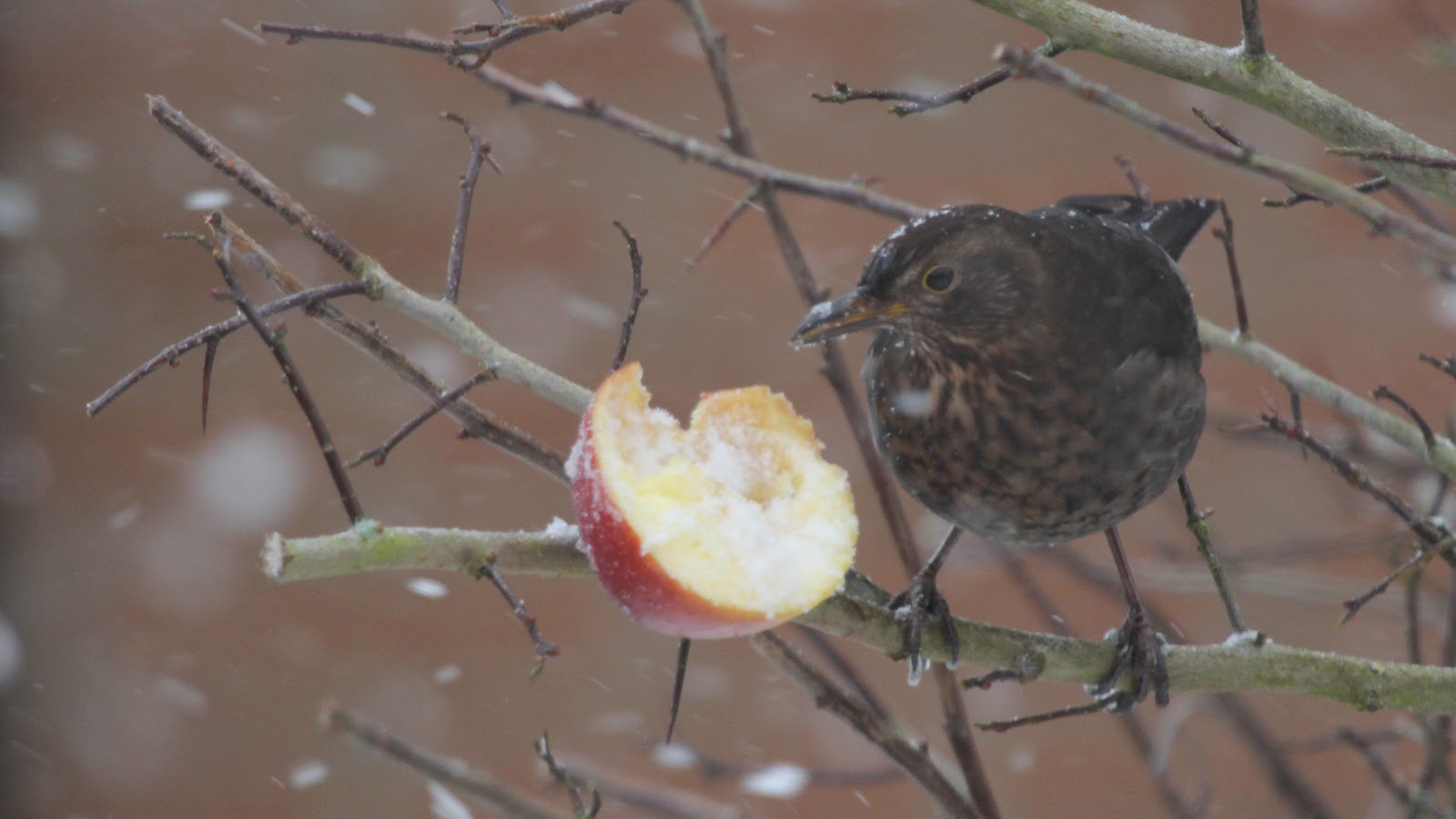
Blackbirds are primarily ground feeders, but today with the heavy snow falling they were struggling. They usual patrol under the feeders for the seeds and suet that drops as the finches and tits sort through for a suitable seed, today this just wasn't possible. So they guarded the apples in the trees very carefully. In their haste to keep the apples from others they would feed quickly and end up knocking them out of the tree. Gradually through the afternoon the only apples left were those on the thin branches, but they still continued to try and est them.
This male though was quick to fly off when this female moved in.
She is quite distinctive, and as it got darker we watched her learn quickly how to balance on the perches of the feeder to get at the seeds.
Lets hope the snow eases tomorrow, and we can actually get out and find out what the rest of the patch thinks of this weather.
Today we said goodbye again, a sad day, but a day to reflect on the past joys shared with a very special man. He was responsible for Helen's love of nature, and was always keen to share special places with me.
He did get the chance to read the blog, and to enjoy the photographs, and I loved to share them with him. We both miss him very much and hope he has found his peace. He will live on with the Seagulls